Full Article
about Valdeaveruelo
Residential municipality with housing developments; near Guadalajara
Hide article Read full article
An evening light over the Campiña
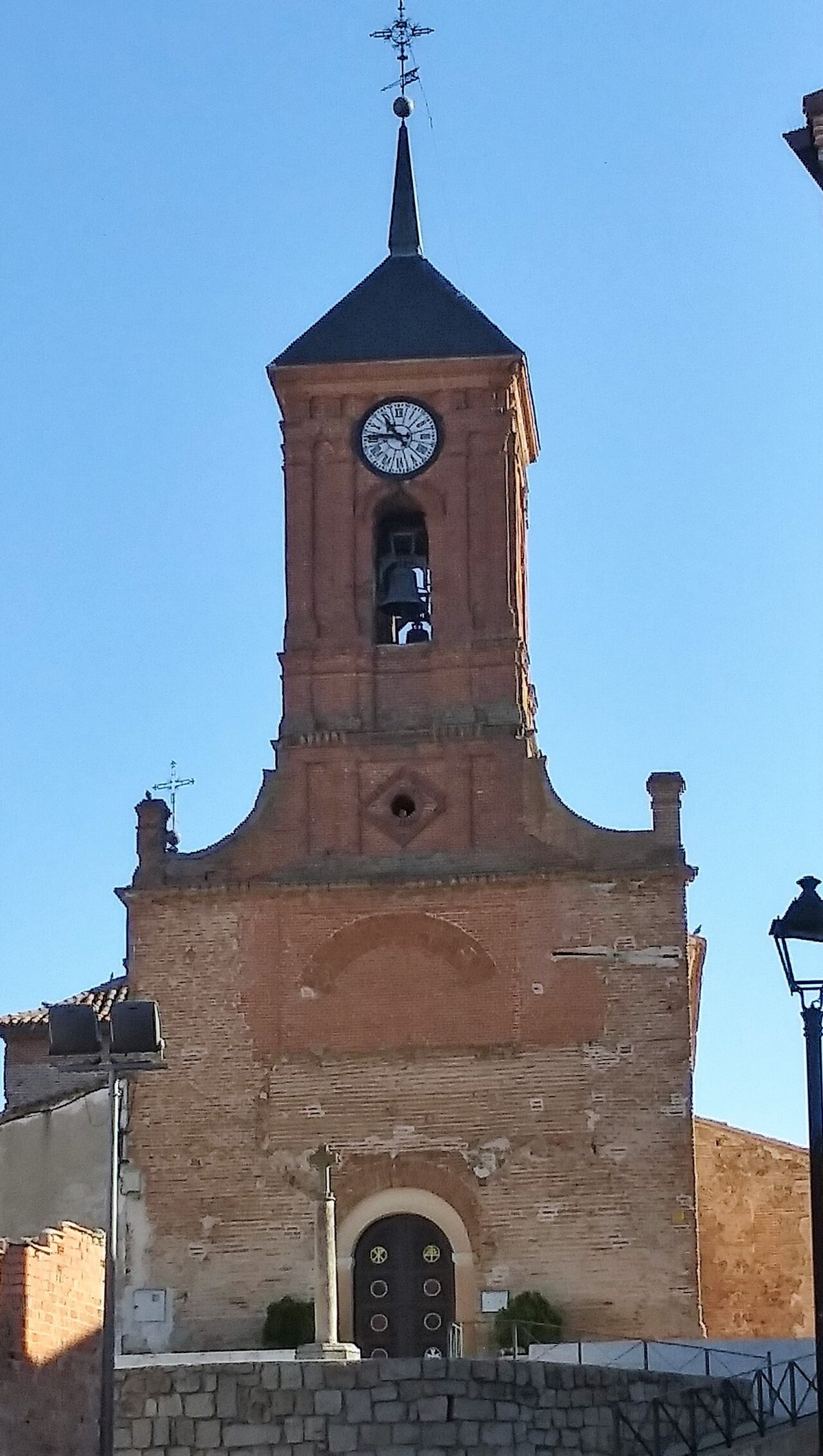
At five in the afternoon, the September light turns the wheat fields around Valdeaveruelo a deep gold. From the road, the village appears as a cluster of brown roofs pressed against the flat land. Only the church tower rises clearly above the rest, square and solid, like a stone beacon in the middle of the cereal plains.
Once inside, the silence feels different from that of other villages in the Campiña of Guadalajara. It is not an empty stillness but an everyday calm: a shutter being lifted, a car passing slowly, voices drifting out from a courtyard. The streets are wide. Some are worn asphalt, others compacted earth, and the pavements stop and start without much logic. Many houses have large wooden gates and plain façades, designed more for storing tools and grain than for display.
There is little here that tries to impress at first glance. The character of Valdeaveruelo sits in small details, in the way doors open directly onto the street and in the rhythm of a place that moves at its own pace.
The church of San Juan
In the centre stands the church of San Juan. It does not aim for grandeur. Built in the 16th century and altered later, it follows the pattern of many rural churches in the province of Guadalajara. The exterior stone carries a toasted hue that shifts throughout the day: grey in the morning, warmer as the sun drops.
Inside, there is often half-light even on clear days. The air smells faintly of extinguished candle wax and stone that has stored the day’s heat. The altarpiece and some decorative elements appear to be later additions, probably from the 18th century, their gilding worn thin along the edges.
Among the pieces that draw attention is a triptych of the Calvary in intense reddish tones. The figures have a certain roughness, something direct and close, as if the painter had worked with the faces of the village itself in mind. It is not polished art in a grand sense, yet it holds the eye.
There is no fixed visiting schedule. In the mornings the door is often open or left ajar. If it is closed, it is worth asking at the houses near the square. In villages of this size, that is still how things work.
Winter kitchens and the matanza
In Valdeaveruelo, as in many villages across the Campiña, the matanza del cerdo shapes the domestic calendar when the cold sets in. The matanza, the traditional pig slaughter and preparation of cured meats, is not a public spectacle here. It remains a family and neighbours’ affair. Still, its presence can be sensed on those days: the smell of spices in kitchens, smoke rising early from chimneys.
The local morcilla, a type of blood sausage, contains plenty of onion along with warm spices such as cinnamon, cumin and pepper, as well as rice. The result is dark and very moist. It is eaten in thick slices, often just warmed through, with a piece of crusty country bread.
This is not something displayed in a village shop window. Arrive at the right time of year and talk to people, and it is possible that someone might offer a taste at home or sell one to take away. In small places like this, conversation still matters more than display.
Food here follows the seasons closely. The colder months draw people indoors, into kitchens where recipes are repeated without much need for written instructions. What reaches the table is shaped by habit and by what the land provides.
Fires of San Juan and September reunions
The night of San Juan, in June, is usually marked with bonfires made from vine shoots and old wood. They are lit at dusk in an open space in the village. Several generations gather around them. Some leap over the embers as tradition dictates, others simply stand and talk while the smoke rises straight into the sky if there is no wind.
At the beginning of September, the main festivities take place. Many former residents who now live in Guadalajara, Alcalá or Madrid return for a few days. The pace shifts. More cars are parked at the corners, the square grows louder and children run through streets that for most of the year remain quiet.
The procession typically follows the streets around the church. Balconies are dressed with white sheets and pale fabrics. Younger children walk at the front, kicking up dust with their trainers, while older residents follow behind at a slower step. It is a brief transformation, a reminder that even a small village has a wider map of connections beyond its fields.
Open horizons and when to come
October is a good time to visit. The fields have already been harvested and the plain lies open, washed in ochre tones under a clear sky. In the late afternoon, the light enters the streets at an angle and stretches the shadow of the tower across the low houses.
For those who enjoy walking, agricultural tracks leave the village between cereal plots. Closed footwear is advisable. After the harvest, many dry stalks remain on the ground and they can be sharp underfoot. Carrying water is also sensible. There is a fountain in the square, although it is not always in working order.
August can feel heavy with the heat of the meseta, Spain’s central plateau. By mid-afternoon most people are indoors and the village seems to pause for hours at a time.
At sunset, it is worth heading up towards the cemetery, set on a small rise just outside the village. From there, Valdeaveruelo can be seen in full: the tightly packed roofs, the tower standing above them, and the surrounding fields stretching out without interruption. When a breeze picks up, it carries the scent of dry earth and firewood.
Nothing particular needs to happen in that moment. The view is simple and direct, the land open on all sides. Time appears to move more slowly here, measured less by clocks than by harvests, smoke from chimneys and the return of those who once left.