Full Article
about Aldeanueva de Barbarroya
Town on the Vía Verde de la Jara, set in unspoilt countryside beside the Río Tajo.
Hide article Read full article
A Small Stop in La Jara
Tourism in Aldeanueva de Barbarroya is simple to explain. You arrive, walk around, and then head out into the surrounding countryside. The village itself is small. Anyone expecting grand monuments or long streets to stroll along will quickly realise this is not that sort of place.
This is part of La Jara, a sparsely populated area in Castilla La Mancha known more for open land than for architectural landmarks. Aldeanueva de Barbarroya fits that pattern. The centre can be seen in a short visit, and the real interest lies just beyond the last houses.
The pace is slow and practical. There is no effort to dress things up. It is a working village that happens to sit in a landscape worth exploring.
Parking and Getting Around
Most people leave the car near Calle Mayor, close to the church of San Juan Bautista. Space is limited. At weekends or during the summer months, it fills up quickly.
From there, everything is within easy walking distance. The village has only a handful of streets, all revolving around the main square. There is no need to plan a route or consult a map. In half an hour the urban area has been covered.
The layout is straightforward. Narrow streets lead back towards the square, and the buildings keep a consistent scale. It is compact and functional rather than decorative.
San Juan Bautista and the Village Streets
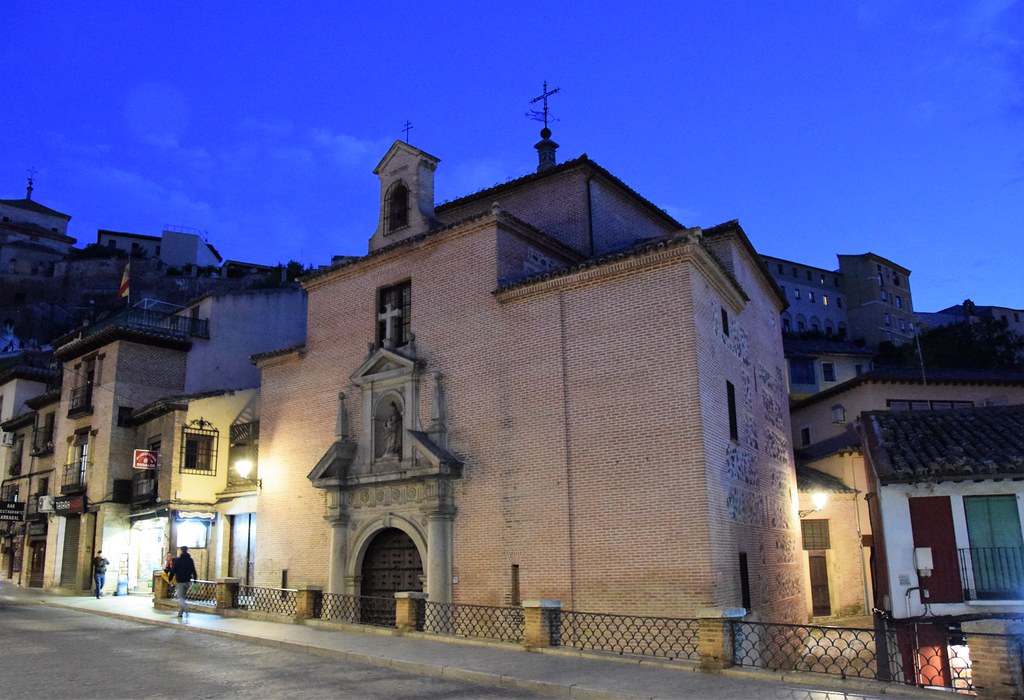
The clear point of reference is the church of San Juan Bautista. Built in the 17th century, it is constructed in reddish stone that can be seen from almost anywhere in the village. Its colour stands out against the muted tones of the surrounding buildings.
Inside, it usually preserves a Baroque altarpiece and an 18th century image of the saint. In Spain, an altarpiece of this kind is typically a large, decorative structure behind the altar, often carved and gilded. Even in a small parish church, it can be the most elaborate feature in the building.
Beyond the church, Aldeanueva de Barbarroya looks much as expected for this part of La Jara. Rubble stone houses line the streets, some with old wooden gates and overhanging eaves. The streets are narrow. There is nothing monumental about them, yet they do not need to be. The appeal lies in their simplicity and in how naturally they sit within the landscape.
The main square is practical rather than ornamental. The town hall stands here, along with a bench to sit on, and little else. It is a space designed for daily life, not for spectacle.
The Landscape of La Jara
Once outside the built-up area, the setting that defines Aldeanueva de Barbarroya comes into view. La Jara is dehesa country. A dehesa is a traditional Spanish landscape of open woodland and pasture, with holm oaks spaced apart across rolling ground.
Here, scattered encinas, patches of scrub and the occasional olive grove create a broad, open scene. It is not a dramatic landscape. It feels uniform at first glance. Yet it changes noticeably with the seasons.
In winter, the fields turn greener. By late summer, the tones shift towards dry browns and dusty gold. After rainfall, rockrose, thyme and rosemary begin to sprout. Their scent often arrives before the flowers are visible, especially on mild days after a shower.
There are rural tracks and old drove roads in the area, some still used for livestock. Others fade gradually as they cross private land. A longer walk can easily fill a couple of hours. It is wise to check a route beforehand or carry a map, as signposting is not always up to date.
The sky is part of the experience. Black vultures and other large birds of prey are present in the wider region. They do not appear on cue. Birdwatching here is a matter of patience rather than immediate reward. The birds are there, but seeing them depends on timing and luck.
In autumn, when the rains arrive, some people head out to look for wild mushrooms. There are no marked routes or organised circuits. Anyone unfamiliar with identifying species is better off going with someone who knows the difference. Foraging is part of rural life in many areas of Spain, but it requires caution and local knowledge.
Local Festivities and Rural Rhythms
The main village festivities usually take place in August, centred on San Juan Bautista. There is a procession in honour of the saint, evening dances known as verbenas, and gatherings in the square. The atmosphere reflects the size of the place. Neighbours meet up, and people who have moved away often return for those days.
At other times of the year, romerías are organised to nearby hermitages. A romería is a traditional pilgrimage, often involving a short journey into the countryside followed by a communal meal or celebration. These events are simple and closely tied to the agricultural calendar.
Occasionally, travelling stalls or small fairs appear, linked to rural life. Olives, livestock or homemade products take centre stage. These are not events designed with visitors in mind. They are for the local community and the surrounding area.
Anyone coming to Aldeanueva de Barbarroya should arrive with clear expectations. This is a brief stop followed by open country. Park where a space is available, walk through the few streets, pause at the church and the square, and then head out along the tracks that leave the village behind. That is where the most interesting side of Aldeanueva de Barbarroya begins.