Full Article
about Alconchel de la Estrella
Town known for its pilgrimage to the Virgen de la Cuesta; set on a hill with sweeping views.
Hide article Read full article
A Small Dot on the Map in La Mancha
Some villages announce themselves long before you arrive. Others require a deliberate detour. Alconchel de la Estrella belongs firmly to the second group. It appears at the end of a road that seems to lead nowhere in particular, and then suddenly there it is: a handful of streets, deep quiet, and the sense that time moves differently here.
Fewer than eighty people live in the village. That fact alone shapes the atmosphere. There is no rush, no background hum of traffic, no sense of urgency. Just stone houses, large wooden doors and the sound of wind passing through the surrounding holm oaks.
The name Alconchel hints at an Arab origin, something common in this part of La Mancha due to centuries of Islamic presence in the Iberian Peninsula. The addition “de la Estrella” refers to old Marian devotions, linking the village to traditional Catholic worship of the Virgin Mary. Interesting details, certainly, but on arrival what stands out more than history is the stillness.
Walking through the village is straightforward. In fact, that is the point. You move past whitewashed façades marked by time, small yards attached to homes and iron window grilles that have seen many winters. There are no information boards every few metres, no signposted routes urging you along. It feels uncurated, and that is part of its appeal.
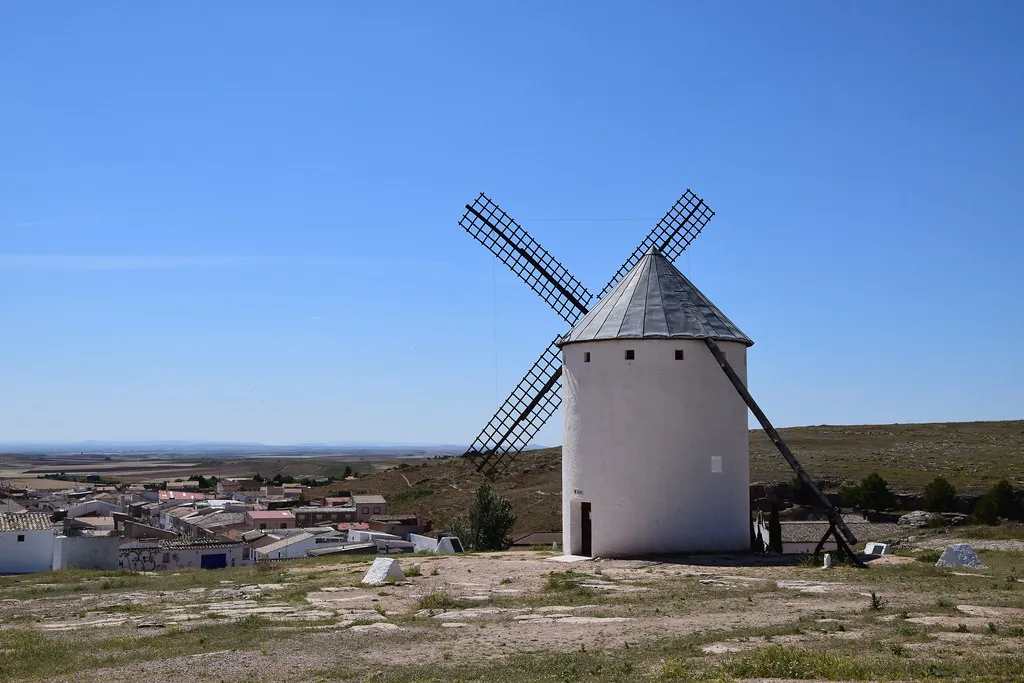
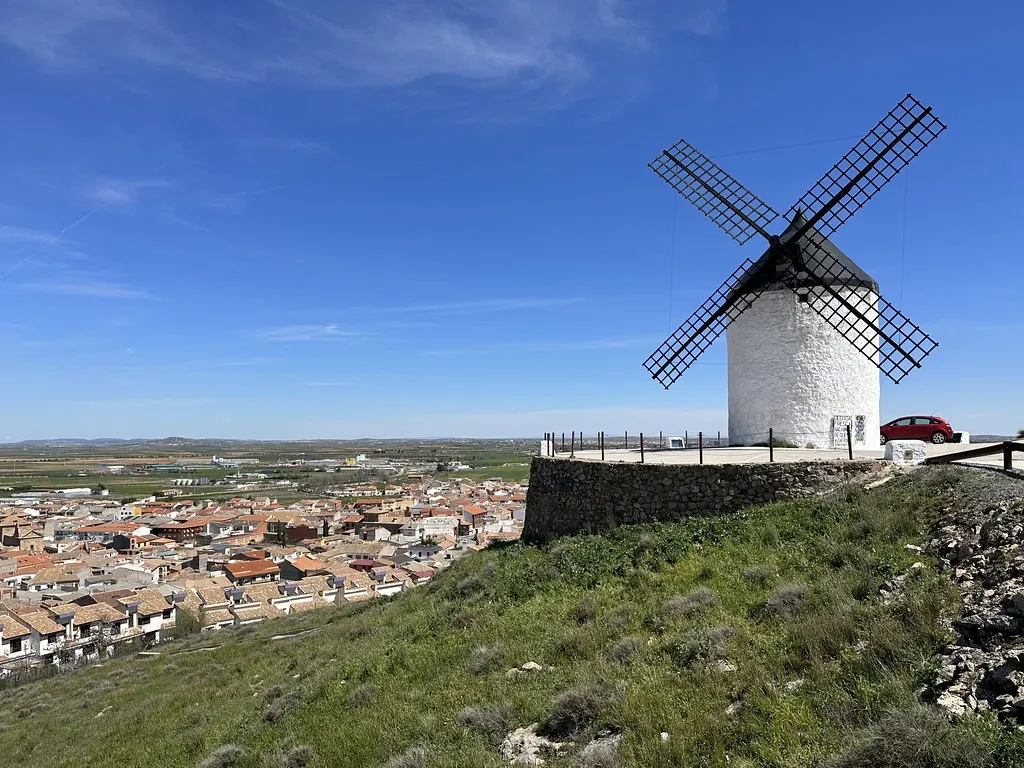
At the edge of the built-up area, the landscape opens almost immediately. Wide fields stretch towards a flat horizon that is unmistakably Manchego. Patches of holm oak and juniper break up the farmland. In spring, when there is a breeze, the air often carries the scent of thyme and rosemary. Look up for a while and you may spot birds of prey circling above the cereal crops.
Simple Sights, No Heavy Backpack Required
The heart of Alconchel de la Estrella is its parish church. It is a simple building, very much in line with many rural churches across Castilla. There are no towering spires or elaborate decorative flourishes designed to impress. Instead, you find stone walls, balanced proportions and a quiet interior with old wooden pews and a modest altarpiece.
From the church, the main streets branch out. This is where the village’s agricultural logic becomes clear. Wide doorways once designed for carts, interior courtyards and houses laid out around practical needs all point to a life shaped by farming. It does not feel like a restored stage set. It feels like a place that continues to function much as it always has.
Beyond the houses, several low hills rise from the surrounding land. One often mentioned locally is Cerro Gordo, visible from different points around the municipality. From its summit, the landscape makes sense as a whole: cultivated plots, areas of scrubland and kilometres of open countryside.
For those who enjoy walking, the agricultural tracks around Alconchel de la Estrella offer an easy way to explore. They pass through fields of wheat or barley, depending on the year, and small stretches of land dotted with scattered holm oaks. After rain, the ground can become seriously muddy, so sturdy boots are a sensible choice.
Photographers may find the interest lies in the details rather than grand monuments. Old stone walls, weathered doors and expansive evening skies provide plenty to focus on. After dark, if the sky is clear, the absence of strong artificial lighting reveals a generous spread of stars.
As for food, the village is too small to function as a conventional gastronomic destination. However, across the surrounding area it is common to find locally made products such as aged cheeses, mountain honey and traditionally produced cured meats from nearby villages. These reflect the agricultural character of the region rather than any specific culinary scene within Alconchel itself.
When the Village Comes Alive
Life in Alconchel de la Estrella follows a steady rhythm for much of the year, but August brings a change. The patron saint festivities are usually held then, when many residents who live elsewhere return for the summer. Processions move through the streets, gatherings take place in the square and the atmosphere shifts towards reunion. In a village of this size, most people have known each other for decades.
Easter, or Semana Santa, is observed in a restrained way. Religious events are simple and organised by the residents themselves, without grand displays. The emphasis is on community rather than spectacle, reflecting the scale of the place.
Visitors during these periods will quickly notice how visible an outsider can be in such a small setting. Even so, a brief conversation can easily lead to a story about the village or its past. In places with so few inhabitants, everyday life and shared memory are closely intertwined.
Getting There and Setting Expectations
Alconchel de la Estrella lies roughly an hour’s drive from the city of Cuenca, almost entirely along quiet secondary roads. The scenery shifts gradually as you travel, with increasingly open fields and smaller villages appearing along the way.
There is usually no regular public transport service to the village, so arriving by car is the practical option. It is also wise to download maps in advance, as mobile coverage can disappear among so much open countryside.
This is best approached as a short stop within a wider route through the province of Cuenca in La Mancha. A slow walk through its streets, a pause to take in the silence, a look at the horizon from a nearby track, and then on you go. Some places work precisely because they are small and understated. Alconchel de la Estrella fits comfortably into that category, content not to demand attention and all the more distinctive for it.