Full Article
about Belinchón
A farming village near Tarancón, noted for its Gothic church.
Hide article Read full article
Midday in the Plaza
In the shade of a hackberry tree in the main square of Belinchón, the bells of the church of San Miguel Arcángel mark midday. Light slips in low through the entrance and falls in uneven patches across the stone floor. At that hour the village sounds of small, ordinary things: a door closing with a sharp thud, a tractor engine passing slowly, someone calling a dog from across the street.
Belinchón lies in the province of Cuenca, within the wide plains of La Mancha, in the basin of the river Záncara. From the provincial capital it is a little over an hour by road. The settlement itself is compact and easy to walk in a matter of minutes. Narrow streets thread between whitewashed houses, their wooden gates darkened by sun and winter weather.
The parish church of San Miguel Arcángel, traditionally said to date from the 16th century, is the most recognisable building in the village. Its tower, topped with red roof tiles, stands out against the pale façades around it. Inside, the atmosphere is restrained: stone, quiet, and a baptismal font that seems to have witnessed generations of local families. There is no sense of spectacle here, only continuity and habit.
Fields Shaped by Time
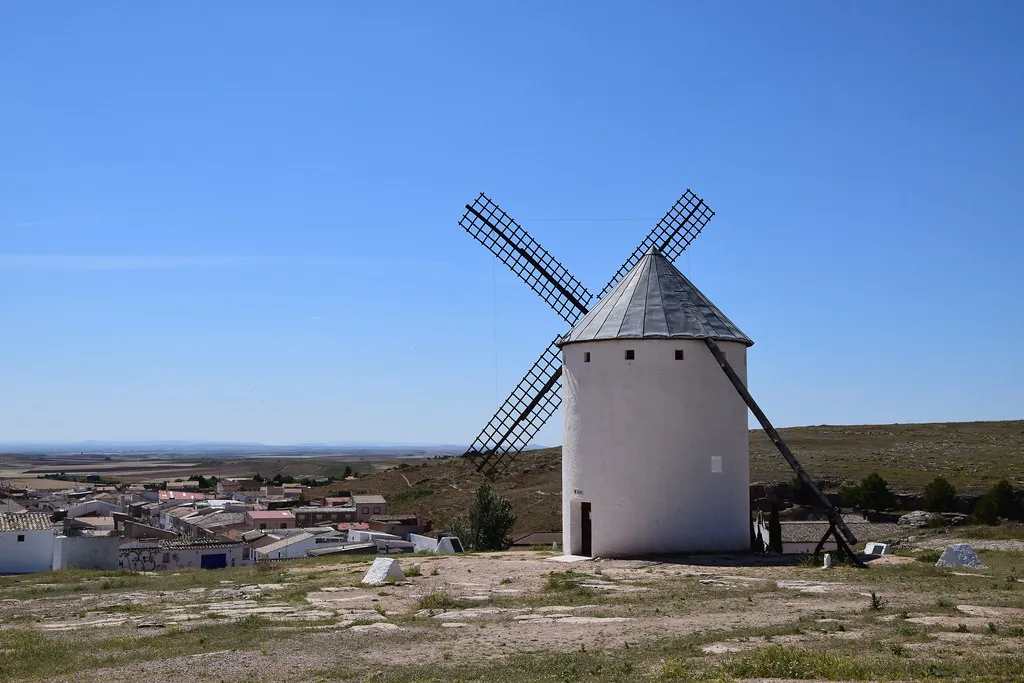
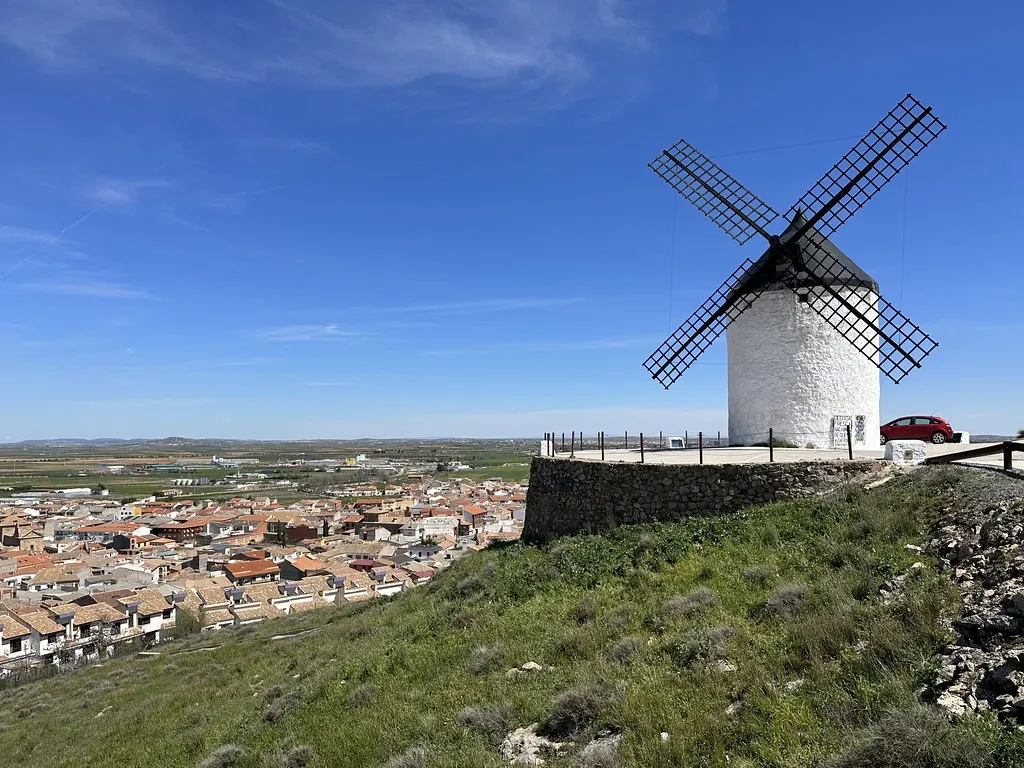
The landscape around Belinchón does not try to impress. It is working countryside, shaped over a long time. Plots of cereal stretch outwards from the village, turning to stubble once the harvest has passed. Low stone pens sit half absorbed into the earth.
Spring brings a brief flush of green, but it fades quickly. Before long the familiar brown tones of dry La Mancha return. Boundaries between fields are sometimes marked by small stone walls, sometimes by simple ridges of earth. Almond trees appear here and there, brambles line the edges of tracks, and the circular stone rim of an old well still signals where water was once drawn.
This is a landscape that rewards patience. There are no dramatic viewpoints or sudden changes. Instead, it unfolds gradually, in muted colours and long horizons.
Dirt Tracks into Silence
Several agricultural tracks lead out from Belinchón towards the surrounding farmland. Local residents use them to reach their plots. They are not signposted as official walking routes, yet they can be followed without difficulty, provided walkers use common sense and respect the ongoing work of the fields.
In winter, some stretches turn muddy and tractor tyres leave deep ruts in the ground. In summer the opposite happens. Fine dust rises with each step. Even so, half an hour on foot is enough for the village to fall behind and for near total silence to settle in, broken only by the wind or the distant hum of a motor.
Walking here is simple. There are no interpretation panels or marked circuits. The appeal lies in the openness and the steady rhythm of the land. The Záncara basin shapes this terrain, even when the river itself is not immediately visible. Agriculture remains the defining presence.
Celebrations and the Local Calendar
Life in Belinchón revolves to a large extent around the church and the religious calendar. In summer the patron saint festivities dedicated to San Miguel Arcángel take place. Many residents who live elsewhere return for a few days, and the streets become noticeably busier. The calm pace that defines much of the year shifts, and the village feels more animated.
Holy Week, known in Spain as Semana Santa, also retains a certain tradition here. Sober processions move through the main streets at dusk, reflecting a style typical of smaller Castilian towns. There are also occasional romerías, popular pilgrimages often linked to Marian devotions. Families from the surrounding area gather for these celebrations, although participation varies from year to year.
These events are not presented as grand spectacles. They are part of a recurring cycle that structures village life. For visitors, they offer a glimpse of how faith and community remain interwoven in rural La Mancha.
Eating and Everyday Supplies
Belinchón is a small village, and it is not always easy to find somewhere to eat without prior planning. Many visitors spend part of the day here and then continue on to nearby towns with a wider range of services.
In local homes, cooking remains closely tied to what the season provides. Legume stews appear regularly, along with vegetables from the garden when available. Tocino, cured pork fat, and other preserved sausages are part of the traditional larder. Manchego cheese, one of the region’s best-known products, often features on family tables, accompanied by bread and wine from the area.
This is straightforward, rural cooking. It reflects availability and habit rather than fashion.
When to Visit Belinchón
For walking around Belinchón and its surroundings, spring and autumn are generally the most agreeable times. The light is softer and the fields shift subtly in colour. Summer heat builds from mid-morning onwards, so early starts or late afternoon strolls are more comfortable. Winter can be dry and windy, with days when the cold slips easily through the open streets.
Belinchón is not a place of major monuments or rapid sightseeing with a checklist in hand. It makes more sense at a slower pace. A walk through its streets, the sound of the countryside nearby, the measured tolling of the church bells: these are the elements that define it.
In the basin of the Záncara, among cereal fields and old stone walls, the village continues much as it has for years. Visitors who arrive without expecting spectacle may find that this steady, unadorned rhythm is precisely the point.