Full Article
about Campo de Criptana
Icon of La Mancha for its famous windmills on the Sierra; a universal literary setting and town of steep white streets
Hide article Read full article
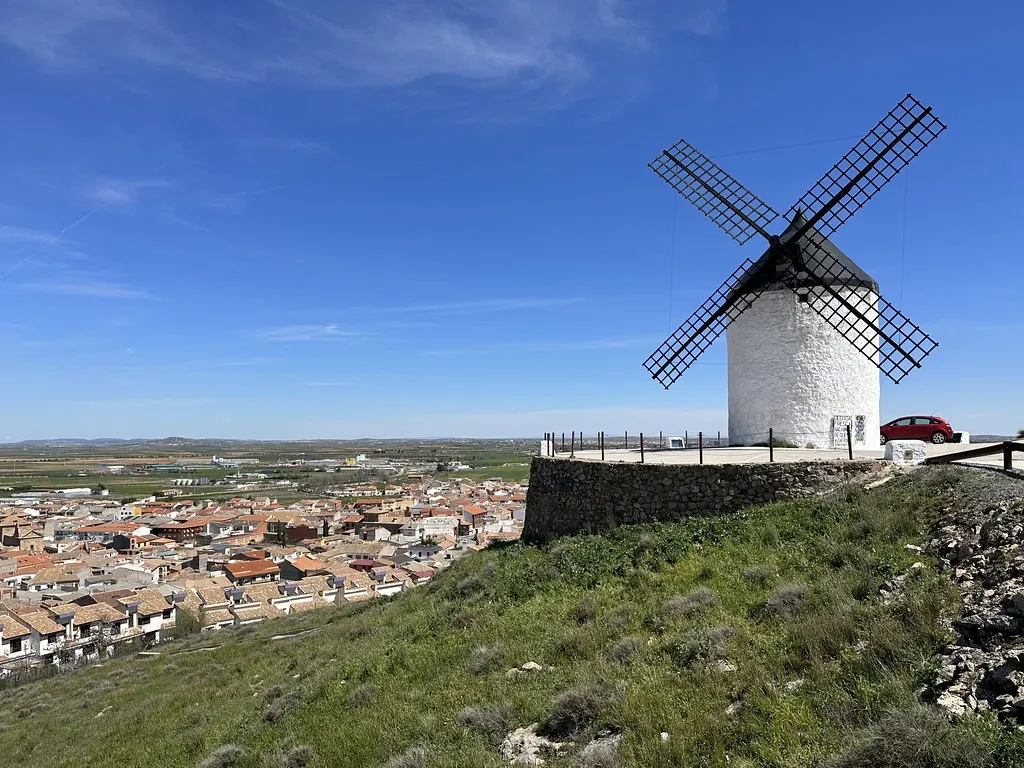
The bells of the church of Nuestra Señora de la Asunción strike eight just as the wind shifts. Up on the Sierra de los Molinos, the sails of the stone and timber giants begin to turn, slowly at first, as if waking, then with more purpose when the air holds steady. The sound carries across the hill: a dry creak that feels almost human, mixed with the whistle of wind slipping between the blades. From this height, Campo de Criptana spreads out over the plain of La Mancha like a cloth of pale streets and red roofs pulled tight across a table.
The murmur of the mills
It is best to climb the Sierra early. Not so much because of the sun, which presses down quickly in summer, but for the quiet. At that hour the windmills are more than an image. You can hear the timber working as the wind pushes through the sails and threads its way through narrow gaps.
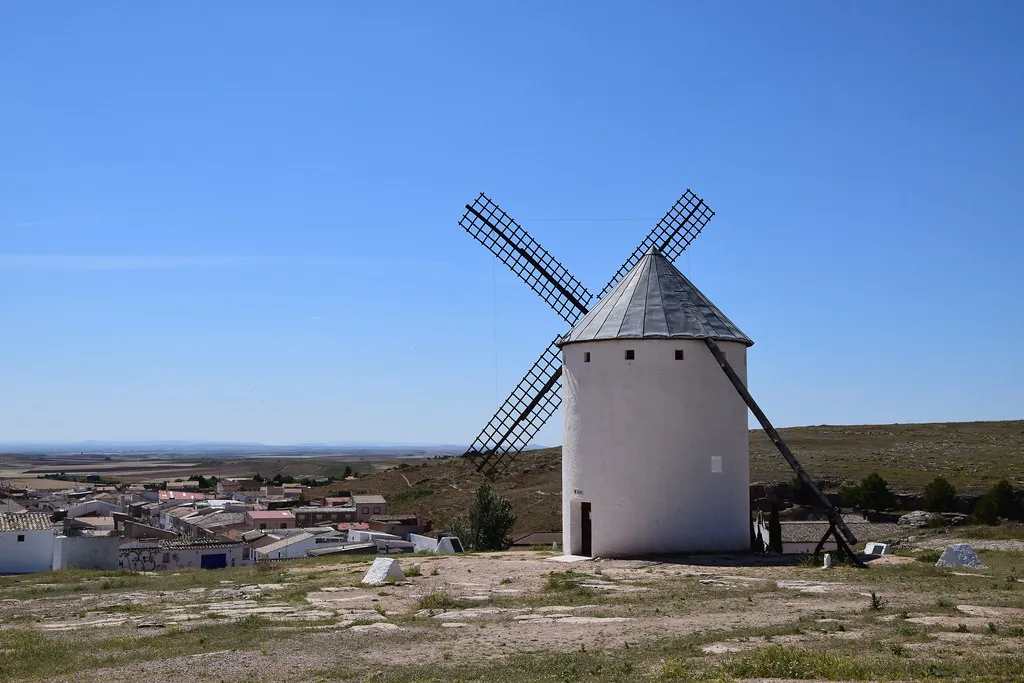
El Infanto, often considered the oldest, has slightly uneven sails. Burleta carries the scent of grease and wood worn smooth by centuries of friction. Inside, the grinding stone still shows grooves where a fine, almost golden dust clings when light falls through the small window. It is hard not to think of the windmill episode in Don Quijote. Miguel de Cervantes set his giants here, and from this hill the choice makes sense.
Three of the mills, Infanto, Sardinero and Burleta, were built in the 16th century and are protected as historic monuments. Some can be visited, though opening times vary depending on the season and may even depend on the wind or on whether there is staff inside. The simplest approach is to head up without rushing and ask locally.
The painter Ignacio Zuloaga became co-owner of Burleta. It is said that he would climb the hill at first light, when the light over La Mancha is still cool and clear and the shadows of the mills stretch down the slope.
Sloping streets and white earth
Walking down into the old quarter feels like giving in to gravity. The Albaicín Criptano, as locals call it, clings to the hillside with streets that rise and fall at a marked incline. Underfoot, the surface shifts from worn stone to uneven slabs, with the occasional patch of more recent cement.
Several houses are dug into the rock itself. From the outside there is little to see: a wooden door, a small window, the rest burrowed into white earth. Now and then a door opens and someone steps out in slippers to put out the rubbish. The silence here differs from the one on the hill. A tap drips somewhere, an old hinge squeaks, a television murmurs too early in the day.
El Pósito, built in the 16th century as a grain store, has the look of a small fortress in brick and stone. Today it serves as the municipal museum. Inside are objects that trace the town’s agricultural past: heavy harvesting tools, documents from the old grain store and a scale model showing the more than thirty mills that once stood on the hill in the 16th century. The museum also presents Sara Montiel, born in Campo de Criptana and later one of the most recognisable names in Spanish cinema.
When the town shifts its pace
Semana Santa, Holy Week, is one of the times when Campo de Criptana fills up. The sound of drums and cornets travels through the streets before the religious floats appear. The air carries the scent of warm wax and flowers already beginning to fade. Many women wear black mantillas, the traditional lace veils, and children step carefully in new shoes that have yet to soften.
In August the rhythm changes again with the fiestas of Cristo de Villajos, closely tied to residents of the town and surrounding area. Temporary structures rise in the main square and the night heat settles low over the ground. In many homes gazpacho manchego is prepared, the hearty stew of game meat and torta cenceña flatbread rather than the cold tomato soup found in Andalusia. Meals stretch late into the night, conversation lingering long after plates have been cleared.
From the home kitchen
In some bakeries in the centre, mantecadas are still made using old recipes, often with pork lard rather than butter. They carry a faint savoury note that balances the sugar and a texture that crumbles almost before you have taken a proper bite.
Manchego cheese here is not presented as a souvenir. It forms part of many farmers’ breakfasts: bread, olive oil and a wedge cut by hand. Ask around and more than one person will say that a wheel aged for several months holds the most concentrated flavour, while a younger cheese is milder.
In winter, migas appear in large iron pans. They include panceta, whole garlic cloves and sometimes raisins that burst sweetly against the fried breadcrumbs. Pisto manchego usually arrives topped with an egg and, in many households, with a little meat or panceta browned first in the same pan.
Around the hill
The Ruta de los Molinos covers barely a couple of kilometres, yet it rewards a slow pace. The effort lies not in the distance but in the pauses. In one direction sits El Toboso; in another, the plain seems to stretch without end until the bell tower of another village rises on the horizon.
Back on the Sierra, when the wind gathers again, the sails resume their steady turn. The creak returns, the same dry note carried across centuries. Campo de Criptana continues below, between whitewashed slopes and open land, with its mills watching over the plain of La Mancha as they have done since the 16th century.