Full Article
about Cervera del Llano
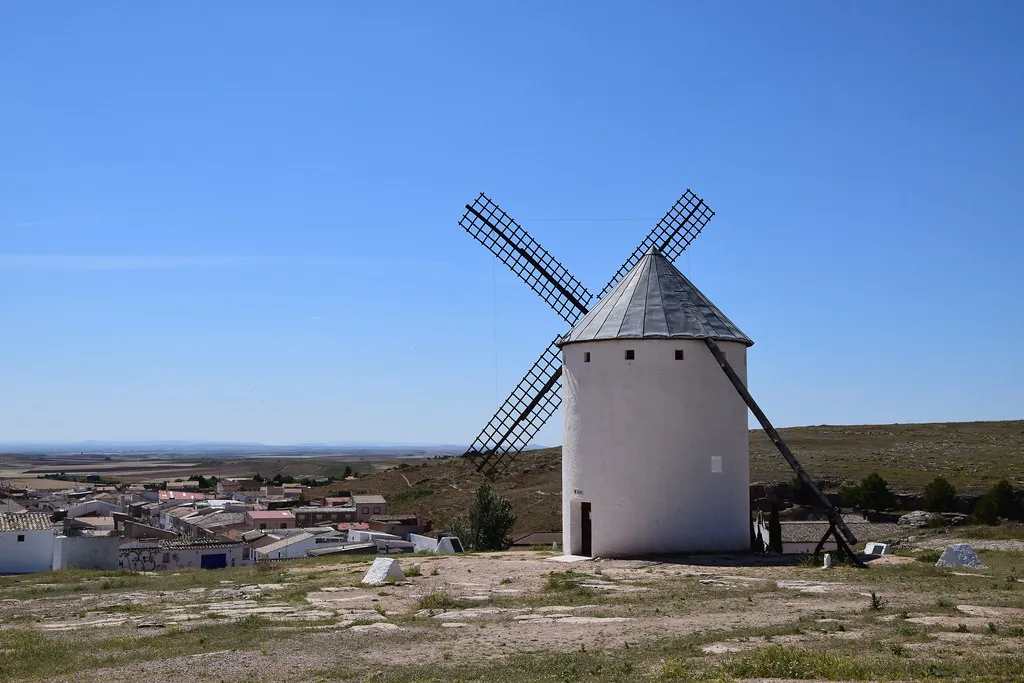
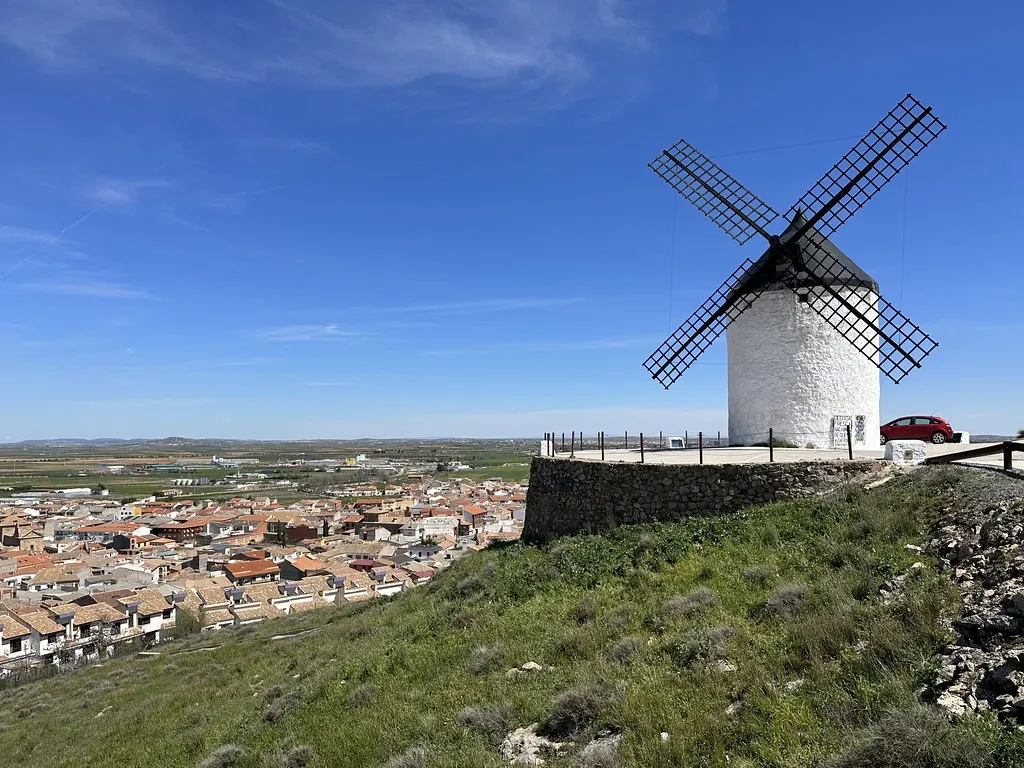
Town on a hill overlooking the plain; wide views
Hide article Read full article
First Light on the Plains
Early in the morning, before the sun begins to press down on the land, the fields around Cervera del Llano take on a pale, almost silvery tone. A light breeze moves through the wheat and barley, and the village appears suddenly in the middle of the plain, low and compact, its whitewashed façades set against the wide La Mancha sky.
Cervera del Llano lies just under one hundred kilometres from Cuenca, in an area where the flatlands of La Mancha start to feel drier. The approach runs through agricultural plots and long straight roads that keep the horizon in view for miles. Wheat and barley dominate the landscape. Dirt tracks branch off towards farm buildings, and tractors are a familiar sight.
Once inside the village, the scale shifts. Streets narrow into short stretches lined with single-storey houses. Many doors are wooden, some still fitted with old iron hardware. Everything feels close to the ground, shaped by a rural rhythm that has changed less here than in larger towns.
The Church at the Centre
The parish church forms the visual anchor of Cervera del Llano. Built in pale stone, it has a simple bell tower that can be seen from most nearby streets. The structure appears to have been constructed in stages. Parts of it may date back to the closing centuries of the Middle Ages or the beginning of the early modern period, which is common in this part of Castilla La Mancha.
In summer, the church becomes the focal point for religious celebrations. During these days the pace of village life shifts. Relatives who live elsewhere return, houses that have stood closed for months open their doors, and the square fills with conversation long into the evening. The atmosphere contrasts with the rest of the year, when daily life tends to be quieter and more routine.
Walking the Llano
The landscape around Cervera del Llano is broad and markedly horizontal. There are no major hills, only a repeated pattern of cultivated fields, dirt tracks and patches of low scrub. In spring the green is brief but vivid. As summer advances, the colours turn steadily towards yellow and ochre.
Several agricultural paths leave directly from the village, linking it with nearby hamlets and farms. These tracks are usually compacted earth and straightforward to follow if there has not been recent rain. Encounters are likely to be with a passing tractor or neighbours working their land rather than other walkers.
Along certain stretches, traces of older rural life come into view. There are former wine cellars dug into small earth banks, old animal enclosures and washing places connected to streams that carry very little water for most of the year. These elements reflect an agricultural way of life that still shapes the identity of the area.
Practical considerations matter here. The wind is noticeable on the plain, even on clear days, and in summer the heat intensifies from midday onwards. Walks in the surrounding countryside are more comfortable early in the day or later in the afternoon.
Birdlife, Open Sky and Quiet Nights
The plains of La Mancha are known for steppe birds that favour open, treeless terrain. At dawn or towards evening it is relatively common to see flocks crossing the fields. With patience, it is sometimes possible to spot bustards and other species typical of this habitat, though sightings are never guaranteed.
After rainfall, temporary puddles form along the tracks. These attract herons, ducks and other migratory birds pausing on their routes. The scene changes subtly depending on the season and the weather, yet the sense of space remains constant.
When night falls, attention turns upwards. Light pollution is very low, and on clear evenings the stars appear with a sharpness that can surprise anyone used to urban skies. If the visit coincides with a new moon, the pale band of the Milky Way can be distinguished above the darkened fields. The surrounding silence reinforces the effect. Away from major roads, the most common sound is the wind moving through the wheat, occasionally broken by a nocturnal bird passing briefly overhead before the plain returns to stillness.
Festivities and Local Food
The main festivities in Cervera del Llano usually take place around August, traditionally linked to San Bartolomé. During these days the square fills with music, gatherings of neighbours and religious events. Many people who grew up in the village choose this moment to return, so the population increases noticeably compared with the rest of the year.
Cervera del Llano is small, and options for eating or staying overnight within the village itself are limited. In nearby towns it is easier to find classic La Mancha cooking. Typical dishes include gachas, a hearty preparation based on flour; lamb stews; local cheeses; and olive oil produced in regional mills. These are substantial meals, shaped by the demands of long days working in the fields.
Getting There and Choosing the Season
Access to Cervera del Llano is via regional roads that cross the agricultural plain. The journey is straightforward but requires a little planning, as there can be considerable distances between villages with no services in between. Travelling at an unhurried pace suits the landscape, which unfolds slowly and without dramatic changes.
Spring and early autumn tend to offer the most comfortable conditions for walking the tracks around the village. In high summer the sun falls directly on open ground with no shade, and in winter the wind can feel harsh across the exposed fields.
In return, there is something that is rarely missing here: silence. At night, far from busy routes, the quiet is almost complete. The wind moves through the wheat and then settles. A brief call from a bird crosses the darkness and fades quickly into the flat expanse of La Mancha.