Full Article
about Honrubia
Key junction on the A-3; known for its Ermita del Santo Rostro.
Hide article Read full article
Between the Meseta and the Levante
Honrubia sits in the south of Cuenca province, where the plains of La Mancha begin to tilt towards Albacete. Its location is historical: for centuries, it lay on one of the natural corridors between Spain's central plateau and the Mediterranean coast. That past as a place of transit is still legible today, with major highways and service stations tracing the same route just outside town.
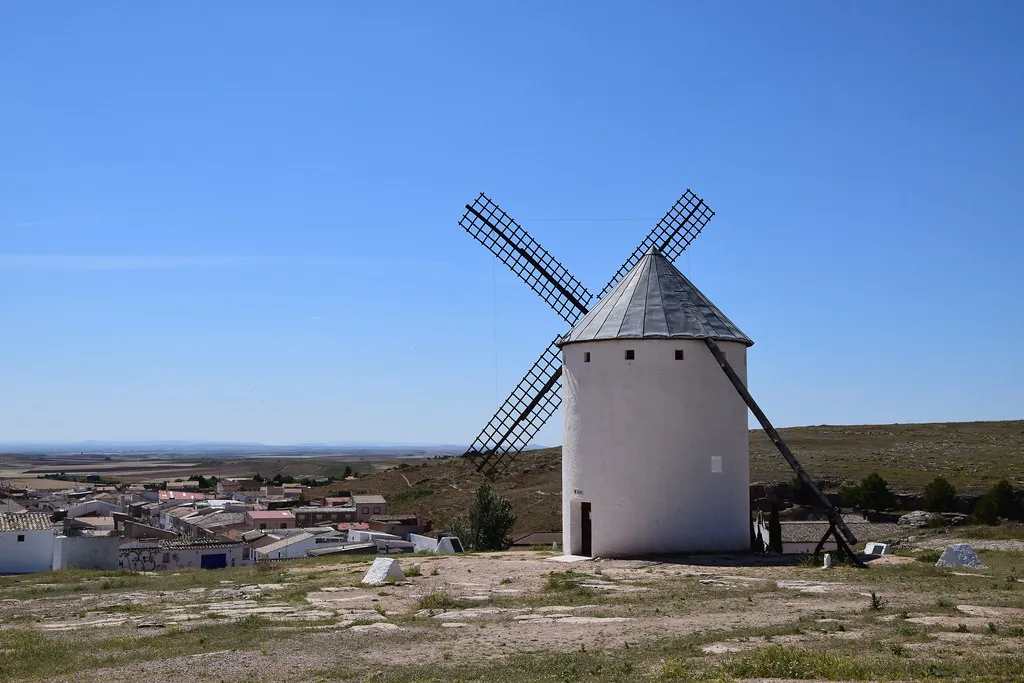
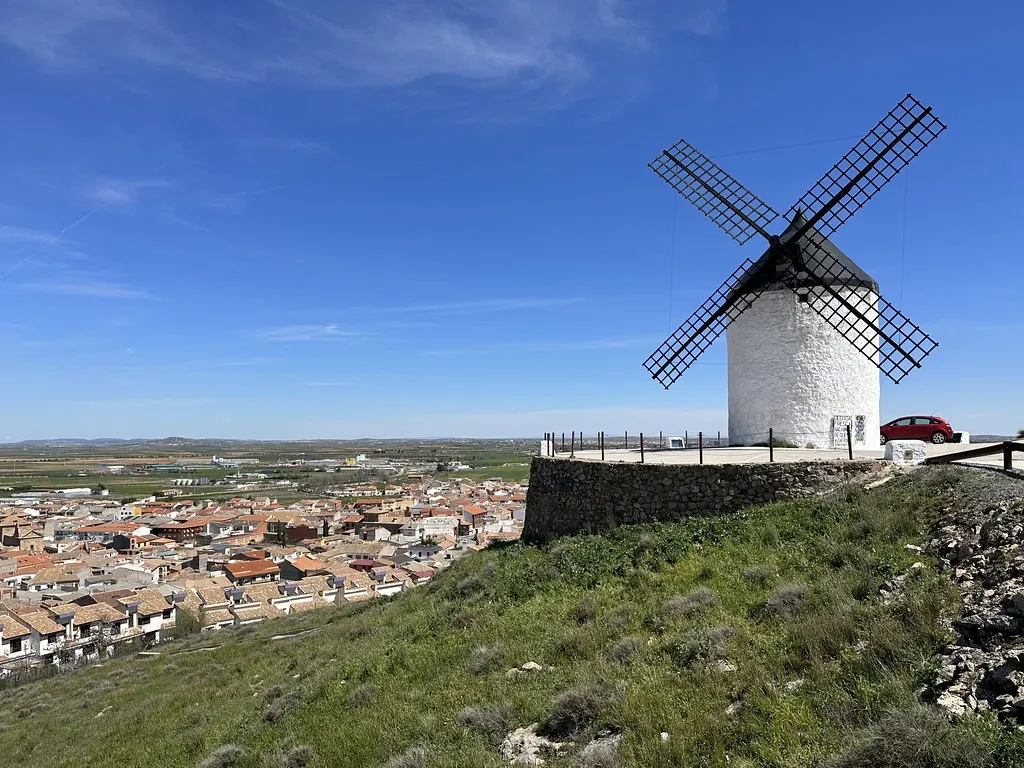
Leave the asphalt, however, and the geography simplifies. The landscape here is the classic one of this part of La Mancha: a succession of cereal fields, occasional sunflowers, and scattered olive groves. The horizon stays low and the sky opens up.
With some 1,500 residents, Honrubia operates on the scale of an agricultural town. The oldest buildings cluster near the main square, their walls of thick masonry or tapial (rammed earth) pierced by large wooden gates that once led to courtyards and storage sheds. You won't find grand monuments, but rather a consistent vernacular architecture and an urban layout dictated by farming needs.
The Church and the Pulse of the Plaza
The parish church occupies the centre, as it does in most towns across the region. The building shows signs of successive modifications over time—a common story for rural parishes. Its true importance is in how it anchors the plaza that spreads out before it.
This plaza functions as the town's living room. It has benches, trees that provide shade in summer, and a steady flow of neighbours going about their day. Several main streets depart from here, making it the logical starting point to understand Honrubia's rhythm and size. The church itself is less notable for any specific artistic detail than for its role as a fixed point in the community's daily geography.
The surrounding streets are narrow and practical. Their width was determined by the need to accommodate carts and provide access to storerooms, not by architectural ambition. The result is a quiet, functional grid that feels proportionate to the town's purpose.
The Agricultural Plain
Walk to the edge of town and the fields begin almost at once. The terrain rolls gently, with few features to break the sightlines. This is a landscape of extensive cultivation, where the year's rhythm is set by sowing and harvest.
In the more open plots, you might spot wildlife. Species like the great bustard or stone-curlew are known to inhabit these plains, though they require patience and a keen eye to identify. Birds of prey are more readily seen, often using fence posts as vantage points over the crops.
The dirt tracks leading from Honrubia are not waymarked hiking trails; they are working farm roads that connect fields and farmsteads. They are, however, perfectly suitable for walking or cycling. Their appeal lies in their simplicity, leading you directly into a world defined by crop cycles, vast skies, and long sight distances.
The silence here has a particular quality. With nothing to contain it, sound seems to dissolve into the space. It is an open, continuous landscape where human activity and natural cycles have been intertwined for generations.
Field and Table
The local cuisine is a direct reflection of the fields you see. The dishes are born from practicality, making use of what was at hand. Migas—fried breadcrumbs with garlic—is a staple. Gachas, a thick savoury porridge, and pisto manchego, a slow-cooked vegetable stew, are common on menus.
When in season, game stews appear, following recipes that vary slightly from one home to another. These are typically accompanied by Manchego cheese, local olive oil, and wines from the region. These three products are not just accompaniments; they are pillars of the local economy, tying the meal directly back to the surrounding land.
Festive Dates in the Local Calendar
Honrubia's festive year follows the traditional Manchegan cycle. In January, bonfires are lit for San Antón, where neighbours gather and animals are blessed—a ritual that still links faith to rural life.
The patron saint festivities in summer mark the year's peak. The population swells as people return to town, and social life moves decisively into the streets and plaza.
Holy Week is observed with a sober tone. The processions are modest in scale, organized by local cofradías (brotherhoods) and focused on community participation rather than theatrical display.
Finding Your Bearings
Honrubia is located directly alongside the motorway linking Madrid with the Levante coast, making access by car straightforward. The drive from the city of Cuenca takes just over an hour.
The town itself can be walked thoroughly in a short time. The real context, however, lies outside it. Allocate time to follow one of the farm tracks on foot. It is there, with the built-up area at your back, that Honrubia’s character comes into focus: a settlement shaped by and for the expansive plain that surrounds it.