Full Article
about Las Labores
Small farming town ringed by vineyards and olive groves; a quiet slice of traditional La Mancha country life.
Hide article Read full article
A Village That Moves at Its Own Pace
Some places are all about sights and checklists. Others feel more like a pause. Tourism in Las Labores belongs firmly in the second category. This is a small village in La Mancha where daily life still revolves around the countryside and familiar routines. There are no grand attractions, no carefully arranged façades for visitors. What you see is simply what is there.
Just over five hundred people live here, and that scale shapes everything. There is no traffic to speak of, no shop windows designed to catch the eye of outsiders. The streets are narrow, the houses whitewashed. When the wind crosses the surrounding fields, it carries a silence that settles over the village.
Las Labores sits in the province of Ciudad Real, at around 650 metres above sea level. It forms part of inland La Mancha, a landscape that seems flat at first glance until you begin to notice its subtle shifts.
The houses are practical rather than decorative. Thick walls and small windows are not aesthetic choices but common sense, protection against the winter cold and the intense summer heat. Anyone who has experienced July in this part of Spain will understand why such measures matter.
You can walk across the village in half an hour, and then cross it again without effort. That is part of the rhythm here. It is a place for wandering without direction, glancing into open patios or greeting someone seated by their front door.
The Church and the Heart of the Village
The parish church of San Carlos Borromeo stands in one of the most visible parts of the village centre. Compared with many churches in La Mancha, it is relatively recent, built at the beginning of the 20th century.
Its importance lies less in architectural detail and more in what happens around it. The bells still mark the hours of the day. The nearby square acts as a meeting point, particularly after mass or towards the end of the afternoon. People stop to talk. Conversations stretch out. The movement is modest, yet it says a great deal about how Las Labores functions.
There is no rush to leave. The centre remains a shared space, defined by routine encounters rather than spectacle.
Out into the Fields
To understand Las Labores, you need to step beyond the built-up area. Paths lead out towards olive groves and cereal fields. Many are wide farm tracks, unpaved in long sections, and regularly used by agricultural vehicles.
Walking here is straightforward. The terrain is flat, the horizons long, and traffic is scarce. In spring the green lingers for a while and poppies appear along the edges of the tracks. Summer changes the scene completely. The land dries out, and the yellow of ripened grain takes over.
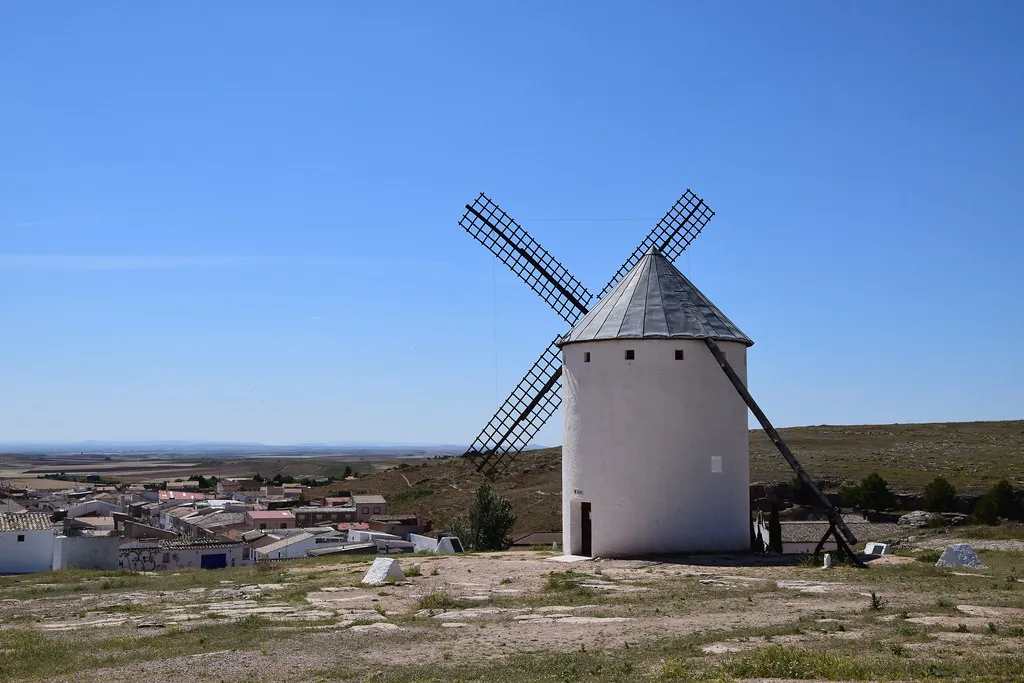
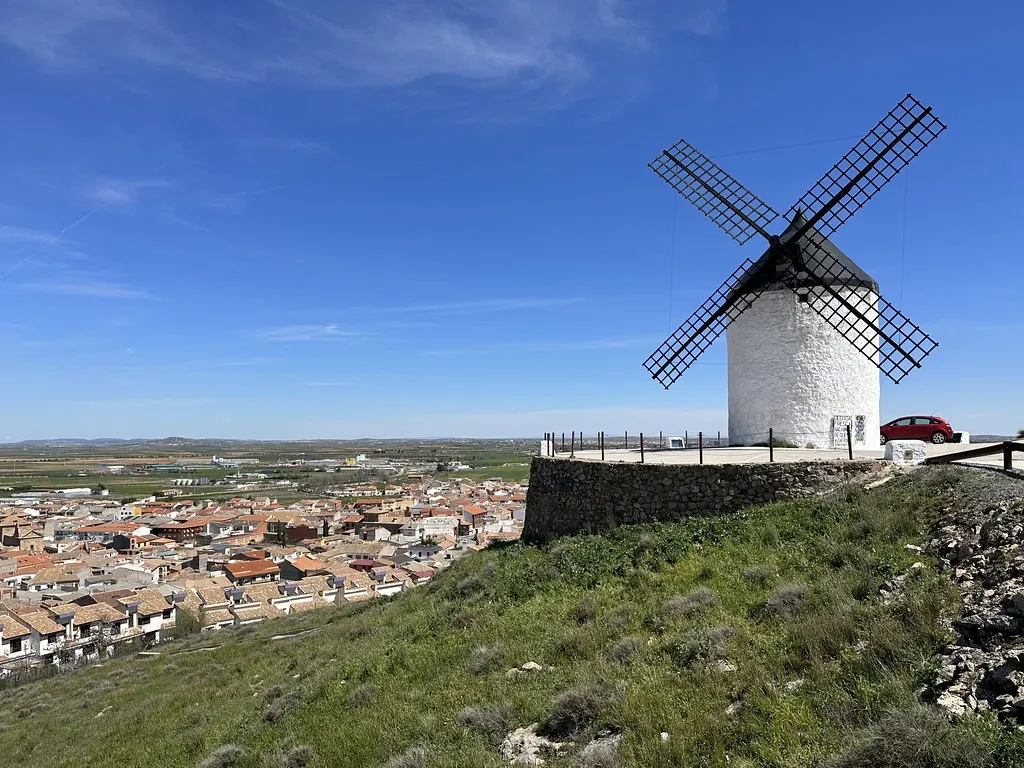
From a nearby rise, the essence of La Mancha becomes clear: open countryside, scattered houses and, overhead, the occasional bird of prey circling on the thermals. It is an agricultural landscape that defines the whole comarca, or county, and Las Labores fits squarely within it.
Food, Sleep and the Wider Area
Las Labores is not organised around tourism. Options for eating or staying overnight are limited, which is typical in villages of this size.
That said, the culinary traditions of La Mancha remain very present in the area. Hearty dishes such as gazpacho manchego and gachas appear at family gatherings and local celebrations. Gazpacho manchego is not the cold tomato soup some visitors may know, but a substantial meat and flatbread stew associated with rural cooking. Gachas, made with flour and other simple ingredients, are equally filling. These are recipes shaped by life in the fields: straightforward components and generous portions.
Visitors who choose to stay nearby often use the village as a quiet base and travel on to other municipalities in the area. Tomelloso, for example, is larger and closely linked to wine production. Other surrounding villages share the same agricultural backdrop that characterises this part of Castilla La Mancha.
The appeal is not variety in the conventional sense, but continuity. One settlement flows into the next, tied together by fields of olives and grain.
When Las Labores Comes Alive
For much of the year, Las Labores is calm. Very calm. Yet there are certain weeks when the atmosphere shifts.
Festivities dedicated to San José Obrero and Santa Ana bring together residents and those who return to the village for these days. Traditional games appear, along with religious events, and the streets see more activity than usual.
During Semana Santa, or Holy Week leading up to Easter, there are simple, very local processions. In January, animal blessings linked to older rural customs are still maintained. These practices are part of a long-standing agricultural culture, reflecting the bond between people, livestock and land.
None of these events are designed to attract visitors. They are expressions of local life, celebrated because they matter to the community itself.
Arriving and Understanding the Place
Reaching Las Labores from Ciudad Real involves travelling along regional roads that cut through fields of cereal and olive trees. By car, the journey presents no particular difficulty. In summer, the heat can be intense and the landscape turns noticeably dry.
Climate plays a significant role here. The sun is strong for many months of the year. Winter can be cold, especially when winds sweep across the plateau of the Meseta.
Las Labores does not try to impress. That may be precisely why it works. It is a small village in La Mancha that continues at its own steady pace. Approached with that expectation, it makes sense. The value lies not in headline attractions, but in the steady presence of fields, familiar faces and a way of life that follows the seasons.