Full Article
about Manzanares
Major farming hub and crossroads; it has a well-preserved medieval castle and museums of interest such as the Cheese Museum.
Hide article Read full article
A town shaped by roads and memory
Manzanares sits on the map of La Mancha at a historic crossroads. Between the cereal plains of the Campo de Calatrava and the routes that once led south towards Andalucía, this was a strategic position in the Middle Ages. The Order of Calatrava established itself here early on, building a fortress to oversee the surrounding territory. Around that defensive point the settlement grew, set among pastureland, drovers’ roads used for seasonal livestock movements and an economy closely tied to sheep farming.
One object sums up the town’s relationship with its past. A table is preserved here, said to be the very one on which the Manifesto of Manzanares was drafted in 1854. That political text helped spark the revolution that brought down the government of Espartero. In the house where it was signed, the table and several objects connected to the episode are still kept. It is a small detail, yet it reflects a wider pattern. Manzanares has tended to safeguard its material memory, from medieval defensive buildings to long-established religious traditions.
Pilas Bonas Castle and the logic of the landscape
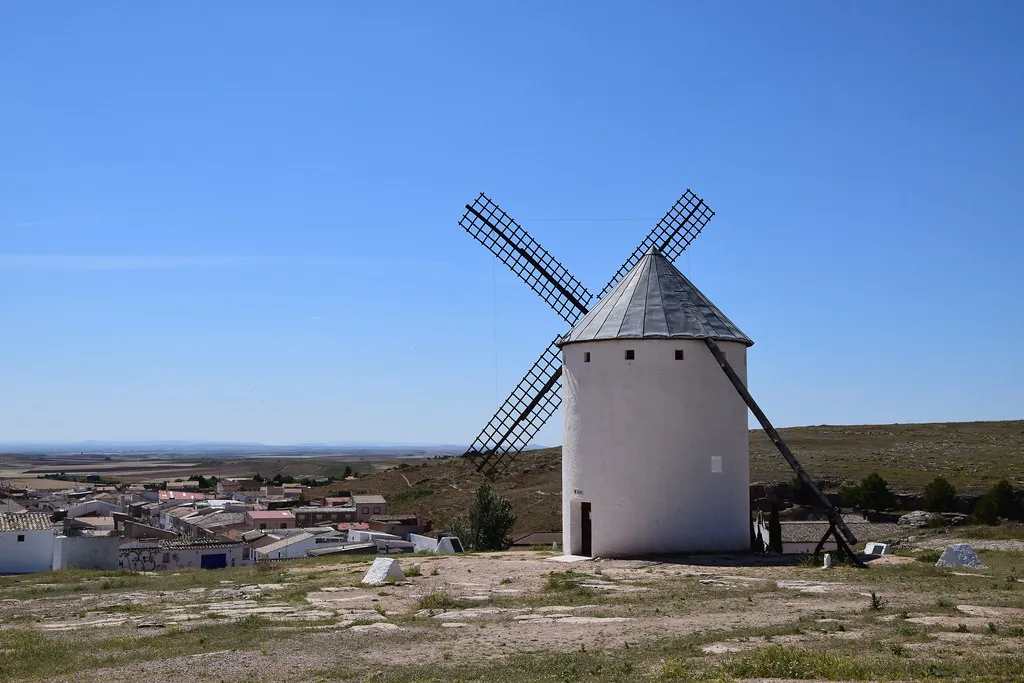
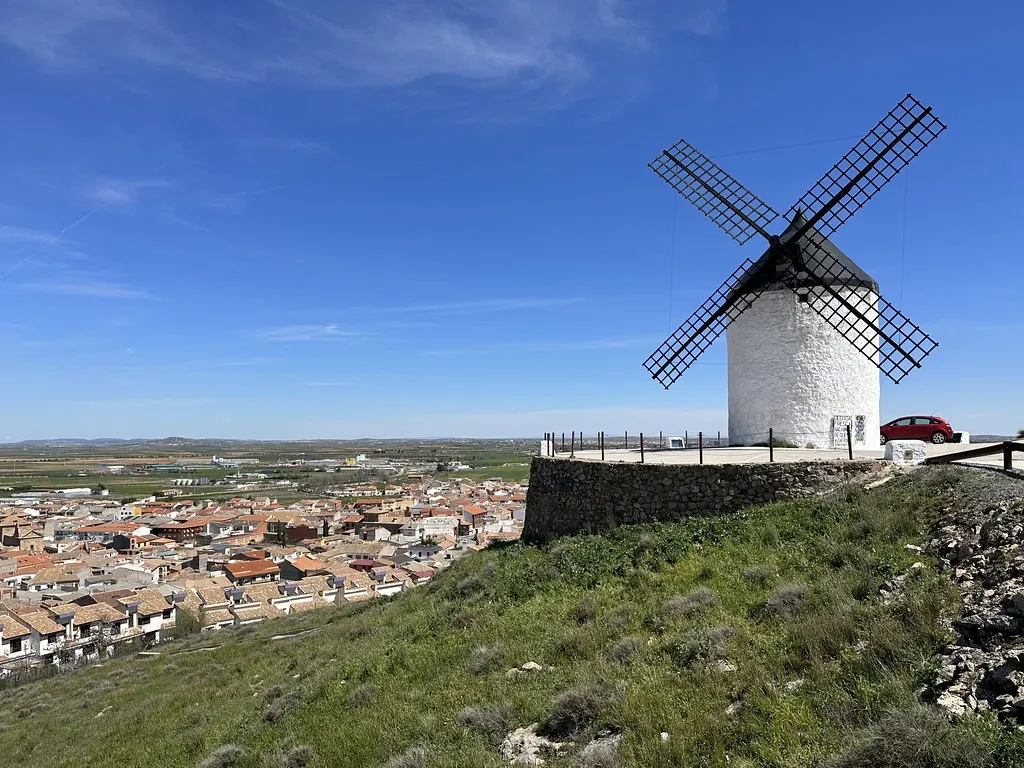
Climbing up to Pilas Bonas Castle makes it clear why the settlement took root in this exact spot. The fortress was built in the 13th century under the Order of Calatrava, on a modest rise overlooking the plains of La Mancha. The hill is not dramatic, but in this landscape even a slight elevation allows control over kilometres of open ground.
The keep and part of the surrounding walls remain. Beyond the architecture itself, what stands out from the top is the coherence of the setting: open fields, cereal plots and a clean, uninterrupted horizon. The sense of space is striking. It also explains the historical importance of livestock and the seasonal movement of flocks across the area. In a territory defined by distance and exposure, visibility was power.
The castle does more than illustrate medieval military strategy. It anchors the story of Manzanares in a broader rural context, where agriculture and grazing shaped daily life for centuries. The surrounding plains are not a backdrop but the reason the town exists at all.
Manchego cheese and a pastoral culture
Manzanares maintains a longstanding link with Manchego cheese. The town is home to a museum dedicated to this product and to the pastoral culture associated with the Manchega sheep. The exhibition sets out an idea that is sometimes overlooked: Manchego is not simply a culinary speciality but a direct result of the landscape and the dry climate of the Meseta, Spain’s central plateau.
Traditional curing methods depend heavily on dry air and the steady wind that sweeps across the plains of La Mancha. For generations, flocks and small family-run farms sustained this economy. Sheep provided milk, and the conditions of the region shaped how that milk was transformed and preserved.
Today production is regulated under the denominación de origen, the official designation of origin that protects certain Spanish food products. Even so, the foundations remain unchanged: milk from Manchega sheep and long maturation periods. The museum places the cheese within a wider way of life, where transhumance, climate and terrain all played a part. In doing so, it links gastronomy with geography in a very concrete way.
A Holy Week heard before it is seen
There is one moment in the year when the rhythm of Manzanares shifts noticeably: Semana Santa, or Holy Week. Here, the processions do not begin with the religious floats emerging from a church doorway. They begin with sound. Drums and cornets move through the streets in advance, announcing what is to come.
Several brotherhoods, known as cofradías, take part in the processions that pass through the historic centre and converge on the main square. Some local traditions date back centuries, although many of the brotherhoods have adapted their rituals over time. The continuity lies in the collective participation and the way the streets become the stage.
At night, when public lighting is reduced and the processions advance by candlelight alone, the atmosphere changes completely. The familiar urban setting takes on a different tone, defined by shadow and rhythm rather than daylight and traffic. Even for visitors unfamiliar with Spanish Holy Week traditions, the sequence is easy to follow: sound first, then image, then silence as the procession moves on.
The hill of the hermitages
On the outskirts of the town, a small rise known as the cerro de las ermitas brings together several hermitages built between the 16th and 18th centuries. The site functions both as a romería space, used for local religious gatherings and pilgrimages, and as a regular walking route for residents.
The path up to the hill offers a clear view of the typical landscape of this part of La Mancha: scattered holm oaks, cereal fields and long straight stretches of open countryside. It is not a lengthy walk, yet it provides context. The relationship between the town and its immediate surroundings becomes visible, not as an abstract idea but as a lived geography.
The hermitages themselves reflect centuries of devotional practice. Their presence on a slight elevation echoes the logic seen at the castle: even small changes in height matter in a region defined by flatness.
Getting your bearings
The centre of Manzanares can be explored on foot without difficulty. The main square brings together several historic buildings, and from there streets lead towards the castle and the oldest churches. The layout remains readable, shaped by its origins as a defended settlement that gradually expanded.
The municipality is well connected by road to other towns in La Mancha and to Madrid via the motorway that crosses the region. There is also a railway station on the line that runs through this part of the province of Ciudad Real, reinforcing the idea of Manzanares as a point of passage as well as a destination.
Those interested in vernacular architecture should look closely at some of the traditional houses in the old quarter. Interior courtyards, wide gateways designed for carts and whitewashed façades built to deflect the intense summer heat are recurring features. They speak of a time when agricultural work shaped domestic space.
On market days, the main square returns to its historic role as a meeting point. That function still carries weight in everyday life here. Manzanares may have grown from a medieval watchpoint on a plain, but it continues to revolve around shared spaces and collective memory, grounded in the same landscape that first gave it purpose.