Full Article
about Miguel Esteban
In the heart of La Mancha; near the wetlands and with a winemaking tradition
Hide article Read full article
A Village Where Time Sits Down
There is a moment, just as you leave the road from Toledo and turn into the village, when the sat nav becomes slightly overconfident. “Turn left,” it insists, and to the left there is a field of sunflowers. “Recalculating.” That is usually when it becomes clear that Miguel Esteban is the sort of place where time does not simply pass through. It pauses. It sits on a bench for a while and looks around.
This is not a destination designed for travellers ticking names off a list. The rhythm here is more straightforward: a walk around the main square, a chat that lasts longer than planned, something substantial to eat, and an afternoon that gradually softens into evening.
Set in the wide plains of La Mancha, in Castilla La Mancha, Miguel Esteban carries the unhurried feel of a place that has never needed to rush for anyone.
In the Footsteps of Don Quijote
Miguel Esteban has that air of a village unsure of the role it plays in history, or perhaps simply uninterested in making a fuss about it. Among its red-brick houses and quiet streets, there is a recurring suggestion that Cervantes may have drawn inspiration from this area for the famous “lugar de La Mancha” mentioned at the start of Don Quijote.
Truth or legend, it is hard to say. Yet walking across the Plaza de España and looking up at the square tower of the church of San Andrés, it is easy to imagine the kind of landscape and community Cervantes would have known.
The church is generally dated to around the 17th century. Its style is sober, typical of much of La Mancha: solid walls, limited decoration, proportions that feel serious rather than ornate. Inside, there is the scent of wax and old stone. If the doors happen to be open, neighbours drift in and out with complete ease, as though passing through their own sitting room.
There are small details that say a lot about the place. People still address one another as “hermano” or “hermana”, brother or sister, with a naturalness that in larger cities might sound theatrical. Here, it is simply how things are done.
The Gazpacho That Isn’t Gazpacho
One thing worth clarifying straight away: gazpacho manchego has nothing to do with the chilled tomato soup from Andalucía. There are no blended tomatoes and no cold glasses in summer.
What arrives at the table is a hot, hearty stew made with flatbread, game or farm-raised meat and a generous amount of paprika. It is filling in the way that makes you feel properly fed. In many villages across the region it is associated with Sundays or family gatherings. In the bars around the centre of Miguel Esteban it sometimes appears, although not always advertised. Often it is simply a matter of asking.
Then there is Manchego cheese. Made from sheep’s milk and well cured, it carries a firm texture and a flavour with a definite edge, almost sharp enough to prickle at the nose. If anyone wanted to understand half of Spain in a single bite, this would be a convincing place to start.
Food here is less about display and more about substance. Meals stretch out, conversations overlap, and nobody seems in a particular hurry to clear the table.
Up to San Isidro
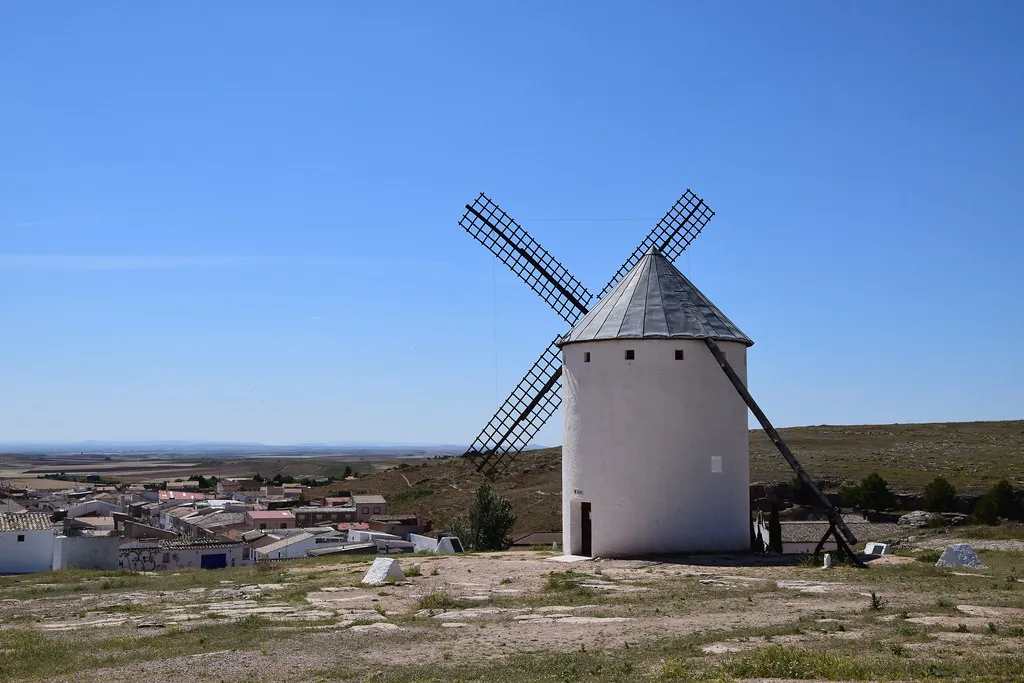
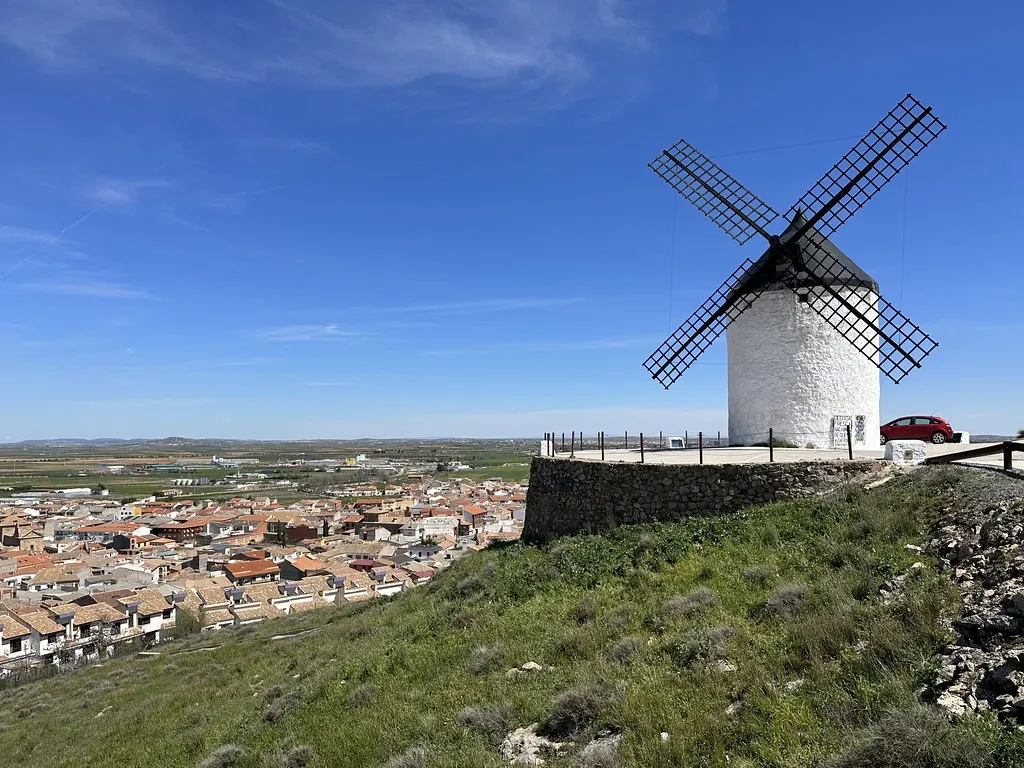
On the outskirts of the village stands the ermita de San Isidro, set on a small hill overlooking the plain. A path leads up from roughly the area of the sports centre, climbing gradually through cultivated fields.
It is not a long walk. The slope is gentle enough to take at an easy pace. Yet on reaching the top something shifts. From here the entire village comes into view, its streets laid out in the orderly pattern common to many towns in La Mancha.
It becomes clear why so many rural chapels were built on higher ground. The choice was not only symbolic. From this vantage point the whole territory is visible, the same land that supports much of the local community.
On the day of San Isidro, in mid-May, it is customary for residents to head up to the ermita. The religious aspect blends with a wider gathering, complete with a band and the atmosphere of a major day in the village calendar. In places like Miguel Esteban, these occasions still draw people together in a way that feels unforced.
September Lights and the Virgen del Socorro
If one month stands out, it is September. For several days the pace of the village changes. Streets are strung with lights, organised peñas form groups of friends who plan events together, music carries on into the night, and families linger at tables longer than usual.
The festivities are dedicated to the Virgen del Socorro. During this period the village also hosts the election of the so-called Reina de La Mancha, an event that has been held for decades and attracts visitors from across the surrounding area.
What matters most is not the formal ceremony itself but the atmosphere that surrounds it. Friends organise themselves into peñas, children stay up later than they would at any other time of year, and neighbours reconnect with people who return to Miguel Esteban only for the fiestas. The sense of reunion is as important as any official programme.
Los Charcones and the Birds of the Plain
A short drive from the centre, on the outskirts of the village, lies the area known as Los Charcones. These are small lagoons that form in this part of the Manchegan plain. At certain times of year they attract waterbirds.
In some springs flamingos can be seen here, along with ducks and other species that use these wetlands as a stopping point. This is not a natural park equipped with extensive infrastructure or sophisticated observation hides. It is an open landscape where the wind is often louder than the people.
The setting feels exposed and expansive, shaped by water and sky more than by buildings. Practical footwear is advisable, as the paths and the tough esparto grass typical of the terrain can make for uneven ground.
A Quiet Stop in La Mancha
Miguel Esteban is not somewhere to plan a long holiday around. It works better as a calm stop on a wider route through La Mancha, or as a short break from Toledo or nearby towns.
What it offers is less about headline attractions and more about pace. A square where conversations stretch. A church that anchors the centre. A hilltop ermita with views over working land. Seasonal wetlands where flamingos sometimes pause. Plates of gazpacho manchego and wedges of cured Manchego cheese shared at an unhurried table.
In a region defined by its broad horizons, Miguel Esteban fits naturally into the landscape. It does not compete for attention. It simply carries on, confident that those who arrive will adjust to its rhythm sooner or later.