Full Article
about Torrubia del Castillo
Small village with remains of an Arab castle; views over the plain and reservoir
Hide article Read full article
A detour into stillness
Some villages seem to appear on the map almost by accident. Torrubia del Castillo is one of them. It is the sort of place you reach because you have time to spare and the satnav suggests a secondary road cutting through open fields. Then you arrive and notice the quiet. Not a dramatic, cinematic silence, but the everyday hush of a settlement with around forty residents, where each sound carries and is quickly recognised.
This small village in the province of Cuenca, part of Castilla La Mancha, has no welcome boards designed for visitors and no marked route to follow. It is somewhere to pause rather than to tour. A few minutes are enough to understand how many inland Spanish villages still function: houses closed for much of the year, one or two doors left open, and streets where tractors are more common than cars.
There is no attempt to dress it up for tourism. What you see is what there is.
The hill where the castle once stood
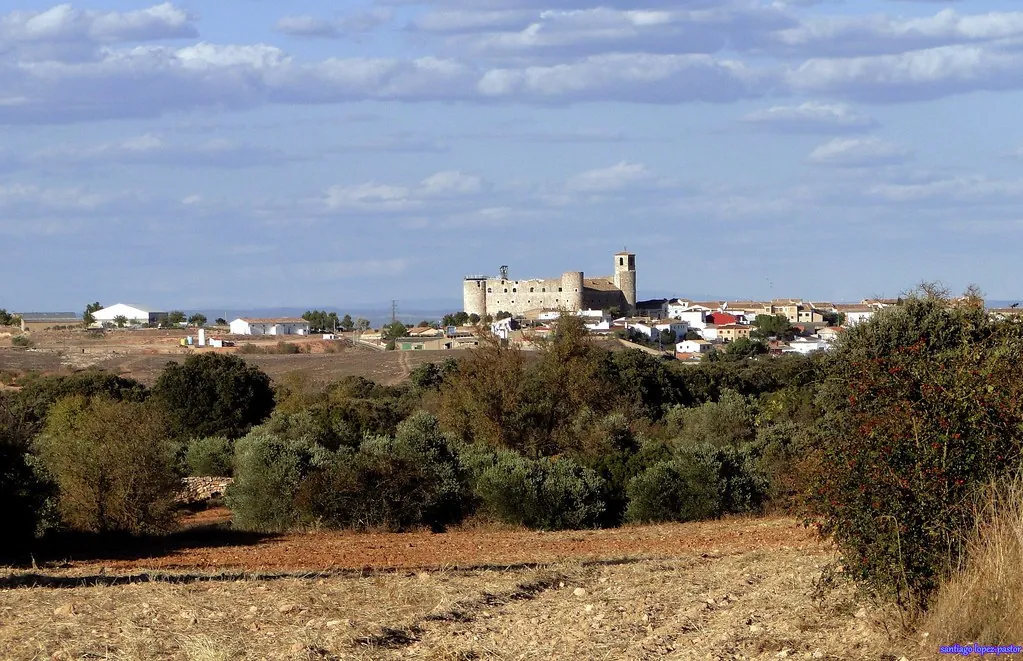
The name Torrubia del Castillo points to a former fortress that once watched over this territory during periods when borders between kingdoms shifted across central Spain. Today, little remains that is clearly visible. If you walk up to the nearby hill, usually indicated by locals without much ceremony, you will find only discreet traces of what stood there and, above all, a wide view of the surrounding land.
From the top, the logic of the location becomes clear. Cereal fields stretch in every direction. An occasional holm oak, known locally as an encina, breaks the line of sight. Agricultural tracks stitch the plots together. It is the classic Manchego horizon, apparently endless, defined more by sky than by buildings.
There is no prepared viewpoint and no information panels explaining the history. You simply stand, look and take in the scale of the countryside. In a region long associated with agriculture and open space, that perspective says as much as any monument.
Ten minutes and you have seen it
The centre of Torrubia del Castillo gathers around a small square where the church of San Andrés stands. Built in stone, with a notably sober tower, it matches the size and character of the village. Nothing about it is monumental, yet it feels proportionate and grounded.
From the square, the main street slopes down and bends between masonry houses, large wooden gates and façades marked by time. Some homes have been restored. Others seem to be waiting for their owners to return in summer or during local festivities. This pattern is common across rural inland Spain, where families often move away for work but maintain ties to their village of origin.
Walking here takes very little time. In fifteen minutes you have covered almost the entire built-up area. That is not a criticism, simply the true scale of the place. Torrubia del Castillo does not offer a long list of sights. Its appeal lies in observing details: the texture of stone walls, the width of a gateway built for farm machinery, the way the street curves with the terrain.
It is a reminder that not every destination needs a full itinerary.
La Mancha, with subtle changes in the land
La Mancha is often imagined as a vast, completely flat plain. Around Torrubia del Castillo, the terrain has a little more movement. Gentle slopes lift and fall between fields. Open farmland alternates with small clusters of encina, adding darker patches to the landscape.
There are no signposted walking routes as such. What you do find are numerous agricultural tracks leading out of the village and disappearing among the crops. For anyone who enjoys walking without too many instructions, or taking a slow drive along dirt tracks, it is easy to spend a while exploring. The experience is less about reaching a specific landmark and more about being out in the open countryside.
It is also a good place to sit for a moment and look at the sky. With very little light pollution, night falls cleanly here. When darkness comes, the sky appears clear and expansive, another facet of rural life that has largely vanished in more densely populated areas.
Festivities and the rhythm of village life
In settlements this small, the calendar revolves around local celebrations. Torrubia del Castillo traditionally marks San Isidro, a saint closely associated with farmers in Spain, as well as other festivities in summer. That is when many former residents return from elsewhere in the country.
During those days, the rhythm changes. There are more people in the streets, music can be heard and tables are set up for shared meals often organised by the neighbours themselves. It is a brief shift from the usual pace. For the rest of the year, life is considerably quieter.
Understanding this seasonal pattern helps to frame what you will find. Outside festive periods, the village returns to its baseline calm. The quiet that greets you on arrival is not staged. It is simply daily life.
Before you go
There is a practical point that is sometimes glossed over in travel articles: Torrubia del Castillo is not set up as a tourist destination.
There are no accommodation options or restaurants in the village itself. Basic services are found in larger towns in the surrounding area. A visit here is usually short, more of a stop along the way than a full-day plan.
With that in mind, expectations fall into place. If you are travelling through this part of Cuenca and are drawn to very small villages that seem almost paused in time, stopping briefly can be worthwhile. It offers a concentrated glimpse of rural Manchego life, stripped back to essentials.
Sometimes that is enough. Park the car, walk for ten minutes, climb the hill, look out over the fields, then continue your journey. Some places work exactly like that. Torrubia del Castillo is one of them.