Full Article
about Tresjuncos
Manchego village known for the Cuenca crime (a court case); surrounded by farmland.
Hide article Read full article
A Village That Doesn’t Perform
Some places feel like a small kitchen where everything is in plain sight and nothing is arranged to impress. Tourism in Tresjuncos works a bit like that. You arrive, park, look around and within five minutes you have a clear sense of what the place is about. Hens somewhere in the background, a few agricultural sheds, quiet streets and a kind of silence that in a city only appears during a power cut.
Tresjuncos sits in the province of Cuenca, within the region of Castilla La Mancha, and has around 250 inhabitants. There is little movement and no signs trying to grab attention. In fact, quite the opposite. The village still revolves around the land, following routines that barely shift with the years: sowing, waiting, harvesting.
At roughly 800 metres above sea level, Tresjuncos is small enough to slow you down whether you mean to or not. A short walk is enough to recognise the same corners. It feels like stepping into a local corner shop where, after a couple of minutes, you already know where everything is.
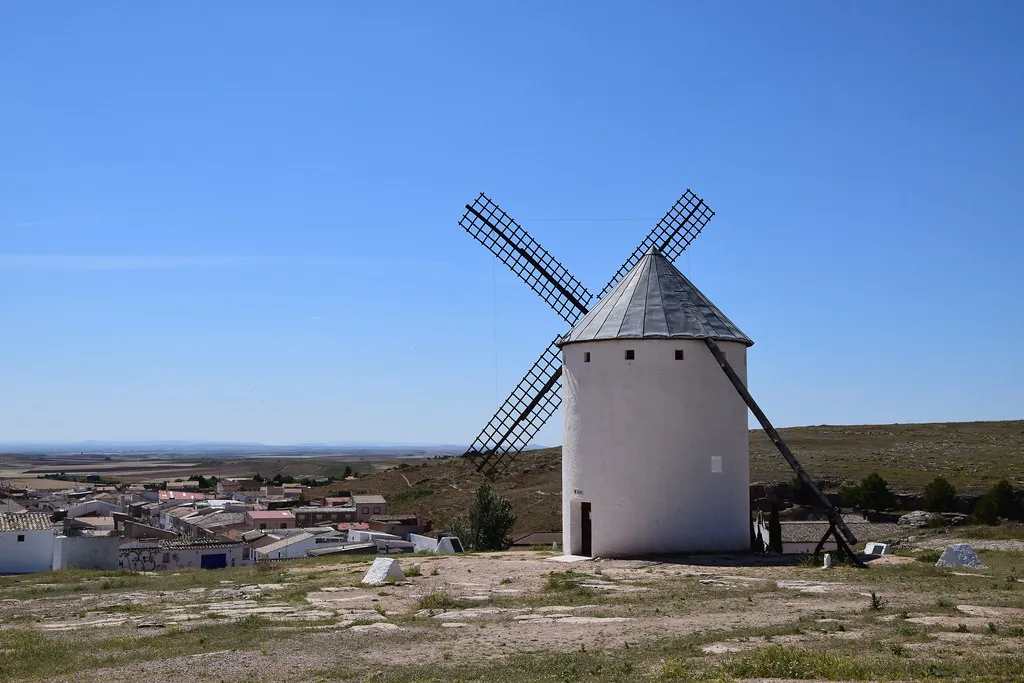
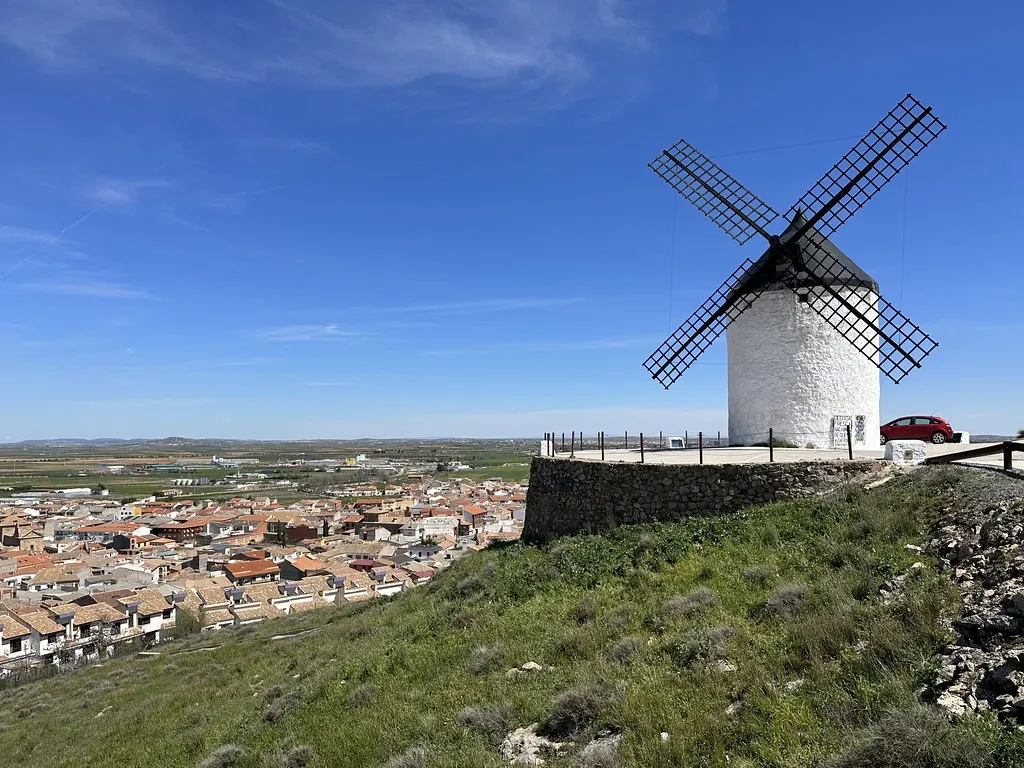
The parish church dedicated to the Asunción stands out most within the village centre. Around it are whitewashed houses, wooden gates and courtyards where farming tools are still stored. There is nothing monumental here. Everything is practical.
Tresjuncos does not try to attract attention. It simply carries on.
The Open Expanse of La Mancha
Step beyond the edge of the village and the landscape opens up at once. Agricultural plains stretch as far as the eye can see. The sensation is similar to looking out at the sea from a very flat beach: a clean horizon and an enormous sky.
Cereal crops remain the most common. Wheat and barley dominate, and the fields shift in colour with the seasons. In spring the greens are intense and fresh. By summer the land turns a toasted shade, almost like fine dust.
When agricultural work is under way, the landscape becomes a little more animated. Tractors move in and out along the tracks, trailers pass by loaded high, and when the ground is dry there is dust hanging in the air.
This is La Mancha in its most direct form. Wide, open, exposed to the weather and defined by the rhythm of cultivation.
Birds and the Sound of Silence
This part of La Mancha is also home to steppe birds, species that thrive in open, treeless plains. For anyone who enjoys scanning the horizon and walking without hurry, there is often something to spot.
Avutardas, known in English as great bustards, share the fields with sisones, or little bustards, and birds of prey such as aguilillas. At times they appear in the distance, like a small boat far out at sea, difficult to identify until it shifts position.
Despite this occasional movement, silence remains the dominant sound. It is broken by farm machinery during busy periods or by the call of an alcaraván, the stone-curlew whose cry carries across the flat land.
There is no dramatic backdrop of mountains or forests. The interest lies in subtle changes: a bird lifting off, a tractor turning at the edge of a field, the wind moving through the crops. It rewards patience more than speed.
Walking the Farm Tracks
There are no signposted routes in the style of a natural park. Instead, wide agricultural tracks leave the village in every direction. They are generally easy underfoot and uncomplicated to follow.
Walking along them feels like taking a long stroll after a family Sunday lunch, simply to stretch your legs. There is no particular objective and no fixed endpoint. The appeal is in the act of walking itself and in the steady repetition of fields and sky.
The light towards the end of the day is often the most appealing moment. As the sun lowers over the plains, shadows lengthen across the soil. For anyone with a camera, this is when those vast Manchego skies come into their own, filling the frame above the flat land.
The setting does not change dramatically from one kilometre to the next. That is part of its character. Tresjuncos offers space to think, to breathe and to adjust to a slower tempo.
Festivities and Village Life
As in many small Spanish villages, the calendar revolves largely around religious celebrations. The patronal festival dedicated to Santa Ana is when much of the year’s atmosphere gathers into a few days.
During this period the main square becomes busier than usual. There are processions, music and neighbours returning to the village to visit family. It resembles the feeling of a large family reunion at Christmas, when suddenly there seem to be three times as many people in the house.
Outside these festivities, social life is quieter. Family gatherings, conversations in the street and the steady pace set by agricultural work define the rest of the year. There is no rush. Daily routines follow the seasons more than the clock.
For visitors unfamiliar with rural Spain, this rhythm can feel markedly different from urban life. Shops and services are limited, and the focus remains on community and the surrounding fields.
Getting There and When to Go
Tresjuncos lies among secondary roads that cross La Mancha through open countryside. Reaching it by car is straightforward, although it is sensible to have enough fuel, as petrol stations are not especially common in this part of the province.
Spring and autumn are generally the most pleasant times to visit. Winter brings a dry cold typical of the central Spanish plateau, while summer can be intensely hot. In both spring and autumn the fields also look quite different, shifting in colour and texture as crops grow or are harvested.
Tresjuncos is not a destination for a long stay. It works better as a short stop, the kind that helps explain how the real La Mancha functions beyond its better-known towns. A pause in a place where daily life continues at a steady pace, closely tied to the land.
Think of it as stepping briefly into a working kitchen where meals are still prepared slowly and without spectacle. In Tresjuncos, life does not hurry, and neither does the village.