Full Article
about Villavaliente
Small farming town with remnants of a Roman road; quiet rural life.
Hide article Read full article
Early in the morning, when the sun is still low, light slips sideways across the main square and settles on the pale stone of the church. The air often carries the smell of fine dust and dry fields, especially in summer, when tractors begin moving before the heat tightens its grip. At that hour, tourism in Villavaliente has little to do with routes or landmarks. It feels more like standing in a small village where the most constant sound is an agricultural engine fading along a dirt track.
Villavaliente lies in the comarca of La Manchuela, in the interior of the province of Albacete. It is one of those very small municipalities where the landscape outweighs the town centre. Around it stretch plots of vines, olive groves and cereal fields that rise and dip gently. The village appears compact in the middle, with short streets and whitewashed façades reflecting the hard midday light.
The pace of village life
The centre revolves around the parish church of San Eduardo. The building is old, its origins usually placed several centuries back, and it has been altered over time. That layered history shows in the walls and in the mix of materials. Inside, the elements are simple: stone, wood and the occasional older feature preserved without much display.
Outside, the square works more as a passing point than as a monumental space. A few benches, irregular shade depending on the hour, and conversations that begin and break off when someone needs to return to the fields. In a village of fewer than two hundred people, almost everything happens on a small scale.
There is no sense of a busy programme or carefully staged attraction. Daily routines set the rhythm. Doors open and close, vehicles pass through briefly, and the quiet returns quickly.
Wine cellars and agricultural roots
In the surrounding area there are still wine cellars dug into the earth or into low hills. They are not always open or signposted, yet they form part of the local wine history. La Manchuela has a long winemaking tradition, and many farmers in the area remain connected in some way to the vine.
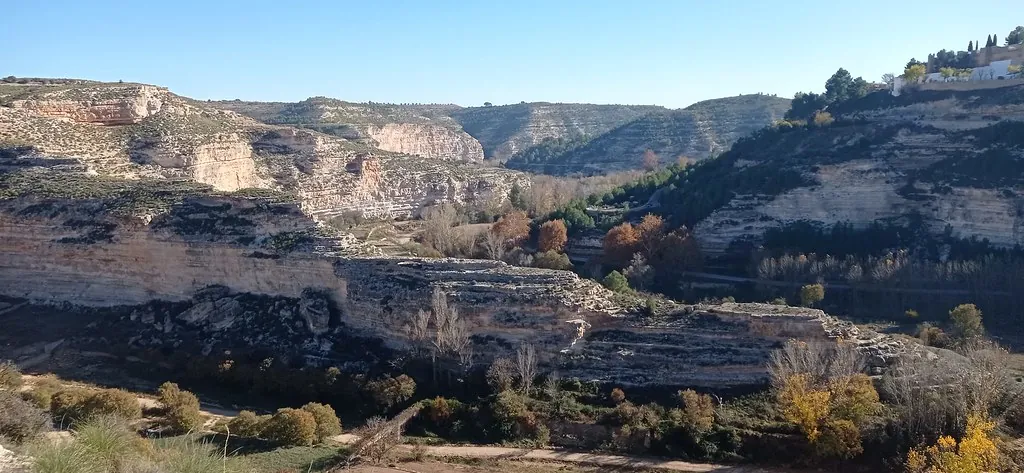
The view from almost any edge of the village explains much of it. Rows of low vines, aligned olive trees and fields that shift in colour with the seasons. In spring, green appears between the furrows. In summer, straw tones dominate the cereal crops and the pale soil.
Agriculture is not a backdrop here but the main framework. The town does not separate itself from the land; it sits within it. Movement in and out of Villavaliente often follows the logic of cultivation, harvests and weather.
Along the farm tracks
Several rural tracks lead out from Villavaliente, used by local residents to move between plots. Walking along them is straightforward because the terrain is fairly open, with gentle slopes and long horizons where the silhouettes of isolated holm oaks or an agricultural building can be seen in the distance.
With a little attention, it is easy to come across partridges, spot a bird of prey gliding overhead or notice hare tracks along the margins of the path. The landscape does not overwhelm with dramatic features. It unfolds gradually, field after field, under a wide sky.
In the hotter months, it makes sense to head out early in the morning or towards the end of the afternoon. Shade is scarce and the sun falls directly here. At midday, light flattens the contours and activity slows. The village can seem almost empty, as if everyone has chosen to wait until the day eases.
Food in this part of La Manchuela
The cooking in this area remains closely tied to what the land has traditionally provided. Hearty dishes appear, such as gazpachos manchegos, a substantial preparation typical of La Mancha, as well as stews made with small game. There are also simple recipes based on flour, olive oil and garlic, ingredients that have long formed the backbone of rural kitchens.
Cured cheeses are common, as is red wine from the comarca. These are not presented as part of a structured gastronomic route. They tend to surface in homes and at family gatherings, continuing a pattern that belongs more to everyday life than to tourism.
Visitors looking for a culinary scene organised around tastings and menus may find something more understated. Here, food reflects continuity rather than reinvention.
When night falls
After dark, stepping a few minutes beyond the built-up area brings a near complete silence. Artificial light is scarce and the sky turns very dark. On clear nights, the band of the Milky Way can sometimes be distinguished with the naked eye.
In summer, it is best to wait until the temperature drops a little. The heat of the day lingers, and the walls of the village continue releasing it for hours. As the warmth finally recedes, the open surroundings become more apparent. The absence of traffic and strong lighting gives the night a depth that is difficult to find in larger places.
Getting there and timing a visit
Villavaliente is located inland in the province of Albacete, within La Manchuela, and is reached by secondary roads that cross open farmland. The journey itself anticipates what awaits: kilometres of cultivation and small villages set far apart from one another.
Arriving in the hottest months calls for some adjustment in pace. Early mornings and evenings are the most comfortable times to move around. At midday, the sun bears down heavily and the village grows quiet.
Tourism in Villavaliente does not revolve around a checklist of sights. It centres on atmosphere, on the relationship between settlement and farmland, and on the way light and temperature shape the day. For those interested in rural Castilla La Mancha beyond its larger towns, this small community in La Manchuela offers a clear sense of scale and continuity, where the fields set the tone and the horizon is never far from view.