Full Article
about Carranque
Known for its spectacular Roman Archaeological Park; a growing municipality near Madrid
Ocultar artículo Leer artículo completo
The Oceanus mosaic stops visitors mid-stride. A ring of sea-creatures, waves and wind gods circles the floor of what was once a Roman dining room; the colours still sharp after sixteen centuries. The guide lifts the tarpaulin roof for thirty seconds, just long enough for the camera shutters, then lowers it again to block the Castilian sun. Welcome to Carranque, where the fourth century lies a metre beneath your shoes.
Most travellers barrel past the village on the A-5 Madrid–Toledo motorway, unaware that the low hill beyond the service station hides one of Iberia’s best-preserved late-Roman villas. The site is compact: a governor’s palace, a basilica and a circular mausoleum, all built around AD 350–400 when this stretch of the Guadarrama valley supplied wheat and wine to imperial troops. Excavations began only in 1983 after a local farmer unearthed coloured tesserae while ploughing; twenty years later the dig opened to the public and the regional government wrapped it in a purpose-built shelter that looks like a giant white caterpillar from the road.
A day returns 1,600 years
Start at the interpretation centre—an oversized hut behind the car park—where scale models explain why the villa faces south towards the river and how under-floor heating channels kept the governor warm in winter. Labels are in Spanish only, but the staff hand out A4 English sheets and, more importantly, sell tickets for the hourly guided tour. Without the guide the ruins are simply low stone walls; with her you learn that the dolphins in the mosaic swim in the direction guests walked to reach the triclinium, and that the broken marble in the atrium came from Carthage, paid for with local olive-oil taxes.
The tour lasts 75 minutes and ends at the nymphaeum, a sunken garden once fed by the Guadarrama and now a quiet pool of green water guarded by terrapins. From here a dirt track leads back towards the modern village, 5 km away across wheat fields. The walk takes an hour, shaded by poplars and noisy with goldfinches; in July you’ll need repellent because the river breeds mosquitoes the size of 50-cent coins.
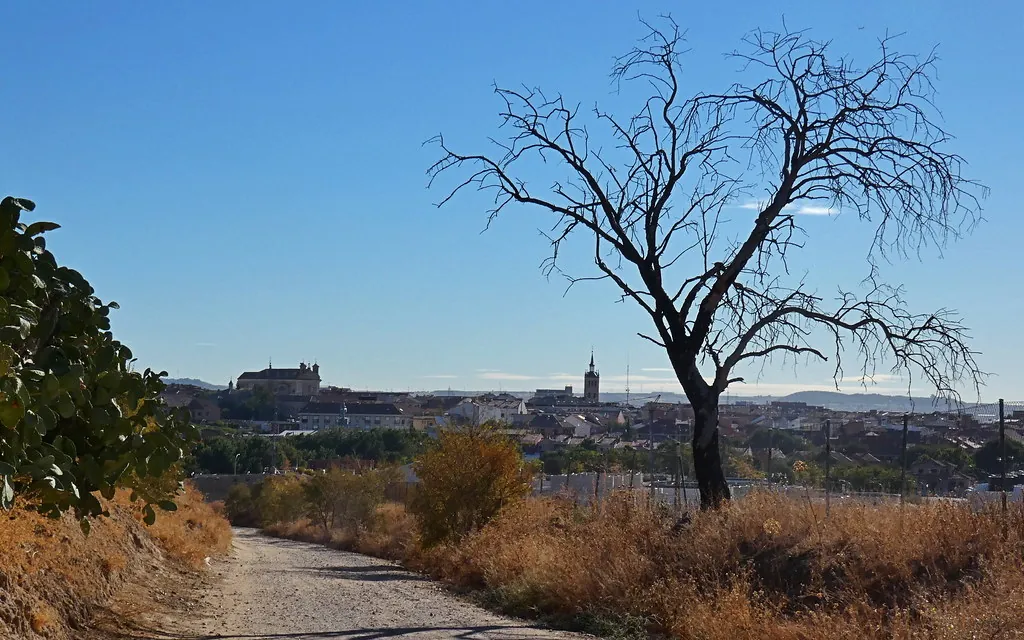
Back in the village centre life returns to the present. Carranque’s 5,000 inhabitants cluster around the Plaza de España, a rectangle of brick houses with wooden balconies painted burgundy and bottle-green. The sixteenth-century church of Nuestra Señora de la Natividad closes at lunchtime; ring the bell marked “sacristán” and a caretaker will let you in for a euro. Inside, the smell is of wax and old stone, the nave lined with sober Renaissance altarpieces paid for by wool merchants when La Mancha clothed half of Europe.
Flat land, big sky
Elevation here is 665 m, high enough to shave three degrees off Madrid’s summer furnace yet too low for the sharp mountain cold of nearby Montes de Toledo. The result is an easy climate from March to May and late September to early November—ideal for the riverside paths that fan out from the village. Cyclists follow the signed “Ruta de la Sagra”, a 35-km loop on farm tracks between Carranque and Borox; walkers can simply follow the Guadarrama upstream to the abandoned watermill at Vega del Jarama and back (8 km, 2 h). Maps are available from the tourist office, open weekday mornings inside the town hall, but the routes are obvious: keep the river on your right and the cereal silos on your left.
Food is sturdy Castilian fare. Hotel Comendador, the three-storey ochre building on the main street, dishes up a three-course menú del día for €16 that might start with garlic soup and finish with torrijas—bread soaked in milk, fried, then sprinkled with cinnamon, essentially Spain’s answer to bread-and-butter pudding. Locals eat at 15:00; arrive earlier and the dining room is yours, the television muttering a bullfight in the corner. If you want a picnic for the ruins, the bakery opposite the church sells Manchego cheese wedges and oval loaves that stay fresh for two days, useful because the archaeological site has no café, only a vending machine that swallows coins and rarely gives change.
Practicalities without the pain
Getting here requires wheels. From Madrid Barajas the hire-car desks are a ten-minute shuttle ride; follow the A-5 west for 50 minutes and leave at exit 56. The last 6 km wind through melon fields and past a solar farm whose panels blink like motorway mirrors. There is no railway: the closest station is in Illescas, 15 km away, but taxis are scarce and the €25 fare wipes out the saving on fuel.
Entry to the Roman park costs €6, plus €2 for the guided visit in English (Saturdays 12:00 only, book 15 min ahead). Opening hours shrink in winter—10:00-14:00 and 16:00-18:00 Tuesday to Sunday—but extend an hour either side from April to September. Monday is always closed; turn up then and you’ll see nothing but a locked gate and a notice telling you to try again tomorrow.
Crowds are rarely a problem. Even on Easter Saturday you’ll share the mosaics with perhaps thirty people, most of them madrileños ticking off another regional site. August brings heat, not humans: temperatures can reach 38 °C and the metal roof turns the shelter into an oven, so the management shortens tours and hands out water. Winter is mild—daytime 12-14 °C—but river mists can swallow the valley for days and the site feels forlorn.
Stay, or scurry back to Toledo?
Carranque has two small hotels and a handful of village houses signed up as casas rurales. Beds are clean, prices hover around €55 for a double, and the night sky delivers stars you forgot existed. Yet most British visitors treat the village as a half-day add-on to Toledo, 35 km south-east. The logic is sound: after the final tour at 13:00 there is little to do except walk the riverbank or drink coffee in the plaza while swifts wheel overhead. Drive back to Toledo for the cathedral, synagogues and a choice of rooftop bars; Carranque will have done its job—showing you a patch of Roman Spain without the crowds of Mérida or the ticket queues of Segovia.
If you do linger, time your visit for the third weekend in July when the town stages its Jornadas Romanas. Legionaries in replica armour march past the bakery, a stall sells honeyed wine, and children throw fabric “rocks” at a cardboard Carthaginian ship. It is faintly ridiculous, thoroughly Spanish, and the nearest most of us will come to dining with dolphins under Oceanus’s watchful eye.