Full Article
about Casarrubios del Monte
Historic town with castle and wall remains; major sport airfield nearby.
Ocultar artículo Leer artículo completo
The thermometer on the pharmacy wall already reads 38 °C at eleven o’clock when the church bell tolls once—half-heartedly, as if even the metal is drowsy. A Yorkshire terrier collapses under a bench in Plaza de España and stays there until the shadows lengthen. This is Casarrubios del Monte on an ordinary July morning, 616 m above sea level, 47 km south-west of Madrid, and still stubbornly alive in spite of the heat.
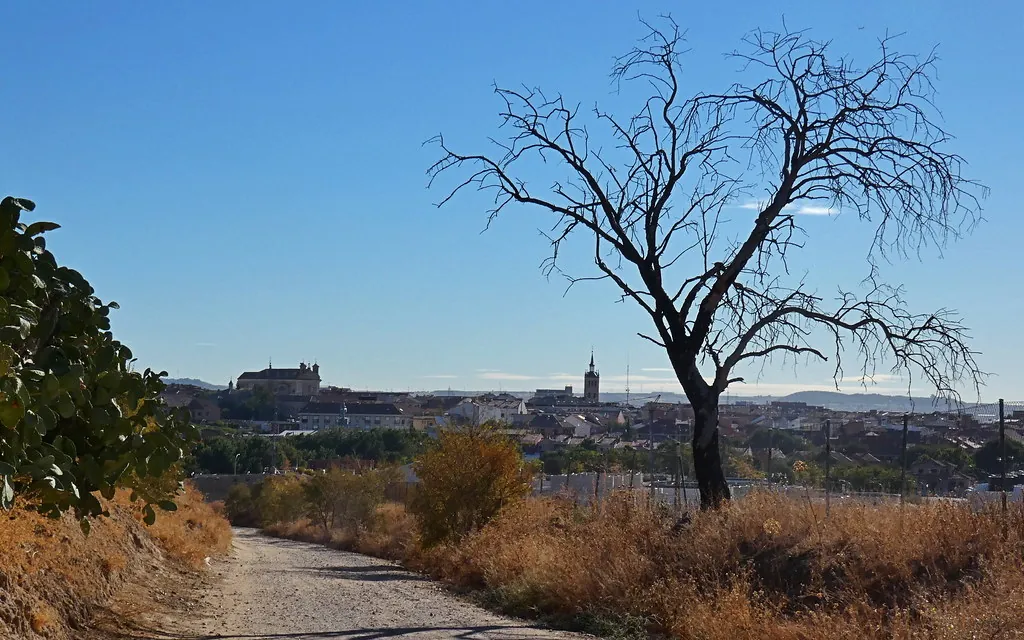
Six thousand-odd souls live here, enough to keep butchers, bakers and a single small Día supermarket in business, yet few guidebooks mention the place. Tour buses sweep past on the A-5, bound for the marble-cold cathedrals of Toledo. Those who do exit the motorway find a grid of sandy-coloured streets that ends abruptly in wheat fields. The horizon is so wide that clouds cast shadows the size of counties; the sky feels bigger than the town itself.
Stone, Brick and a Hint of Nobility
Start at the Iglesia de la Asunción, a sixteenth-century hybrid of brick-Gothic and sober Renaissance that squats in the centre like a referee between past and present. The tower is pure Castilian—plain brick relieved only by a small stone cross—yet inside you’ll find a delicate rib-vaulted ceiling and a single Baroque chapel smuggled in during the 1700s. Opening hours are elastic; if the door is locked, try the house opposite with the brass door-knocker—Antonio keeps the key and is happy to unlock for strangers, though he speaks no English and expects a euro in the donation box.
Round the corner stands the Palacio de Ugena, now partitioned into flats but still wearing its coat-of-arms above the doorway. You can’t go in, yet the façade tells a story: carved laurel leaves for victory, five roundels for the five original lordships, a worn griffin that once warned off tax-dodgers. Walk another three minutes—everything is three minutes here—and you reach the Rollo de Justicia, a squat stone pillar where petty criminals were chained in the eighteenth century. It’s less photogenic than a pillory, more honest than a souvenir shop.
The old town is only eight streets by six, perfect for a slow shuffle that reveals lime-washed houses the colour of buttermilk and timber doors painted the deep green you see on Spanish trains. There are no postcards racks, no multilingual menus, just the smell of bleach from weekly doorstep scrubbing and, at dusk, garlic frying in olive oil drifting through open windows.
Heat, Wheat and the Occasional Cold Beer
Outside the urban core the land opens into a checkerboard of cereal fields and olive groves. The GR-124 footpath skirts the village for 11 km on its way to the ruins of Castillo de Aulencia; you can walk an out-and-back section before lunch if you start at seven and carry two litres of water. The route is flat, stony and shade-free—more Saskatchewan than Surrey—yet skylarks provide the soundtrack and you’ll meet more tractors than people.
Cyclists appreciate the same grid of country lanes: tarmac smooth, traffic negligible, gradients gentle enough for hybrid bikes. A circular 35 km loop eastwards passes an abandoned wheat silo painted with a fading Franco-era slogan and two roadside bars that open at 06:30 for farm workers’ brandy. Bring cash; neither card machine works.
Summer is fierce. Between mid-June and early September thermometers can touch 42 °C, hot enough to warp candle wax inside a parked car. The village obeys the siesta without apology: shops close at 14:00, shutters slam, streets fall silent. Plan accordingly—venture out before ten or after six, and keep a wide-brimmed hat in the boot. Spring and autumn repay the effort: April poppies smear red across the wheat, while late-October stubble glows bronze under lowering skies that wouldn’t look out of place in East Anglia.
Roast Lamb and Manchego that Bites Back
Food is village-level prices, not city mark-ups. Mesón La Reja, on Calle del Medio, serves cordero asado in portions designed for two but happily split on request. The lamb arrives blistered from a wood-fired oven, skin crisp as pork crackling, interior soft enough to spoon. Expect €18 per person including a shared plate of pisto manchego—Spain’s answer to ratatouille—and half a litre of local white wine served ice-cold in a chipped terracotta jug. Vegetarians survive on tortilla de calabacín and the occasional goat’s-cheese salad; vegans should self-cater.
For picnic supplies, Quesos La Sagra on the main road stocks three-month-cured Manchego that carries a faint peppery bite. Ask for a vacuum-sealed wedge if you’re hand-luggage only; security at Madrid regards cheese as a liquid, so keep it under 100 g or surrender it to an irritated guard. The same shop sells membrillo (quince paste) and tiny jars of saffron at half London prices—worth the suitcase space.
Coffee culture is resolutely Spanish: breakfast at 08:00 means a cortado and a croissant the size of a slipper, consumed standing at the bar. By 10:30 the same bar morphs into a betting shop for older men studying racing forms; by 19:00 it’s a family venue where children chase footballs between tables. Service is courteous but unhurried—waitstaff do not hover with card machines, and tipping a euro or two is appreciated.
Fiestas, Fire and a Night-time Boom
Visit in mid-August and you’ll collide with the fiestas de la Virgen de la Asunción. The programme tacked to the church door promises nightly verbenas (open-air dances) beginning at midnight despite the heat. Bring earplugs; the bass from a single loudspeaker can travel two kilometres across the plain. On the final day a firework nicknamed the terremoto (earthquake) is let off in Plaza de España at 03:00—car alarms weep, dogs bark, babies miraculously sleep through it all. Accommodation within the village is impossible unless you booked in March; nearby Navalcarnero has motel-style lodges with pools and triple-glazing.
January brings the humbler hogueras de San Antón. Bonfires flare on street corners, and owners bring dogs, goats and the occasional Shetland pony to be blessed with holy water that freezes almost on contact. The air smells of pine smoke and wet fur; afterwards, locals disappear inside for bowls of chocolate a la taza thick enough to stand a churro upright. British visitors often find this the more authentic event precisely because nothing is staged for them.
Getting There, Staying Sane
No railway station, no coach stop, no Uber. Fly to Madrid, collect a hire car at Terminal 1 and head south-west on the A-5 for 45 minutes (toll-free). Petrol is cheaper at the Repsol just outside the airport than on the motorway. If you arrive after dark, beware: the final exit is unlit and Google Maps occasionally underestimates the roundabout’s circumference.
Accommodation is limited to about ten Airbnb properties, mostly entire cottages with tiny plunge pools and patchy Wi-Fi. Nightly rates hover around €70–90, cheaper than any Madrid two-star. Book early for April-May and September-October when Spanish families use the village as an overspill for commuter-belt weddings. Camping is theoretically possible at the municipal site south of the sports ground, but facilities are basic—cold showers, no card payments, and a gate that locks at 22:30 sharp.
Should you need an English-speaking doctor, Quirónsalud in Navalcarnero (15 min drive) operates a 24-hour urgencias unit. Pharmacies closer to home close for lunch; remember the word paracetamol is the same in Spanish, though pronounced with four syllables.
The Honest Verdict
Casarrubios del Monte will not change your life. It offers no Michelin stars, no ancient synagogues, no boutique hammams. What it does provide is a low-stakes introduction to interior Spain at slow motion: bread fresh at seven, wine poured without ceremony, skies that graduate from eggshell blue to bruised violet without anyone reaching for a phone. Come for two nights en route to somewhere grander, stay three if you crave silence loud enough to hear wheat rustle. And if the August heat or the January smoke doesn’t suit you, simply roll down the car windows, rejoin the motorway and let the horizon shrink back to a more British scale.