Full Article
about Chozas de Canales
A La Sagra town with notable growth; its church and the Riachuela stream setting stand out.
Ocultar artículo Leer artículo completo
The 5 a.m. intercity coach from Madrid drops off twenty-odd passengers beside a shuttered bakery. By half past, most have vanished into new-build flats, laptops tucked under their arms, ties already straight. Thirty kilometres north of Toledo, Chozas de Canales earns its living as a dormitory for the capital, yet the census still lists “cereal farmer” as a profession. That split personality—spreadsheet by day, furrow by dusk—gives the place its traction.
At 557 m above sea level the village sits just high enough for the Guadalquivir basin’s heat to lose its edge. Summer nights fall to 22 °C while Madrid still swelters at 30 °C; in January the thermometer can dip below –5 °C and the surrounding vines are pruned back to knuckles. Frost fans whirr in the vineyards like low-flying helicopters, the only mechanical sound after the last bus leaves.
A grid for walking, not for monuments
Start in Plaza Mayor, a rectangle of granite slabs the colour of wet sand. There is no ayuntamiento balcony, no baroque façade—just benches, a modest church door and the smell of bleach from the morning mop. The Iglesia de San Juan Bautista opens at 7 p.m. for mass; arrive earlier and the sacristan will let you in if you ask at the adjacent house, number 14, where the doorbell is cracked. Inside, the retablo is gilded with ochre rather than gold, a Castilian understatement that extends to the rest of the town.
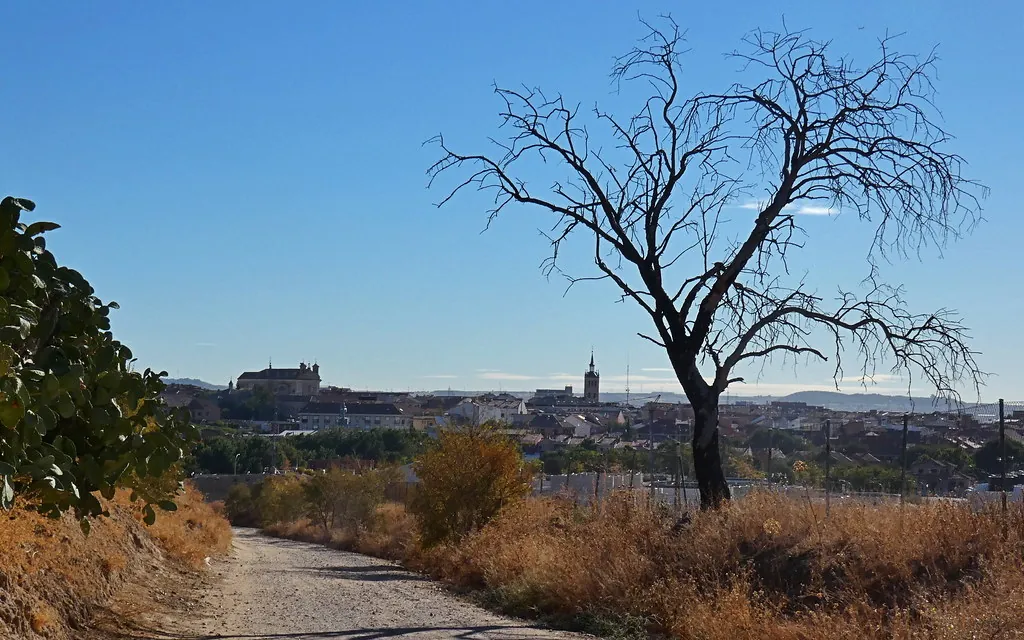
Walk east along Calle Real and the houses shrink: modern brick with ceramic crests beside 1930s adobe whose walls bulge like well-risen loaves. At the far end the tarmac simply stops; a camino of compacted earth carries on between olive groves. This is where the commuter belt dissolves into La Sagra’s cereal ocean—no ticket office, no interpretation board, just a horizon that flatters the sky.
Pedal power on loam
Flat terrain and negligible traffic make Chozas an accidental cycling hub. Hire bikes in Toledo (Avenida de Castilla-La Mancha, €25 a day) and follow the CV-410 shoulder north; after 14 km swing right onto the TO-3188, a single-lane road where wheat brushes your elbows. The loop south to Palomeque and back is 28 km, no gradient steeper than a motorway bridge. Take water—there are no fountains between villages and the only bar in Cedillo del Condado keeps erratic hours.
Mountain bikers hoping for rocky single-track will be underwhelmed; the interest is ecological. Crested larks rise from tyre tracks, and on calm evenings partridges scurry across the path like wind-up toys. September brings harvest dust that hangs in bronze shafts; by December the same fields are green corduroy, the soil so dark it reflects clouds.
What lands on the plate
Lunch options are slim. Bar Central (Calle del Medio, opens 7 a.m.–4 p.m.) does a three-course menú del día for €12: migas crowned with a runny quail egg, followed by cuchara stew thick enough to support a spoon upright. Ask for the wine from nearby Bargas; it arrives in a plain glass bottle with a handwritten label and costs €2.50 a half-litre—less than the bottled water.
Saturday morning produces a pop-up cheese stall beside the post office. The vendor, María Jesús, slices semi-curado Manchego so young it still squeaks; buy a quarter wheel (€14) and she’ll vacuum-pack it for the flight home. If you’re self-catering, the Supermercado Miguel stocks local chato beans, the size of marbles and perfect for slow-cooking with bay and morcilla.
When the village lets its hair down
Fiestas here obey the agricultural clock. The main burst comes around 24 June for San Juan. Temporary bars nailed from plywood open at 11 p.m.; cuevas (temporary basement discos) pump 90s Europop until the generators cut out at 5 a.m. Visitors are welcome but accommodation is non-existent—most revellers sleep in cars or catch the 6 a.m. bus back to Madrid, smelling of gunpowder and anise.
Mid-August adds five nights of verbenas in the same square. British visitors often misread the poster: “Gran Sardinada” promises grilled sardines, not a rock band. Queues stretch 40 minutes; the fish are served on newspaper with bread and cost €3.50 a portion. Bring cash—card machines short-circuit in the heat.
The practical grit nobody mentions
Getting here without a car: take the high-speed AVE from Madrid-Puerta de Alego to Toledo (33 min, £20 off-peak), then a taxi (£30 fixed price) or the once-daily rural bus at 15:40 that deposits you by the bakery at 16:15. Miss it and you’re stranded until the following afternoon.
Where to sleep: there isn’t a hotel, B&B or even a campsite. The nearest beds are in Bargas (Hotel Beatriz, £65 a night, functional) or Toledo’s old quarter (15 minutes farther, triple the price). Most day-trippers time their arrival for late morning and leave on the 19:30 coach.
Weather warnings: Easter can be idyllic at 24 °C or arctic with sleet; pack a fleece even in May. July and August hit 40 °C by noon—sightseeing is best finished before the church bell strikes ten.
Money: the only cash machine belongs to Caja Rural and occasionally refuses foreign cards. Bring euros; the pharmacy cannot swipe plastic for sun-cream.
A parting shot
Chozas de Canales will never feature on a “Top Ten Spanish Villages” list. It offers no castle, no hammam, no infinity-pool boutique. What it does provide is a calibrated antidote to the costa-and-cava circuit: a place where bread is baked at 4 a.m., where the mayor drinks cortados with delivery drivers, and where the loudest noise at night is a tractor cooling down. Turn up expecting postcard Spain and you’ll leave within the hour. Stay long enough to see the same commuters wave the bus driver good-night, and the village starts to make a different kind of sense—one spreadsheet and furrow at a time.