Full Article
about Viso de San Juan (El)
Expanding municipality with housing developments; Olmos castle within its boundaries.
Hide article Read full article
The tower on the plain
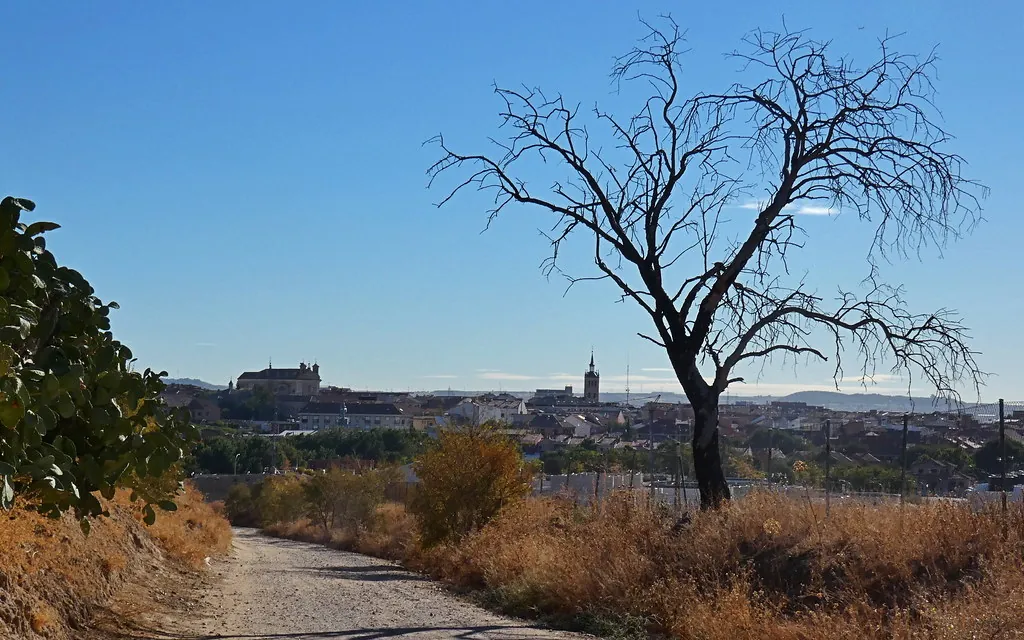
From the road, the land around El Viso de San Juan is flat. Wheat and barley fields stretch to the horizon, broken only by the occasional line of poplars. The rise is subtle, more of a gentle slope than a hill. Halfway up, the ruined tower of the Castillo de Olmos becomes visible. It is a stark, rectangular shape against the sky, built to watch over the plains of La Sagra. Tenth-century Andalusi chronicles note that the army of Caliph Abderramán III camped here. The fortress they knew is gone, but this later tower still holds the high ground.
A name that explains the place
El Viso de San Juan translates directly to ‘The Viewpoint of Saint John’. The ‘viewpoint’ is the geographical fact: a slight elevation above the fertile plain. ‘Saint John’ refers to the Order of the Hospital of Jerusalem, which took control of this settlement during the 12th-century repopulation. For centuries, this was a frontier outpost between Toledo and territories to the south. The castle’s strategic purpose faded after its reported destruction in 15th-century noble conflicts. The population gradually moved downhill, closer to the water and the farmland that sustained them.
The church and the washhouse
The parish church of Santa María Magdalena stands on the original higher ground. Its structure has been altered many times. In the 19th century, unstable vaults were replaced with a wooden roof framework. Look in one of the side chapels and you will find baptismal fonts carved from repurposed Roman capitals, a quiet nod to layers of history. The churchyard served as the local cemetery until public health decrees in the 1800s forced its relocation outside the town.
The functional heart of daily life was lower down, at the public washhouse known as El Pilar. Stone basins sit by a spring-fed trough. Here, well into the last century, women washed clothes and exchanged news. It was a working space, not a decorative one. The main square today shows a mix of periods, dominated by a late-20th century town hall that borrows vaguely from traditional forms.
Marking the year
The local calendar follows an agricultural rhythm. In mid-May, the festival of San Isidro Labrador involves a romería, a procession into the fields for a shared meal. The July festivities for Santa María Magdalena, the patron saint, fill the streets with bull runs and evening dances.
Two other events anchor the community. At the start of autumn, the image of the Cristo de la Buena Muerte is brought down from its hermitage into the town. And on the night of San Juan, bonfires are lit near the old washhouse, a practice that marks the summer solstice.
Walking to Olmos
To understand this landscape, walk it. The most direct path to the Castillo de Olmos follows farm tracks through cereal fields. The climb is steady but not difficult. From the base of the tower, the view justifies its purpose: a complete panorama of the Guadarrama valley and the roads across La Sagra.
The plains themselves are crossed by a network of dirt paths. The walking is flat and open. At dawn or dusk, you might see flocks of steppe birds near fallow plots or irrigation ditches. In the direction of Valdemajuelo, a 19th-century livestock fountain bears a carved verse commemorating its construction. It is a simple rhyme about water, which has always been measured carefully here.
Food from the pantry
The traditional cuisine reflects a pantry built for winter. It centres on the matanza, the annual pig slaughter. Gachas, a thick porridge of wheat flour, paprika, and pork, is a typical cold-weather dish. Tortas de chicharrones, made with cracklings, can be sweet or savoury depending on the family recipe.
Queso de olla, a cheese cured in earthenware pots, is still produced locally. For festivals, especially the romerías, you will find pestiños – fried pastries dipped in honey – and other sweets that have changed little over generations.