Full Article
about Esquivias
Where Cervantes married and lived; it preserves the writer’s Casa-Museo and a literary atmosphere.
Hide article Read full article
An afternoon shaped by light
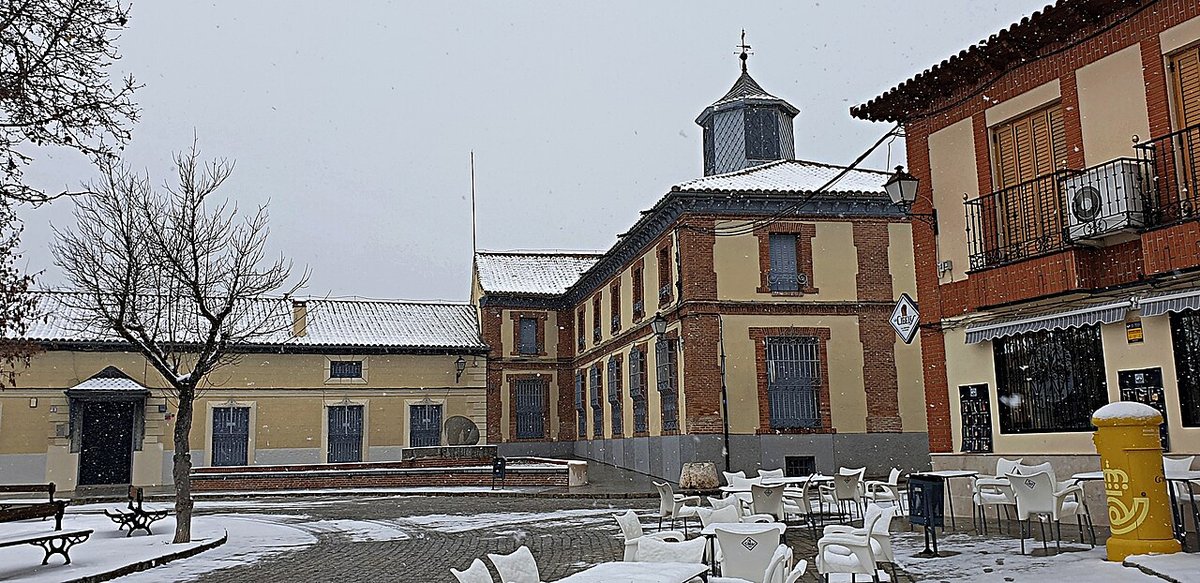
At around four in the afternoon, Esquivias settles into a particular kind of light. It falls flat and golden across the pale façades of the main square, the same hard light that defines the wider Sagra region. When a car passes slowly, dust lifts from the road and hangs for a moment before drifting away.
Up on the church tower, storks clatter their beaks, the hollow sound carrying down to street level. The air often carries the smell of fresh bread mixed with warm earth. Beneath the ash tree in the Plaza Mayor, neighbours talk without hurry, following a rhythm that belongs to places where time still leans more on daylight than on the clock.
This is not a village that tries to impress at first glance. Its atmosphere builds quietly, in small details and repeated gestures, in the way the day unfolds rather than in any single landmark.
A marriage that left its mark
In December 1584, Miguel de Cervantes married Catalina de Palacios in the church of Santa María. He was thirty-seven at the time, already trying to make a name for himself in Madrid by writing plays. She was just seventeen, part of a well-off family rooted in this wine-growing village.
That connection is still present today. The Casa Museo recalls the episode, preserving the dowry contract and recreating several rooms with period furniture. In the bedroom, the bed is low and narrow, covered with thick woollen blankets. There is a faint scent of polished wood and old walls, something shared by many houses of this kind in the area.
Guides often explain that Cervantes himself only stayed here for short periods. Catalina, by contrast, spent much of her life in Esquivias. The story is less about a writer settling down than about a link between a well-known literary figure and a place that continued on at its own steady pace.
The village does not turn that connection into spectacle. It remains part of the background, something acknowledged rather than overstated, woven into daily life rather than set apart from it.
Vines and the character of the Sagra
Esquivias has long been tied to wine. Documents from the sixteenth century already refer to the quality of its vineyards, and for centuries cultivation formed one of the foundations of the local economy.
Traditionally, people spoke of a robust red wine, dark in colour and made to endure long journeys rather than to be drunk young. That practical approach reflects the conditions of the land and the needs of earlier trade, when durability mattered as much as flavour.
The vineyards still surround the village today, especially across the gentle hills that open out into the Sagra countryside. The landscape is broad and agricultural, with subtle changes in colour as the seasons shift.
At the end of summer, the start of the grape harvest brings a noticeable change in the air. There is the smell of split grapes and fermenting must, a scent that lingers in streets and courtyards. Much of the production now goes to wineries elsewhere in the province, though some residents continue to make small quantities for themselves. This often happens in private patios or in old family wine presses that have been adapted over time.
The result is a living tradition rather than a staged one. Wine here is still part of everyday life, even as its role has evolved.
The rollo de justicia and the life of the square
In the Plaza de España, close to the town hall, stands the rollo de justicia erected in the sixteenth century. These stone columns were once symbols of legal authority, marking places that held their own jurisdiction.
This one differs slightly from many others in Castile. It does not end in a cross. The top is broken and rounded, and local tradition says it was struck by lightning centuries ago, leaving it in its current shape.
In the past, such structures were used to make ordinances public and to expose those who had been sentenced. The meaning was clear and visible, rooted in authority and control.
Today, the scene around it has shifted completely. Children cross the square with footballs, bicycles rest against benches, and neighbours stop to talk before moving on. The stone remains, but its presence now sits alongside everyday routines that have nothing to do with its original purpose.
The contrast is part of what defines Esquivias. Historical traces are not isolated or elevated. They share space with ordinary life, quietly absorbed into it.
Storks, open land and the rhythm of the year
Storks return to Esquivias towards the end of winter, reclaiming nests on the church and on some of the taller buildings. They spend their days moving between the village and the surrounding fields, tracing regular paths across the sky.
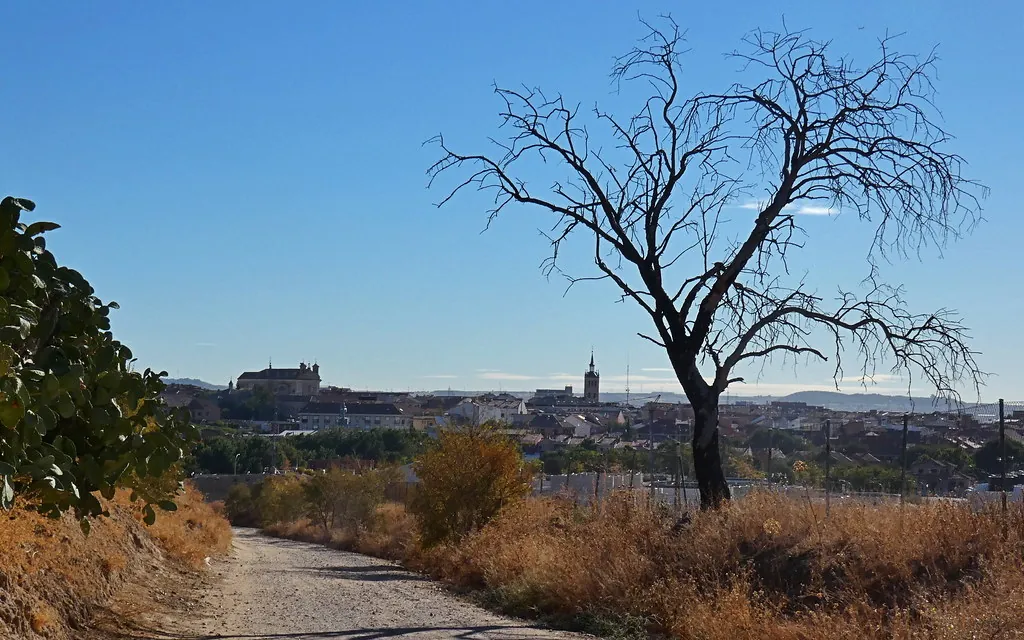
A short walk from the centre leads to the small rise known as the Calvario. From there, the setting becomes clear at a glance: reddish rooftops below, and beyond them a wide agricultural plain that shifts in tone depending on the season.
Summer brings intense heat from midday onwards. Walking through the village is more comfortable early in the morning or later in the afternoon, when the shadows begin to stretch along the streets. August is the liveliest month, with the celebrations of San Roque drawing more activity into the streets. Outside that period, the atmosphere tends to return to its usual calm.
Food follows the same seasonal rhythm. In many homes, gazpacho manchego appears when the weather cools. Despite the name, it has nothing in common with the cold Andalusian soup. Here it is a hot dish made with game meat and pieces of torta cenceña, a type of flatbread. At the end of a meal, sheep’s cheese with thyme honey sometimes makes an appearance, a simple combination that pairs naturally with the strong wines of the area.
The approach is consistent across the village: few ingredients, shaped by the surrounding countryside. Nothing feels elaborate, yet everything reflects the land it comes from.
Esquivias does not rely on spectacle or grand statements. Its identity sits in light, in routine, in the quiet continuity of things that have been done the same way for generations.