Full Article
about Illescas
Capital of La Sagra and major logistics hub; home to El Greco works in the Santuario de la Caridad
Hide article Read full article
At four in the afternoon, when the heat of La Sagra really presses down, the church of Santa María holds a dense shade that smells of warm stone and old wax. Light slips in through the upper openings and breaks across the wooden ceiling, leaving golden patches on the red brick. In one corner there is almost always someone looking upwards, not entirely sure what they are seeing. It happens often in Illescas: people arrive in search of El Greco, cross the square quickly, and barely notice what surrounds them.
If you crouch near the old entrance to the portico, the patterns in the Mudéjar brickwork come into clearer view. They have been there for centuries, quiet and understated, and few people pause long enough to really take them in.
El Greco and the far-sighted cardinal
The Hospital de la Caridad was founded at the beginning of the 16th century on the initiative of Cardinal Cisneros. The paintings by El Greco arrived much later, when the artist was already in the final years of his life. Inside, several canvases linked to the Virgen de la Caridad are preserved. The largest fills the main altarpiece.
The room is usually kept in fairly low light to protect the paintings. Approaching slowly, the colours begin to emerge bit by bit: the cool blues of the background, the deep reds of the robes. In one of the scenes, the painter’s own face can be recognised, slightly tired, looking out towards the viewer.
At the beginning of June, the image of the Virgen de la Caridad is carried in procession down from her sanctuary. During those days, the rhythm of the town shifts, and in the hospital the paintings are often covered with cloths. It is an old custom that still continues.
Five centuries in brick and lime
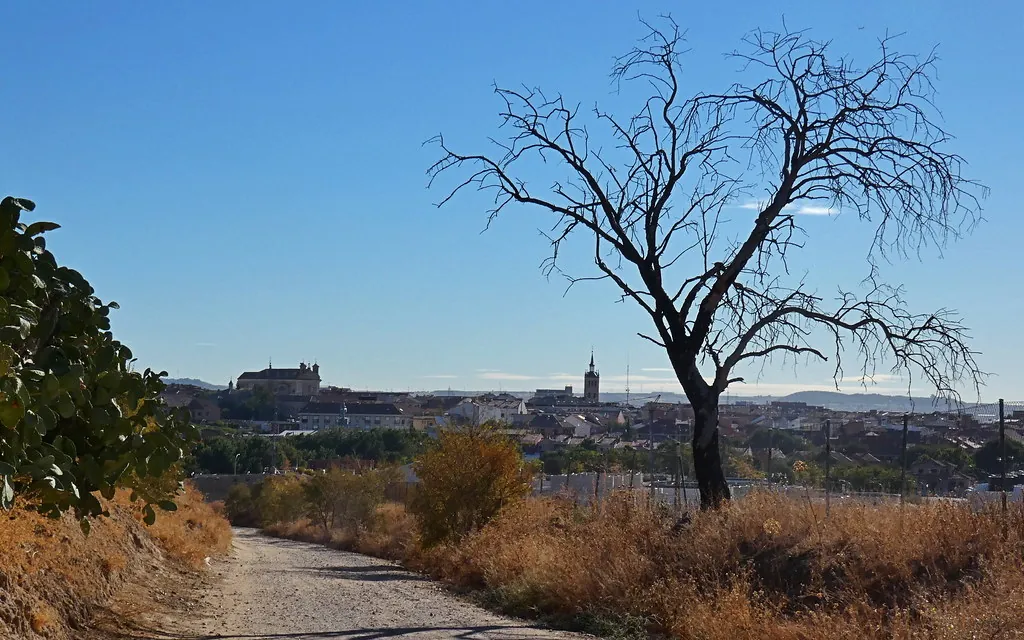
The tower of Santa María, often called La Giraldilla by locals, can be seen from almost anywhere in the old centre. Climbing it means taking a narrow wooden staircase, its steps worn smooth by decades of use. Halfway up, the sound of pigeons nesting among the beams usually slips in.
At the top, the view opens out over the plain of La Sagra. On clear days, the line of the motorway towards Madrid can be made out, along with the surrounding farmland.
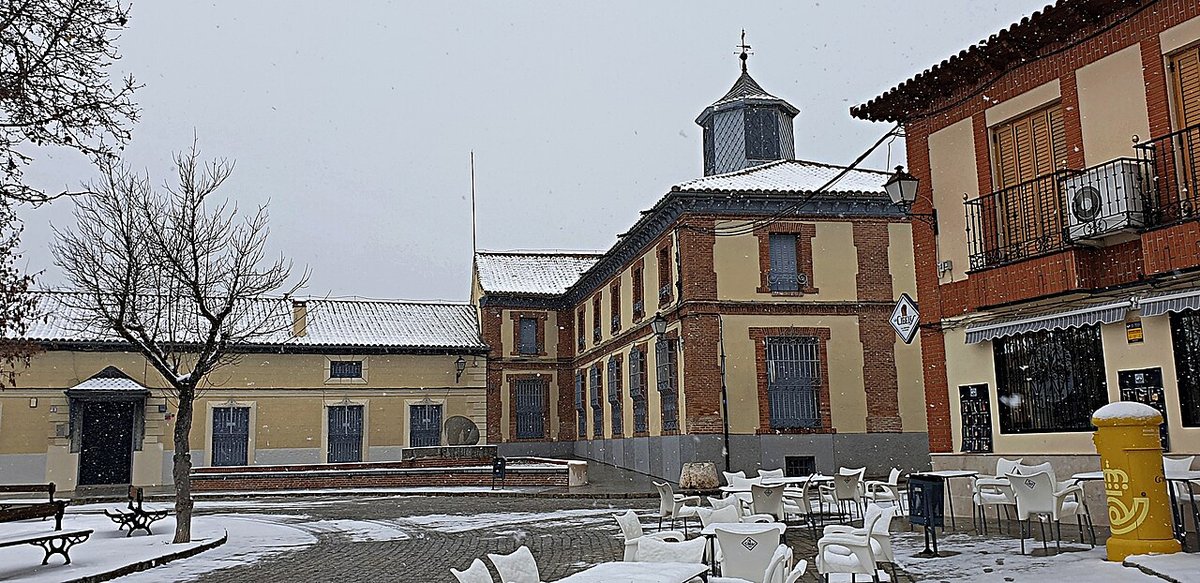
Calle Real keeps several large houses from the 17th and 18th centuries. Some reveal the brick beneath the limewash, flaking under the sun and the dry winters. The town hall occupies a building that was once a prison; the heavy bars on the lower windows are still easy to spot.
Early in the morning, around eight or so, the centre is quiet. The heavy flight of storks from the bell tower can be heard, along with the metallic rattle of shop shutters being lifted.
Fresh oil and home cooking
The surrounding area remains closely tied to olive growing. During the milling season, freshly pressed oil comes out cloudy and a deep green, with that slight burn at the back of the throat that marks it as new.
In many homes, cooking still follows recipes rooted in the countryside. When the colder months arrive, hearty spoon dishes appear, such as gazpacho manchego, which here has nothing to do with the Andalusian version. It is prepared with game meat and pieces of torta de pastor, a type of flatbread that soaks up the broth.
Bread tends to arrive at the table without being asked for, still warm on some mornings. It is a simple habit repeated in many bars across the town.
When to go and what to expect
At the beginning of June, during the festivities of the Virgen de la Caridad, Illescas becomes much busier than usual. There are processions and a noticeable atmosphere in the streets. Those who prefer a quieter visit may want to wait a few days until everything settles back into its usual rhythm.
In July and August, the centre grows very still at midday. Plaza de los Infanzones offers little shade, and the sun falls directly onto the pale paving.
On Tuesdays, a street market is usually set up in its usual area. If arriving by car, it is often simplest to leave it in one of the larger spaces near the entrances to the town and walk into the old centre. Within a few minutes, you are in the main square, without the need to circle around looking for a place to park.