Full Article
about Mocejón
Known for its sword and knife making; set on the Tajo floodplain.
Hide article Read full article
The dust from the ploughed fields settles in Plaza de la Constitución as the evening wind drops. In the iron bandstand, its green paint flaking, a few people sit cracking pipas between their teeth. This is the hour when Mocejón feels most itself, when the scent of baking bread from a nearby oven mixes with the dry earth and the swallows cut frantic circles around the church tower.
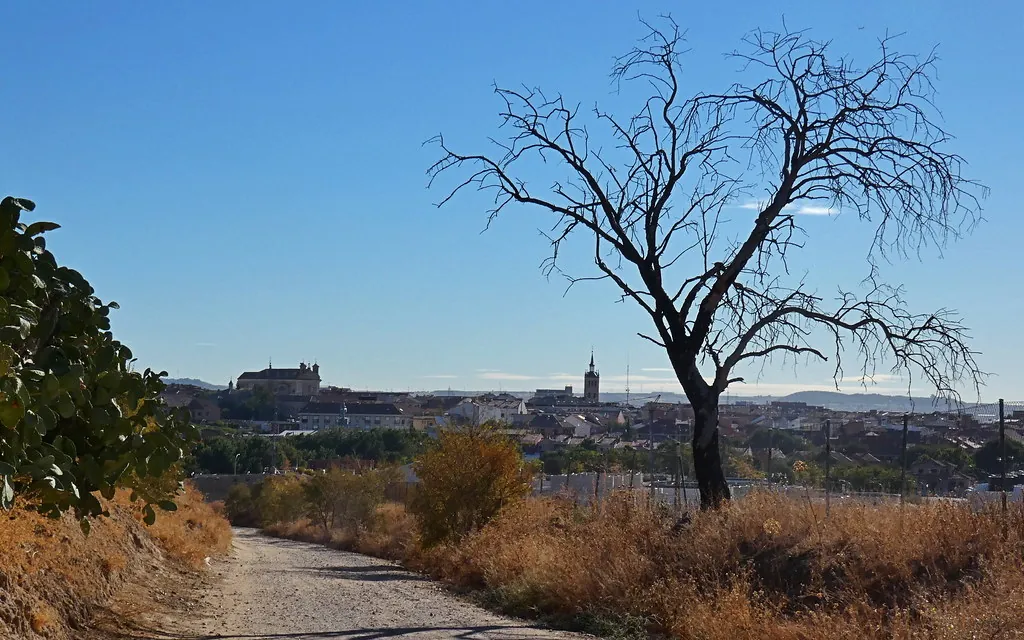
Mocejón sits in La Sagra, a district of Toledo province so close to the capital that its eastern edge almost touches the city’s orbit. You see it in the commuter traffic at dawn. Yet the village centre holds a different pace. Streets of low, brick-built houses stop abruptly, giving way to open fields with no preamble. One minute you are on cobbles, the next you are on a dirt track with the vast plain ahead, the wind a constant presence against your ears.
The Shadow of the Castle
A kilometre out of town, along a track rutted by tractors, the ruins of Higares castle emerge from a rise among olive groves. What remains is a square tower, its walls thick, its windows narrow slits facing the Tagus valley. The climb is short but rough underfoot, scattered with loose stones. In summer, there is no shade here, just the sun and a relentless breeze that sweeps across the barley fields.
The landscape dictates everything. From this vantage point, you see why it was built: visibility for miles in every direction. Today, its utility is gone, replaced by a raw sense of exposure. The silence is broken only by that wind and the distant hum of a combine harvester. Wear sturdy shoes. Bring water. The view is not pretty; it is immense and uncompromising.
A Calendar Marked by Wind and Cold
The festivals here feel like necessary interruptions to the long quiet. For San Blas in winter, the local band marches at an hour when frost still whitens the rooftops. People gather in the square, stamping their feet for warmth, steam rising from cups of ponche. The cold is dry and sharp; it finds every gap in your clothing.
Come spring, the romería for San Isidro unfolds. Decorated tractors and carts process slowly out to a small chapel in the fields. By noon, families have spread blankets on the ground for a meal that lasts hours. The smell of stews cooked in large pots hangs in the air, mixing with the scent of wild thyme crushed underfoot. These are not spectacles for outsiders. They are familiar rituals, repeated year after year, anchoring life to a place where the elements are always present.
What Comes from the Dry Earth
The food is a direct reflection of this terrain. Gazpacho manchego is a winter stew, not a cold soup. It’s a dense mix of game or rabbit with pieces of unleavened torta cenceña bread that soaks up a rich, paprika‑tinged broth. Pisto, a ratatouille of local vegetables, is often served just warm, topped with a fried egg whose yolk becomes a sauce.
You eat lamb stews redolent of rosemary and garlic, and sheep’s cheese from nearby dairies. The flavours are straightforward and robust, made for sharing at long tables after a day’s work outside. They speak of scarcity transformed into sustenance.
Walking the Perimeter
Paths lead from the village edge into the fields. Some drop towards the Tagus riverbank, where poplars line forgotten irrigation channels and the shells of old watermills crumble into the undergrowth. Others head straight into the open plain, following geometric lines between plots of wheat and barley.
The walk to Higares castle is the most defined route. It’s not long, but after rain the clay can be slippery. There are no services once you leave the last house behind. Your company will be skylarks overhead and the soft rustle of dry grass.
A Practical Silence
Visit in late April or May. The fields are green then, and storks clatter their bills atop nests on every available spire. By June, the heat is formidable from mid‑morning onward, bleaching the colour from the land.
Mocejón is minutes by car from Toledo via the CM‑4000 road. Public transport requires going through Toledo first. If you stay into nightfall, you’ll notice how completely the sound drains away. A distant television behind a shutter, a dog barking down a lane. The darkness away from streetlights reveals a scatter of stars you might not expect so close to a city. In that quiet, you finally hear the place: just the wind moving through telephone wires, marking another day gone on the plain.