Full Article
about Numancia de la Sagra
Formerly Azaña; fast-growing town known for its craft-beer industry
Hide article Read full article
The bells of the Iglesia de la Asunción strike eight just as sunlight begins to brush the wheat fields around Numancia de la Sagra. In the Plaza Mayor, chairs are still stacked and the ground holds onto the night’s coolness. Light slowly reaches the façades and stretches out across the cereal fields that encircle the village, an open plain where the wind is often heard before it is seen.
At that hour, neighbours cross the square on their way to pick up bread or a newspaper, while tractors have already been working for some time on the outskirts. It is a setting shaped by routine and open space, where the day builds gradually.
The current name of the municipality dates from the 20th century. Before that it was known as Azaña, a place name often linked to old mills or aceñas connected to the river Tajo, which flows a few kilometres away. No clear remains of those mills survive, yet the historic centre still hints at a slower pace of life. There are worn stone doorways, heavy iron grilles and the occasional voussoir with a coat of arms almost erased by the sun. Walking through the central streets means noticing these small details: corners rounded by decades of carts, walls that keep the day’s warmth well into the night.
A kitchen tied to season and field
Food in Numancia de la Sagra follows rhythms tied to season and tradition. In one of the central streets, roscas de vino are still made using recipes passed down through generations. They combine flour, white wine, aniseed and plenty of olive oil. They tend to appear in winter and during the time of the matanza, the traditional pig slaughter season, when home kitchens stay active for hours.
Gachas de matanza remain a dish associated with family gatherings. Made with chickpea flour, panceta and paprika, they are not an everyday meal. They usually come out on Sundays or when the cold sets in and meals stretch on.
Pisto manchego is often served here with a fried egg on top and accompanied by a rustic loaf. Cured sheep’s cheese from the surrounding area is also common. Many prefer to keep it outside the fridge so it retains its aroma and texture. When celebrations call for something more substantial, caldereta de cordero appears, linked to the flocks that graze across the dry plains of La Sagra, where the grass grows low and fragrant.
The path to Santa Juana
About two kilometres from the village centre, along a dirt track that runs between cultivated fields, stands the ermita de Santa Juana. Local tradition places the birth of Juana de la Cruz here. The house where she is said to have been born no longer exists. Older residents often point out an approximate spot when speaking about it.
The hermitage itself is simple, with pale walls, a curved tile roof and a small rise that opens onto the surrounding landscape. On the Sunday closest to 3 May, a romería takes place. The path fills with people walking or travelling in decorated carts, adorned with wildflowers and coloured ribbons. Dust rises with each step.
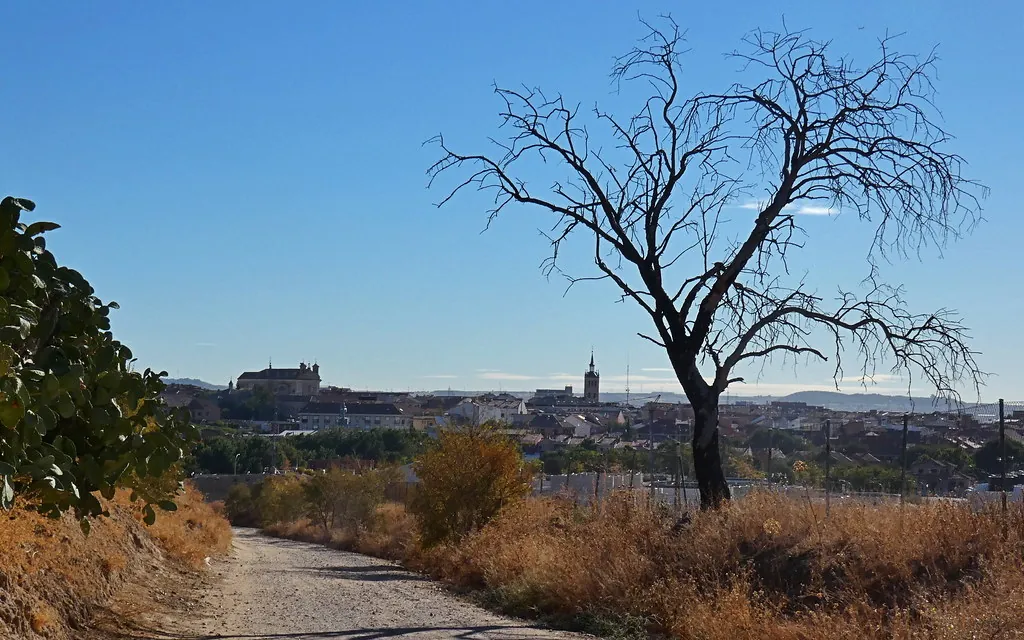
From this slightly elevated point, you can see reddish rooftops, the church tower rising above low houses and, further out, the green line that marks the course of the Tajo. The river does not run directly beside the village, yet on summer nights a cooler breeze sometimes arrives from its direction.
When the streets fill
The local calendar revolves around Santa Juana and dates close to 3 May. Streets are decorated with laurel branches. The procession moves slowly through the centre: children dressed as angels, black mantillas and neighbours following the image while dulzainas and drums provide a sharp soundtrack.
The day usually ends in the square with music and simple food stalls. As night falls, rockets are set off and their echo bounces off the façades.
A few days later comes San Isidro, closely linked to farming life. Agricultural machinery is often prepared for blessing. In August, during the fiestas of la Asunción, evening meals stretch out into the street as the heat fades.
Tracks into open country
The landscape around Numancia de la Sagra is largely flat. From the last streets of the village, agricultural tracks lead out across crops and offer easy walking routes.
One path heads towards an area known as Hontalba, where archaeological remains linked to ancient settlements have been identified. What can be seen today are mainly low walls and small structures barely rising from the ground. It is not a site arranged like a museum.
Other paths descend towards the Tajo. As you get closer to water, poplars and reeds begin to appear. In summer when water levels drop sandy banks form along its edges.
Come in late spring or early autumn if you want to walk these tracks comfortably; midday sun in July or August leaves little shade.