Full Article
about Ugena
Expanding municipality in La Sagra; retains traces of its Mudéjar past
Ocultar artículo Leer artículo completo
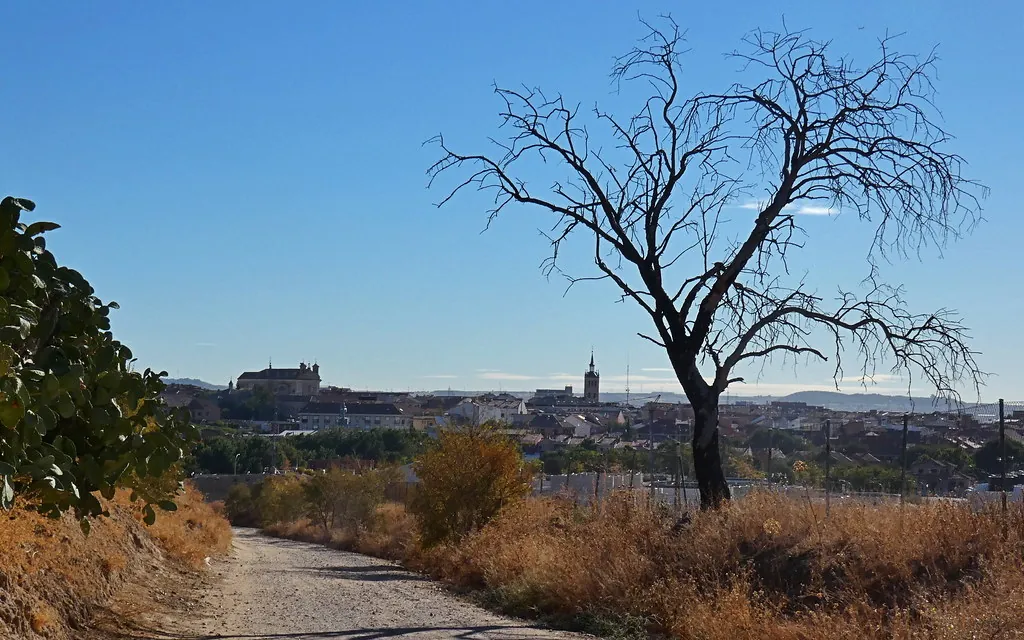
The church bell strikes seven, and the temperature drops three degrees in as many minutes. At 654 metres above sea level, Ugena's evenings arrive with a sharpness that surprises visitors expecting the mild nights of southern Spain. This is Castilla-La Mancha's high plateau, where the sky stretches endless and the horizon sits forty kilometres away, unobstructed by anything taller than a grain silo.
Thirty-five kilometres south of Madrid, the village appears suddenly after a succession of roundabouts and industrial estates. One moment you're passing warehouse distribution centres, the next you're in a proper Spanish plaza with elderly men on benches and children weaving bicycles between the tables of Bar Kiosco la Plaza. The transition happens so quickly that GPS systems often announce your arrival a full minute late.
The Village that Madrid Forgot to Swallow
Ugena exists in that curious space between dormitory town and working agricultural centre. Five thousand residents live here, but mornings see a steady exodus of commuters heading north to Madrid or west to Toledo. The 35-minute drive to the capital has transformed what might have been another dying village into something more complex: a place where traditional Spanish rhythms survive alongside satellite dishes and late-model hatchbacks parked beside crumbling stone walls.
The altitude matters more than most visitors realise. Summer temperatures hover five degrees below Madrid's furnace-like heat, while winter brings proper frost that turns the surrounding cereal fields silver-white. The agricultural calendar dominates conversation here in a way that's rare in modern Spain. Locals discuss rainfall statistics with the enthusiasm that Londoners reserve for house prices, and the colour of the wheat—green in spring, gold by July, ochre after harvest—provides the village's only real seasonal drama.
Church Square, the heart of Ugena, reveals the village's personality immediately. The Iglesia de San Juan Bautista dominates one side with its robust tower, built from the same honey-coloured stone that appears throughout Castile. Unlike the elaborate confectionery of Andalusian churches, this is architecture designed for weather: thick walls, small windows, a solidity that suggests it has endured centuries of extremes and expects to endure centuries more. The plaza fills gradually through the evening: teenagers gather by the war memorial, mothers push prams in decreasing circles, and the bars set out tables that will stay occupied until well past midnight.
What Passes for Excitement Here
The British habit of seeking constant stimulation meets its match in Ugena. This is not a village of dramatic attractions or Instagram moments. Instead, it offers something increasingly rare: the chance to observe ordinary Spanish life proceeding at its own pace. The Tuesday market spreads across the car park behind the health centre, selling everything from cheap underwear to vegetables grown in gardens that locals maintain on the village outskirts. Quality varies enormously, but the prices—€2 for a kilo of tomatoes, €15 for leather sandals—remind you that this isn't tourist Spain.
Cycling provides the main diversion, though calling it cycling might be generous. The flat agricultural tracks that radiate from the village suit hybrid bikes perfectly, offering twenty-kilometre circuits through wheat fields and olive groves. Download an offline map first; signposting is minimal and the landscape so uniform that getting lost requires only a moment's inattention. Bring water—lots of it. The wind that makes summer cycling bearable also dehydrates faster than you'd expect at this altitude.
Walking works better for understanding the place. Follow the road past the cemetery and you'll reach the old railway line, now a dirt track leading towards Illescas. It's five kilometres each way, entirely flat, passing through the agricultural infrastructure that sustains the region: irrigation channels, storage barns, the occasional farmhouse surrounded by eucalyptus trees planted as windbreaks. The walk takes ninety minutes at a stroll, returning you to Ugena in time for lunch, which starts at 2 pm and not a minute earlier.
Eating Without Expectations
Spanish village food follows its own logic, and Ugena makes no concessions to international tastes. Asador del Carmen serves the local specialities without apology or explanation. Roast lamb arrives in portions that could feed a family of four; smart visitors order media raciones and still struggle to finish. The chips come thick-cut and properly salted, the salad consists of tomatoes that taste of something and lettuce that's seen better days. It's honest food, priced for locals—expect to pay €12-15 for a main course, €2 for a caña of beer.
El Zaguan offers slightly more refinement, though refinement remains relative. Their gazpacho deserves attention during summer months, served properly cold with diced vegetables on the side. Winter brings cocido, the Castilian stew that explains why locals can handle the altitude's winter bite. It's available only on Thursdays, sells out by 4 pm, and requires an empty afternoon afterwards—the combination of chickpeas, meat and potatoes induces a sleepiness that no amount of coffee will overcome.
Bar Kiosco la Plaza handles the in-between times. Their toasted sandwiches, filled with jamon serrano or tortilla, provide adequate sustenance for British stomachs still adjusting to Spanish hours. Coffee arrives properly strong, and the terrace offers prime people-watching opportunities. The English is limited but the staff have developed an efficient system of pointing and gesturing that transcends language barriers.
The Practical Reality Check
Getting here requires planning. Madrid-Barajas airport sits 46 kilometres north—hire a car and drive southwest on the A-42, taking exit 52 towards Illescas. The journey takes forty minutes on clear roads, considerably longer during Madrid's rush hours. Public transport exists but tests patience: trains run from Madrid's Puerta de Atocha to Illescas every hour, followed by a taxi ride that costs €12-15 and must be pre-booked for the return journey.
Accommodation presents the biggest challenge. Ugena contains no hotels, forcing visitors into nearby Illescas (Hotel Sercotel Princesa de Éboli, functional but forgettable) or Toledo itself, twenty minutes west. Casa Rural El Jardín de los Niños sits five minutes outside the village, offering the only genuine rural experience with a pool and garden, though you'll need a car to reach restaurants or shops.
The village shuts down between 2 pm and 5 pm—plan accordingly. Shops roll down metal shutters, bars stop serving food, and the streets empty as locals retreat indoors for lunch and siesta. British visitors expecting constant availability find this frustrating; accepting it as part of the experience marks the transition from tourist to temporary resident.
When to Come, When to Stay Away
Spring brings the plateau at its best. April and May see the wheat fields turning from winter brown to vivid green, while temperatures hover in the comfortable low twenties. September offers similar conditions with the added drama of harvest, though the landscape becomes increasingly parched as summer progresses.
Avoid August if possible. The village empties as locals escape to the coast, and temperatures regularly exceed 35 degrees despite the altitude. January and February bring proper winter—frosty mornings, sometimes snow, and a wind that cuts through inadequate British clothing. The village functions perfectly well in winter, but the outdoor café culture that defines Spanish life retreats indoors.
Ugena won't change your life. It offers no epiphanies, delivers no bucket-list moments. Instead, it provides something increasingly valuable: the chance to spend time in a real Spanish village where tourism remains incidental rather than essential. The sky really is that big, the horizon really is that distant, and the pace really is that different from whatever you left behind. Whether that's enough depends entirely on what you're seeking.