Full Article
about Villaseca de la Sagra
Known for its "Alfarero de Oro" novillada contest; palace and bullfighting tradition
Hide article Read full article
Between Toledo and Madrid: Life on the Plain
Any look at tourism in Villaseca de la Sagra begins with the wider setting. La Sagra is a broad agricultural plain between Toledo and Madrid that for centuries served both as farmland and as a corridor of movement. Villaseca sits in this intermediate strip, around 30 kilometres from Toledo, in open country where cereal crops have long set the pace of daily life.
This is a landscape defined by horizontality. Fields stretch out with few interruptions, and settlements rise gently from the plain rather than dominating it. For generations, wheat and barley have shaped the local economy and the rhythms of the year. The geography explains much about the town’s character, from its modest architecture to its enduring traditions.
Villaseca’s origins are usually linked to the reorganisation of the territory following the Christian conquest of Toledo in 1085. In the years that followed, much of La Sagra was repopulated with small agricultural communities connected to the city of Toledo. By the Late Middle Ages, Villaseca appears in documents as part of this network of villages devoted to dry farming. Growth was gradual and closely tied to the land, something still visible in the layout of its streets.
The Parish Church and the Shape of the Old Town
The centre of Villaseca de la Sagra revolves around the parish church of San Juan Bautista. The present building seems largely the result of works carried out in the early modern period, probably between the 16th and 17th centuries, although some elements may have replaced an earlier structure. Its tower, visible from various points in the surrounding area, fulfils a simple and practical role common to churches on the Castilian plateau: acting as a landmark in an almost entirely flat landscape.
In places like this, the church is not only a religious building but also a visual anchor. When fields dominate the horizon, a tower becomes a point of orientation, a fixed reference amid open land.
The square in front of the church remains the focal point of everyday life. From here, several streets branch out in irregular lines, reflecting organic growth rather than formal planning. The town developed gradually, adapting to corrals, kitchen gardens and agricultural tracks. Its layout still follows those older patterns.
Along these streets, traditional houses of one or two storeys can still be seen. Many have whitewashed façades, iron window grilles and wide gateways designed for carts or for storing tools and equipment. This is not monumental architecture. It is practical building, shaped by the needs of a farming community that constructed with the materials available locally and prioritised function over decoration.
The Agricultural Landscape of La Sagra
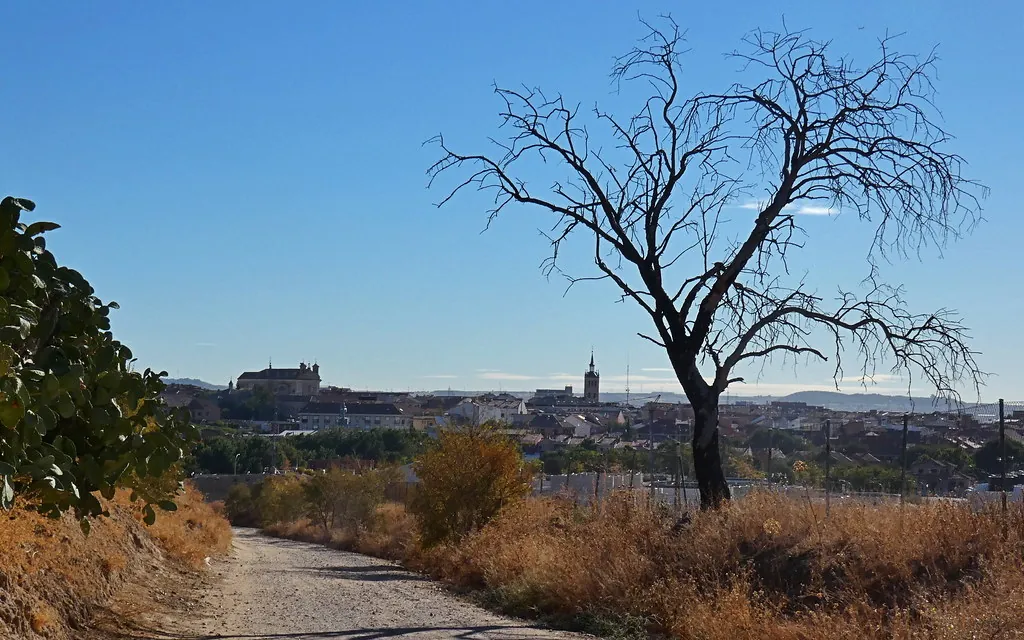
Step beyond the built-up area and the setting that explains Villaseca becomes immediately clear. La Sagra has historically been a cereal-growing region, with large, flat expanses dedicated to wheat and barley. That pattern has changed little over time. The roads and tracks around Villaseca are often former agricultural routes that once connected fields and neighbouring villages.
The relationship with Toledo has always been close. For centuries, much of the produce from these lands was destined to supply the city. This economic link helped sustain many of the small towns in the area, even during periods of agricultural difficulty. The plain and the city were interdependent, each relying on the other in different ways.
Today, the surroundings can be explored easily on foot or by bicycle. The terrain is largely flat, with open fields and the occasional isolated agricultural building. There are no major gradients and few heavily signposted routes. These were working paths first and foremost, and time has turned them into quiet tracks suitable for unhurried walks or rides.
The experience is simple: wide skies, cultivated land and long, straight horizons. Understanding Villaseca means understanding this environment. The town is inseparable from the plain that surrounds it.
Traditions Marked by the Farming Calendar
Local celebrations still follow the familiar rhythm of many towns in the region. Festivities dedicated to San Juan Bautista, around 24 June, mark one of the main moments of the year. The date coincides with the beginning of summer and with a period of reduced agricultural activity, which traditionally made it easier for the whole community to take part.
As in other parts of Spain, these patronal celebrations are rooted in religious devotion but also serve as social gatherings that bring neighbours together. In Villaseca, they remain closely linked to local participation rather than large-scale tourism.
Religious events connected to Semana Santa, Holy Week, are also observed, along with other dates in the liturgical calendar. These are generally straightforward acts, strongly tied to family traditions and to the continuity of community life. The emphasis is on shared practice rather than spectacle.
In towns shaped by agriculture, the calendar has long been organised around sowing and harvest. Even as farming methods evolve, the structure of the year still echoes that older order.
Visiting Villaseca de la Sagra Today
Villaseca de la Sagra is well connected by road to Toledo and to the main axis linking the regional capital of Castilla La Mancha with Madrid. Access is usually via the A‑42 and nearby regional roads, making it a straightforward journey from either city.
The town itself can be explored in a relatively short time. Its scale encourages a slower pace, with attention given to the church, the main square and the network of streets that reveal its agricultural past. The visit makes most sense when seen within the broader landscape of La Sagra, a historic farming region made up of small municipalities that grew around the land and the routes leading to Toledo.
Walking through the streets and then heading out towards the surrounding fields helps clarify that enduring relationship. Villaseca de la Sagra is not defined by grand monuments or dramatic scenery. Its identity lies in continuity: a settlement shaped by cereal fields, sustained by its link to Toledo and organised around a parish church that still marks the centre of community life.
For travellers interested in the rural history of central Spain, it offers a direct encounter with the plain of La Sagra and with the long-standing patterns that have structured it.