Full Article
about Yuncler
La Sagra town with an old farmhouse turned into the town hall; industrial
Hide article Read full article
Late Light on the Plain
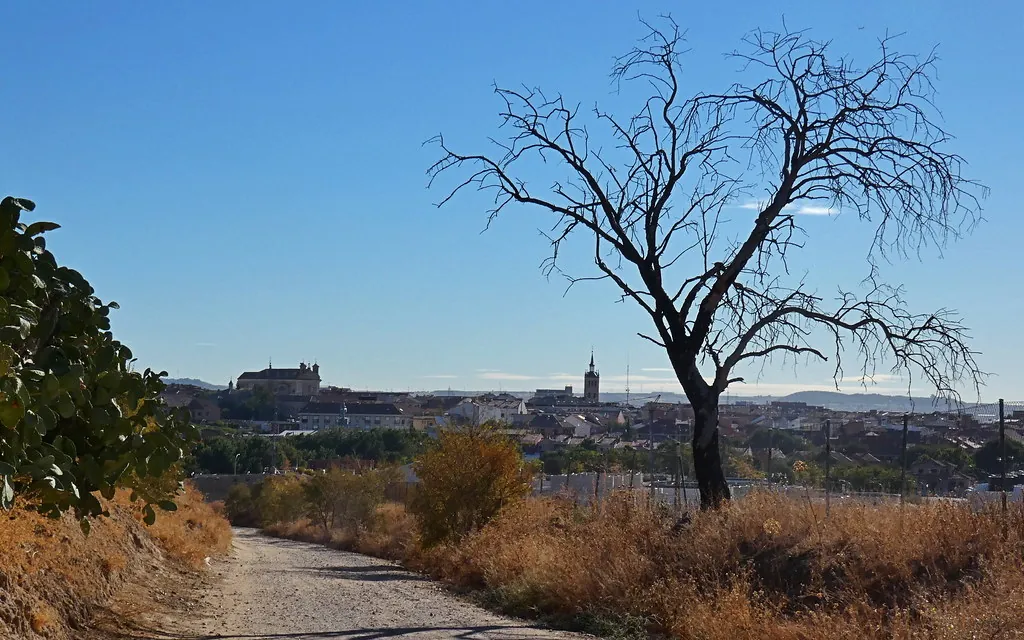
Cicadas start up when the sun touches the line of the cereal fields. It is six in the evening in Yuncler and the air carries the warm scent of straw, that dry, slightly sweet smell that hangs over the land when the wheat stands tall. From the main square, where a few teenagers half‑heartedly kick a football around, the tower of the church rises against the broad sky of La Sagra, the flat comarca north of Toledo.
At that hour almost everything seems paused. A shutter lowers slowly. A bicycle crosses the street. Someone sits on a bench looking towards the road that leads to Toledo. Yuncler is one of those villages on the Sagra plain where the landscape sets the tone. Just over five thousand people live here, surrounded by near‑level farmland, straight tracks and open horizons where the wind travels without obstruction.
Toledo is a little over half an hour away by car and Madrid less than an hour, yet the rhythm of the village is marked by other measures: when the fields are sown, when the grain is harvested, when the summer fiestas begin.
Santa María Magdalena and the Heart of the Village
The tower visible from almost any street belongs to the parish church of Santa María Magdalena, the most recognisable building in Yuncler. Its stone has taken on that toasted hue shaped by centuries under the sun of Castilla‑La Mancha. In the late afternoon the façade sits half in shadow, half lit by an orange light that slants in from the west.
Step inside and the atmosphere shifts. There is quiet, a faint scent of wax and a welcome coolness when the temperature outside climbs. It is not always open, which is common in villages of this size, so mornings or times of worship offer the best chance of seeing the interior.
Around the church much of daily life unfolds. The square and surrounding streets still show low houses with interior patios and wide gateways. These entrances were designed when tractors replaced carts but the dimensions of the buildings stayed much the same. The layout hints at how agricultural life adapted over time while the physical space remained rooted in earlier patterns.
Tracks Through Wheat and the Guatén
On the outskirts of Yuncler the scenery changes little, yet it says a great deal about the place. Several agricultural tracks run out between plots of wheat and barley, stretching straight towards the horizon. They are easy routes, without slopes, where the soundtrack is the wind brushing through the ears of grain or the distant hum of a combine harvester in summer.
The arroyo or río Guatén runs through the municipality. Here it flows quietly, almost concealed among reeds. Nearby stands an old bridge that many locals describe as very ancient. Some place its origins in Roman times, although clear information about its history is not always easy to find. Whatever its exact age, it makes a pleasant stopping point to pull over and stretch your legs. The water moves slowly and, towards the end of the day, frogs and birds can be heard among the rushes.
In the hottest months it is wise to bring water and a hat. Shade is scarce on the plain and from mid‑morning onwards the sun bears down with intensity.
The Ermita de Nuestra Señora de la Paz
One of the slightly higher points in the area is home to the ermita de Nuestra Señora de la Paz. Small and white, with a curved tiled roof, it sits above the surrounding fields. It is not a dramatic viewpoint, La Sagra is simply too flat for that, but from here the character of the landscape becomes clear: long fields, straight tracks and, on clear days, a horizon that seems far away.
Many residents drive up or take a short walk, especially at sunset when the heat eases and the countryside begins to smell of dry earth. It is a simple place, more about the feeling of space than about architectural grandeur.
July: When the Pace Changes
For much of the year Yuncler is quiet. In July, however, the mood shifts with the local fiestas. Streets in the centre fill more than usual, peñas, local social groups, bring music and energy, and evening events often stretch over several days.
Visitors who prefer a calmer impression of the village may wish to avoid these dates or come early in the morning. Those who arrive during the fiestas will see a different side of Yuncler: terraces busier than usual, people returning to the village for the celebrations, and streets that stay lively well into the night.
When to Visit Yuncler
The most comfortable seasons are usually spring and autumn. In March and April the plain turns green and the agricultural tracks become pleasant for walking or cycling. The landscape feels softer, and the distances less stark.
Autumn shifts the fields from yellow to brown, and the afternoons take on a gentler light. There is a sense of transition in the air as the agricultural cycle moves on.
Summer can be demanding from midday onwards. If visiting in July or August, it is worth setting out early. At eight in the morning the village is still cool, some shutters remain down and the streets hold a brief silence that fades as soon as the sun begins to press down.
Yuncler does not compete with grand monuments or dramatic scenery. Its appeal lies in the scale of its sky, the steady presence of its fields and the way daily life continues to follow the land. For those travelling through La Sagra, it offers a pause among wheat, wind and wide horizons, within easy reach of Toledo and Madrid yet guided by its own timetable.