Full Article
about Yunclillos
Small farming town; known for its quiet streets and proximity to Toledo
Hide article Read full article
Morning in the Plaza
By ten in the morning, the main square of Yunclillos still holds on to a trace of night-time damp. The dark paving around the fountain takes its time to dry, and the first conversations of the day echo between white façades. A neighbour drags a chair out to the doorway, another crosses the square with a baguette tucked under his arm. The day begins without hurry.
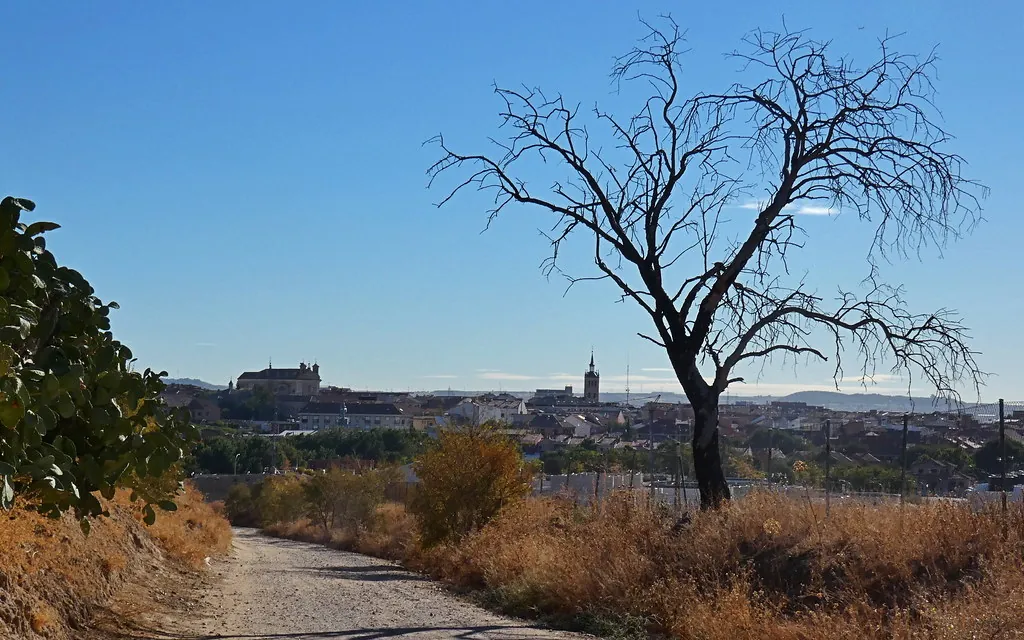
Yunclillos lies in the heart of La Sagra, a broad comarca in the province of Toledo. It is one of those places that make sense almost immediately on arrival: fairly straight streets, low houses and the tower of the Iglesia de San Pedro Apóstol marking the centre. From several corners you can see the bell tower rising above the reddish rooftops, a useful reference point if you come in on foot along the country tracks.
The houses mix recent renovations with details that still recall the agricultural life of a few decades ago. Wide wooden gates open into whitewashed inner courtyards. Former corrals sometimes still store tools or even the odd chicken. There is no grand historic quarter filled with monuments, yet the village functions very much as a village, shaped by routines that have not disappeared.
Beyond the last row of houses, the landscape of La Sagra stretches out in large cereal fields that run to the horizon. In spring the countryside turns soft and green. By June the wheat begins to glow gold, and the wind moves through the ears of grain as if the land were breathing. In winter, when the soil is barer, the sky seems to occupy almost the entire scene.
The Church and the Square
The Iglesia de San Pedro Apóstol organises Yunclillos both physically and socially. Its outline appears as soon as you approach from any of the roads into the village. Like many churches in this part of Castilla La Mancha, the building has evolved over the centuries, combining older sections with later alterations.
Around it opens the Plaza Mayor, a simple space where much of daily life unfolds. Neighbours stop for a chat, cars pull up briefly before a quick errand, children cross on their way home. During the fiestas, a large part of village activity concentrates here, with the square acting as a shared front room for everyone.
A short wander along the surrounding streets reveals details best noticed at a slow pace. Iron door knockers worn smooth by years of use. Small windows protected by old metal grilles. Courtyards that release the smell of cooking as midday approaches. These are not grand sights in a guidebook sense, but they sketch a clear picture of place.
Tracks Through the Fields
The urban area gives way almost immediately to agricultural tracks. There are no signposted hiking routes as you might find in mountain regions, yet many of these dirt paths can be followed on foot or by bicycle without difficulty.
They are open routes with very little shade. On clear days, views extend far across the plain of La Sagra. Between the cereal plots stand small olive groves, the occasional isolated farm building and temporary ponds where storks or herons sometimes pause.
In summer it is wise to set out early in the morning or towards evening. At midday the sun falls directly on the fields and there is barely any shelter. The exposure is part of the character of the landscape: wide, level and unbroken.
For those who enjoy road cycling or easy off-road riding, the surroundings allow for kilometres of steady progress between fields. The terrain does not demand technical skill, but it does ask for an appreciation of open space and long horizons.
A Village Keeping Its Rhythm
Yunclillos does not revolve around tourism. What visitors encounter is the everyday life of a small municipality: people going in and out of the church, farmers returning from the fields in the late afternoon, conversations held while leaning in a doorway.
There are no museums or interpretation centres. A calm walk through the streets already offers a fairly complete sense of the place. The appeal lies in observing how things continue rather than in ticking off sights.
The cooking that endures in local homes follows the traditions of La Mancha, the historic region that covers much of this part of central Spain. These are hearty dishes designed for agricultural work. Migas, made from fried breadcrumbs often cooked with garlic and other simple ingredients, appear on many tables. Gachas, a thick savoury preparation based on flour, are another classic. When seasonal vegetables are available, pisto is prepared, a Spanish dish of stewed tomatoes, peppers and other vegetables. The food reflects the climate and the labour of the fields.
Fiestas and Traditions
The patron saint festivities usually take place in August. For several days the square and the area around the church become the focus of activity. There are processions, evening music and that atmosphere of reunion typical of Spanish villages when those who live elsewhere return for a few days.
In January, the celebration of San Antón continues. Traditionally associated with the blessing of animals, the day still draws some neighbours who bring dogs or other pets to be blessed. It is a brief scene, modest in scale, yet very much part of village identity.
Semana Santa, Holy Week in the lead-up to Easter, is also observed here. The processions are short and pass through narrow streets, accompanied by residents. The scale is small compared with larger cities, but the ritual remains important.
When to Visit Yunclillos
Spring and early autumn are usually the most pleasant times to walk in the surroundings of Yunclillos. The fields shift in colour and the temperatures allow for unhurried exploration.
Summer brings intense heat across this part of the province of Toledo. If visiting during those months, it makes sense to head out early for a walk along the tracks and leave the central hours of the day for shelter in the village.
Winter, on the other hand, offers cold yet very clear days. On such mornings the plain of La Sagra appears with surprising sharpness. The landscape is not dramatic in a conventional sense. It is broad, quiet and, when the wind moves through the cereal, faintly hypnotic.
Yunclillos will not overwhelm with monuments or attractions. It presents instead a stretch of Castilla La Mancha as it is lived: fields that dictate the seasons, a church tower as a point of reference, a square where daily life continues at its own measured pace.