Full Article
about Yuncos
Major industrial and residential hub; home to the Museo de Coches de Cine
Ocultar artículo Leer artículo completo
The morning bus from Madrid drops its passengers at 551 metres above sea level, and something shifts in the air. Forty-five minutes earlier they were breathing diesel fumes on the capital's Avenida de América. Now they're inhaling dry earth and olive wood smoke, the signature scent of La Sagra region.
Yuncos doesn't announce itself with medieval towers or baroque facades. Instead, it sprawls across flat agricultural land where wheat fields meet industrial estates, a place that grew from 2,000 to 10,000 residents in just two decades. This is commuter Spain, where Madrid's gravity pulls workers daily along the A-42 autovía, yet the village retains enough of its agricultural backbone to feel distinctly unmetropolitan.
The Working Village Reality
Walk the main drag at 2:30 pm and you'll witness the daily exodus. Cars stream out towards Toledo and Madrid as locals head to factory shifts. The streets empty. A handful of retired men occupy bench space in Plaza Mayor, watching life proceed at Castilian pace. By 5 pm, the reverse migration begins. This rhythm defines Yuncos more than any monument ever could.
The Church of Nuestra Señora de la Concepción stands solid and unadorned, its 16th-century stone weathered by extremes of continental climate. Summer temperatures regularly hit 40°C; winter mornings drop to -5°C. The altitude amplifies everything. When Madrid swelters at 35°C, Yuncos often registers several degrees higher. When snow falls on La Sagra's plains, it settles here first.
Inside Bar La Plaza, Ana serves gachas manchegas to a mixed crowd of agricultural workers and IT technicians. The dish costs €8, arrives in earthenware, and sticks to ribs with medieval efficiency. Local olive oil, pressed from groves visible through the window, gives everything its distinctive bite. Nobody's speaking English. They barely speak Spanish—conversation flows in castellano peppered with la sagra dialect, where consonants drop and words blur together.
Flat Land, Big Sky
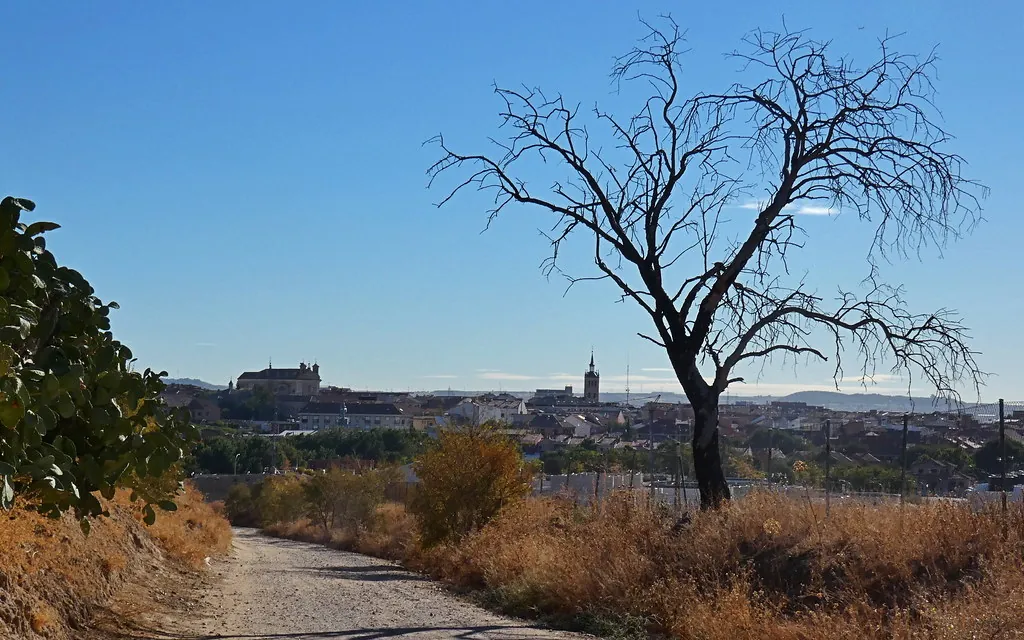
The surrounding landscape offers what flat land does best: uninterrupted horizons. Agricultural tracks radiate towards Numancia de la Sagra and Yuncler, forming a grid across cereal fields that shift from green to gold to brown with seasonal precision. These tracks serve serious walkers better than casual strollers. Distances feel longer under the high plateau sun; carry water, because shade exists only where electricity pylons cast shadows.
Cyclists appreciate the gradients—or lack thereof. A 30-kilometre loop south towards Esquivias involves just 89 metres of climbing. Road bikes glide past olive plantations where trees grow low and wide, adapted to Bise winds that sweep across La Mancha plateau. Mountain bikers find the terrain less rewarding; this is gravel bike country, where farm tracks stretch endlessly towards distant wind turbines.
Birdwatchers should lower expectations but pack binoculars anyway. Steppe species—calandra larks, short-toed larks—skulk in cereal stubble. Booted eagles hunt overhead. The real spectacle happens during spring and autumn migrations, when the flatlands become a highway for cranes and storks travelling between Africa and northern Europe. Patient observers might spot great bustards, though agricultural intensification has reduced their numbers dramatically.
When the Village Parties
August transforms everything. San Bartolomé festivities turn quiet streets into a heaving mass of humanity. The population doubles as extended families return, cars line every available space, and temporary fairground rides occupy land normally given over to wheat. Fireworks start at midnight and continue until dawn. Local police, augmented by Guardia Civil, manage traffic that would shame Oxford Street.
December brings more restrained celebrations for the Immaculate Conception. Religious processions wind through streets decorated with lights that struggle against early darkness. Temperatures hover around 5°C; locals huddle inside bars, emerging only for the official fireworks display that marks feast day proper. British visitors expecting cosy Christmas markets will be disappointed. This is Spain, where festive means loud, late and liquor-fuelled.
Carnival arrives February or March, depending on ecclesiastical calendars. Fancy dress ranges from elaborate home-made creations to supermarket specials. Children parade as Disney characters; adults favour political satire. The event feels more South American than European, proof of historical connections that span the Atlantic. British stag parties should look elsewhere—Yuncos carnival remains resolutely local, with no infrastructure for foreign visitors who can't navigate Spanish social codes.
Getting Here, Staying Fed
Madrid-Barajas airport sits 50 kilometres northeast. Hire a car—essential transport, not optional extra—and drive southwest on A-5 towards Badajoz. Exit 82 marks Illescas; follow CM-4000 for eight kilometres of agricultural nothingness until Yuncos appears. The journey takes 45 minutes without traffic, twice that during Madrid rush hours.
Public transport demands patience and Spanish language skills. ALSA coaches connect Madrid Estación Sur to Illescas every hour; local buses from Illescas to Yuncos run three times daily, except Sundays when service ceases entirely. Miss the last bus and a taxi costs €15-20. Nobody at Barajas speaks English about rural bus connections; prepare questions in Spanish or accept defeat gracefully.
Accommodation presents challenges. Yuncos offers no hotels, no hostals, no official tourist lodging. The nearest beds lie eight kilometres away in Illescas, where Hotel Illescas provides functional rooms from €55 nightly. Toledo, 23 kilometres distant, gives better options but negates the village experience. Consider Yuncos as day-trip territory, somewhere to pass three hours rather than three days.
Dining follows similar patterns. Lunch service ends at 4 pm; evening meals start after 9 pm. British stomachs expecting 7 pm dinners will go hungry. Bar La Plaza serves solid traditional food—pisto manchego, migas with grapes, roast lamb cooked in wood-fired ovens. Prices hover around €12-15 for substantial plates. Wine comes local, rough and cheap; beer arrives properly chilled. Nobody rushes service; meals take time, conversation fills gaps between courses.
The village shop closes Saturday afternoons and all day Sunday. Plan accordingly. ATMs exist—two of them—both charging €2 for foreign card withdrawals. Mobile phone signal varies by provider; Vodafone works reasonably, O2 struggles. WiFi remains patchy outside central bars.
Yuncos won't change your life. It offers instead a glimpse of Spain that exists beyond flamenco and sangria, a place where modern economic realities collide with agricultural traditions, where Madrid's influence reaches but doesn't quite dominate. Come for two hours, walk the agricultural tracks, eat gachas in Bar La Plaza, watch the commuter exodus. Then drive back to Toledo before the afternoon heat builds, leaving Yuncos to its daily rhythm of departure and return.