Full Article
about Noblejas
Town with a winemaking tradition and wineries; noted for its industrial and cultural vitality.
Hide article Read full article
At seven in the morning, the bells of the church begin to ring, their sound drifting across the western slope of the Mesa de Ocaña. From the main square, where the ground still holds the cool of the night, you can hear the first metal shutters rolling up. Life in Noblejas does not rush. Cars ease their way down the slopes as if the land itself sets the pace. This part of the plateau breaks into small terraces of vineyards and olive groves that wrap around the built-up centre, shaping both the landscape and the rhythm of daily life.
A tower built from something else
The tower of the church of Santiago Apóstol looks slightly out of place. Its stone is paler, and the blocks are cut to a different size. In the village, people often say that some of the material came from an old fortification that once stood on a nearby hill, now just a faint rise in the land. Whether that story is accurate or not, the sense of a relocated piece remains when you stand at its base.
From above, the view opens out across the Mesa de Ocaña: long stretches of fields, straight tracks, and the occasional olive grove breaking the uniformity. Modern elements sit within that scene too—late twentieth-century housing blocks, rooftop aerials, the metal doors of small workshops. Noblejas has not been preserved as a relic.
Inside the church, the smell is of wax and aged wood. The vaults run along the nave with the solid logic typical of Castilian churches. To one side, a low doorway leads to underground rooms. It has often been said in the village that documents of the Inquisition were once kept there. Today, there is damp, bare walls, and boxes of decorations brought out at Christmas.
The sound of the old washhouse
The Fuente Vieja sits at the lowest point of Noblejas. Reaching it means gradually losing height along streets that sometimes turn into worn steps. Down below, stone basins remain in place, lined up, their edges smoothed down by decades of use.
Water arrives through narrow channels that cross the site, keeping up a steady murmur against the stone. According to older residents, women from the village continued to wash here well into the 1960s.
In summer, the atmosphere shifts. Shade is limited, the light turns sharp and white, and the quiet is broken by the sound of children arriving with bicycles. It’s better to come early. By midday, the sun falls directly onto the stone, and the heat settles heavily in this sunken corner.
Sunday smoke and ripe tomatoes
Food here stays closely tied to what is produced nearby. Lamb from the surrounding hills, pale honey that often carries a scent of rosemary when the jar is opened, and cured cheeses that call for bread and a glass of local wine.
On Sunday mornings, the smell of wood smoke appears early. Many houses still keep an oven or a grill in the courtyard, and by around ten the air begins to fill with the soft smoke of meat cooking slowly.
Pisto is made here with very ripe tomatoes. In August they can arrive in the kitchen almost soft after spending the day in the sun. It’s not unusual to see them still drying in wooden trays in some courtyards.
If you want to take home honey or wine from the area, ask at one of the village shops. They’ll tell you who produces it.
When to walk and when to wait
Spring brings a noticeable change. Paths between vineyards become easier to walk, and the air carries the scent of rosemary as it begins to flower along the edges. It’s a good time to follow any of the unpaved tracks that lead out from behind the cemetery into open land.
Summer shows a different side. Heat builds from mid-morning, and by eleven many streets are empty. Visiting in July or August means adjusting to that rhythm—set out early and leave longer walks for dawn.
At certain points in summer, parking near Plaza de España becomes difficult. Outdoor terraces stay lively well into nightfall when families are visiting from Madrid.
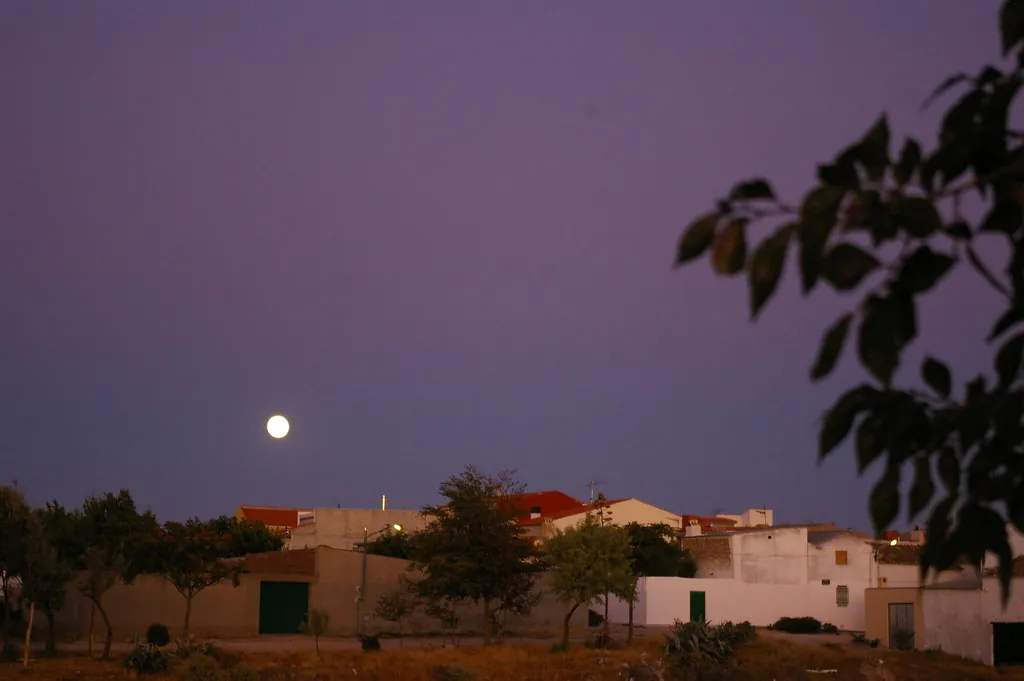
At sunset, when façades take on a golden tone, everything slows even further. Chairs appear outside front doors. From where you can still find traces of an old wall on a hill to north-east, you see red rooftops, that mismatched tower, and land stretching flat towards Toledo