Full Article
about Villamuelas
Located beside the Castro reservoir; a quiet village of fishermen and farmers.
Hide article Read full article
Some villages appear on the map and you know exactly what you are going to find. Then there is Villamuelas, which feels more like stopping at a petrol station on a secondary road and ending up in a ten-minute chat with someone from the village. Everything moves more slowly than expected, and somehow you stay a little longer.
This small municipality on the Mesa de Ocaña, in the province of Toledo, has around 600 inhabitants and sits at roughly 600 metres above sea level. Agriculture still shapes much of the calendar here. It shows in simple details: tractors moving in and out of the village, trailers loaded during harvest time, or the mid-afternoon quiet broken only by the sound of church bells.
Villamuelas has not altered its appearance to suit visitors. It looks much as it has for decades: quiet streets, low houses, and the sense that daily life follows the practical logic of a farming community.
The Mesa de Ocaña: Long Horizons, Unhurried Days
The landscape around Villamuelas is typical of the Mesa de Ocaña: broad cereal fields and open horizons where the sky takes up almost half the view.
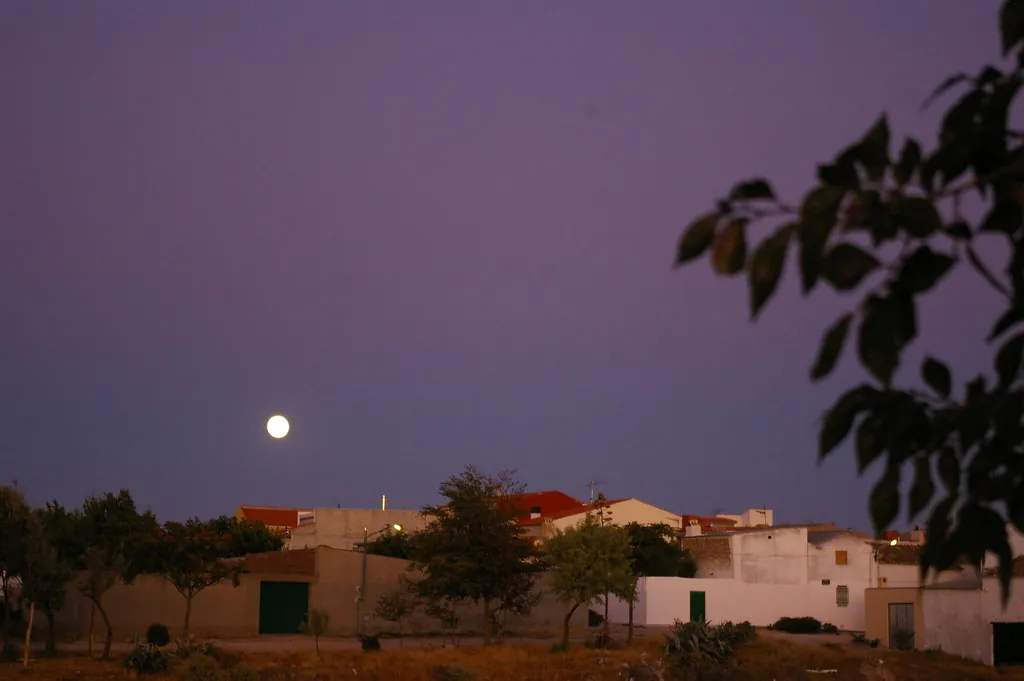
For anyone used to mountainous regions, the setting may come as a surprise. There are no dramatic ravines or purpose-built viewpoints. Instead, there is flat terrain, agricultural tracks and a particularly clear light towards the end of the day.
In spring the fields turn green for a few brief weeks, transforming the surroundings. Summer follows with the golden tones of ripened grain. After the harvest, the land shifts to brown, the soil worked and exposed. It can look austere at first glance, yet there is something absorbing about a landscape without artifice, especially if watching the subtle changes of rural life holds appeal.
This is a place of space and sky. The absence of visual clutter becomes part of the experience.
Simple Plans in the Village and Beyond
Villamuelas is not about ticking off a long list of attractions. A simple plan works best.
Start with a walk through the centre. There is no need to search for specific monuments. Instead, pay attention to the details: old iron window grilles, interior courtyards hidden behind large gates, and the occasional wine cellar built into the lower levels of some houses. These small elements say more about the village than any landmark plaque could.
Beyond the houses, agricultural tracks lead out into the surrounding fields. They can be explored on foot or by bicycle without much difficulty. The routes are flat and connect with other parts of the comarca, or county. In summer it is wise to head out early or later in the day. The sun in this part of Toledo is strong and shade is scarce.
There is no elaborate infrastructure for visitors. The reward lies in the rhythm of walking across open ground, with little more than the sound of the wind or distant farm activity.
Steppe Birds and Open Country
The open fields around Villamuelas hold particular interest for those who enjoy observing wildlife.
With some patience, and a pair of binoculars, it is possible to spot bird species typical of Spain’s cereal steppe. At certain times of year, avutardas and sisones move through the crops, usually in the early morning or at dusk. These are large, ground-dwelling birds adapted to wide, treeless landscapes. Birds of prey can also be seen patrolling the fields or perched on posts and farm buildings.
It is not a constant spectacle. Sightings tend to come in brief moments rather than continuous activity. When they do happen, the wait feels worthwhile.
The lack of crowds and traffic adds to the sense of quiet observation. Even a short pause by a field edge can turn into an unexpected encounter.
Food in the Homes of La Mancha
In villages such as Villamuelas, cooking remains closely tied to the traditions of La Mancha, the wider region to which this part of Castilla La Mancha belongs.
Hearty dishes take centre stage in colder months. Gachas, a thick savoury preparation often based on flour and oil, and migas, fried breadcrumbs typically combined with simple ingredients, are both associated with rural cooking. Stews are straightforward, with olive oil and bread playing an important role.
Queso manchego, the region’s well-known sheep’s milk cheese, and local wines frequently appear on the table, especially during family gatherings or village celebrations.
It is not complex cuisine. It is the sort of food that makes immediate sense after a morning spent working outdoors.
Festivals and Village Life
The festive calendar maintains the traditional summer patron saint celebrations. Processions move through the streets, and evening dances bring together much of the village, including those who return from cities for a few days.
Semana Santa, Holy Week before Easter, is also observed with religious events that tend to be sober in tone, in keeping with many villages in this part of Toledo.
Outside those dates, daily life continues to follow the agricultural rhythm. Stories still circulate about harsh winters in the past, about the matanzas that once gathered entire families to prepare pork products for the year ahead, and about field campaigns that occupied weeks at a time.
The sense of continuity is strong. Even as modern life reshapes rural Spain, Villamuelas retains a pace that feels anchored to the land.
Getting There and When to Go
From the city of Toledo, the journey to Villamuelas takes around an hour by car along regional roads that cross the Mesa de Ocaña. From Aranjuez, the drive is somewhat shorter, heading south.
The route is straightforward: long straight stretches, light traffic and open fields that gradually set the tone for the village’s calm atmosphere.
There is no single best season to visit. Villamuelas changes noticeably over the course of the year, mainly due to the crops. A green spring lasts only a few weeks. Summer brings the golden phase of mature grain. Winter feels more restrained, with bare fields and a quieter palette.
The shifts are subtle rather than dramatic. For anyone interested in observing how an agricultural landscape functions, each visit offers a slightly different nuance.
Villamuelas does not try to impress. It remains what it has long been: a small community on the wide plains of the Mesa de Ocaña, where life unfolds at the speed of the fields that surround it.