Full Article
about Villatobas
Municipality with large areas of pine and oak forest; archaeological remains
Hide article Read full article
Where the wind arrives first
The wind of La Mancha reaches you before Villatobas does. It moves freely across the road that cuts through the Mesa de Ocaña and meets you even before the first houses appear. The village emerges gradually among open cereal fields, with no abrupt shifts in the landscape. Everything here feels level and expansive. Long horizons stretch out in every direction, and the settlement took shape where the terrain allowed, without excessive concern for symmetry or display.
Villatobas belongs to the Mesa de Ocaña, a comarca, or county, defined by agricultural plains in the south of the province of Toledo. The land dictates the rhythm of life. Fields dominate the view, and the built-up area gathers compactly at the centre, surrounded by open countryside that seems to go on indefinitely.
This is not a place of dramatic arrivals. The approach is subtle. The village appears as part of the plain rather than in contrast to it.
Land shaped by the Order of Santiago
For centuries, Villatobas was under the control of the Order of Santiago, one of the military orders that played a central role in the medieval repopulation of southern Toledo after Christian forces took control of the territory. The Order organised and administered large areas of land, and that historical framework still helps explain the shape of the municipality today.
The municipal boundaries are extensive. The fields are open and uninterrupted. The urban core remains relatively compact. This pattern is typical of territories structured by the military orders, where agricultural productivity was a priority and settlements were concentrated for practical reasons.
Life in Villatobas has long revolved around the plaza and the parish church, with farmland spreading out in all directions. For generations, the local calendar followed the cycle of cereal crops and seasonal agricultural tasks. That connection to the land continues to define the place. Activity increases during harvest periods and quietens when the fields lie fallow.
Today, the population stands at around three thousand. Despite changes over time, agriculture still carries weight in the local economy. Cereal crops dominate the landscape, with patches of olive groves in certain areas of the municipality.
Nuestra Señora de la Asunción
The parish church of Nuestra Señora de la Asunción occupies the most recognisable position in Villatobas. Its volume defines the village skyline, and the tower is visible from a considerable distance when approaching by road.
Construction began in the Early Modern period, and, as with many churches in rural Spain, the building evolved over time. Agricultural communities often expanded or altered their churches according to the economic possibilities of each era, and this one reflects that gradual process. Inside, elements from different construction phases coexist. The main altarpiece is later than the original structure and follows a fully Baroque aesthetic.
Beyond its artistic features, the church remains closely tied to local life. Religious celebrations take place here, along with community gatherings, and it anchors key moments in the festive calendar. The building is both a visual landmark and a social reference point, reinforcing the central role of the plaza and surrounding streets.
The ermita of Padre Jesús Nazareno
A short distance from the centre stands the ermita dedicated to Padre Jesús Nazareno. The structure is modest, typical of rural Baroque architecture in La Mancha. Its exterior is simple, directing attention towards the altar space inside.
Like many churches and chapels in the area, the ermita suffered losses during the Spanish Civil War. Images and altarpieces were destroyed or disappeared, and the original image of the Nazareno was lost during those years. In time, another image was introduced in order to preserve devotion and maintain the Good Friday procession.
That procession continues to be one of the most significant moments in the local calendar. It reflects a continuity that connects present-day Villatobas with earlier generations, even after periods of rupture and change.
A village defined by its fields
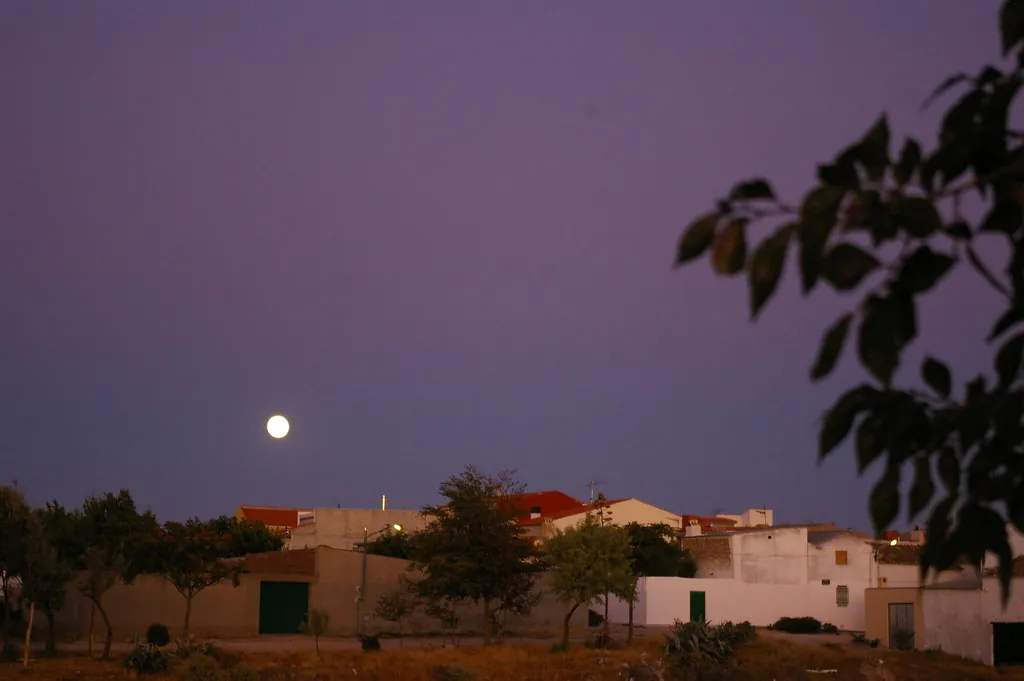
The surrounding countryside is open and easy to explore via agricultural tracks. There are no major tourist infrastructures or especially marked routes. Moving just beyond the urban edge is enough to encounter the characteristic landscape of the Mesa de Ocaña: flat terrain, long plots of farmland and a sky that appears to widen towards sunset.
The relationship between the village and its environment is direct. There is little transition between street and field. The outskirts dissolve quickly into farmland, reinforcing the sense that everything here depends on the plain.
Within the urban area, walking is straightforward. Streets are lined with houses built of brick and tapial, a traditional rammed-earth technique, many of them arranged around interior courtyards. Roofs are covered with curved tiles. The plaza continues to function as a daily meeting point, with benches and some shade during the hotter months.
Those interested in vernacular architecture can look closely at the wide gateways of older homes, originally designed to allow carts to pass through. Small details in wrought iron or carved wood still survive on façades and under eaves, quiet traces of earlier building traditions.
Villatobas is not a place to rush. A slow walk through its streets, followed by a short wander towards the outskirts, helps to make sense of the village in relation to the countryside that surrounds it. Everything leads back to that plain. Even the wind feels shaped by it.