Full Article
about Anquela del Pedregal
Located in the sexma of Pedregal; harsh climate and moorland landscapes.
Hide article Read full article
The Road Comes First
Tourism in Anquela del Pedregal does not work in the usual way. Before anything else, you have to get there.
From Molina de Aragón, a town in the province of Guadalajara, a dirt track runs out towards the village for several kilometres. It is not a road in the conventional sense. If it has rained, you will notice straight away: mud, puddles and loose stones make the surface uneven. A higher vehicle helps, and so does taking it slowly. This approach is part of the visit.
At the entrance there is a small clearing where you can leave the car. From that point on, everything is done on foot. There are no car parks, no marked bays, no signposted routes. Just a handful of houses gathered in open country.
A Village Reduced to Its Essentials
Anquela del Pedregal is tiny. Some houses are still inhabited. Others are half collapsed, their walls standing but roofs gone or sagging. There are no shops, no bar, no services of any kind. The streets are dirt and stone, uneven underfoot and shaped more by use than by planning.
The Iglesia de la Asunción stands out slightly from the rest. It has a simple tower, visible from almost anywhere in the settlement. When walking between the houses, it acts as a point of reference. The building does not dominate in a grand way, but in a place this small even modest height makes a difference.
You can walk around the whole village quickly. Ten or fifteen minutes is enough if you do not linger. Rubble stone walls, wooden beams and roofs covered with old tiles are typical of this part of the Señorío de Molina, a historic region around Molina de Aragón. On some façades, a carved stone coat of arms remains. It is a reminder that the village once had more importance than it does today.
There is no attempt here to dress things up. What you see is what remains: a small rural settlement that has thinned out over time, now home to just 28 inhabitants.
Landscape in Command
In Anquela del Pedregal, the landscape matters more than the buildings.
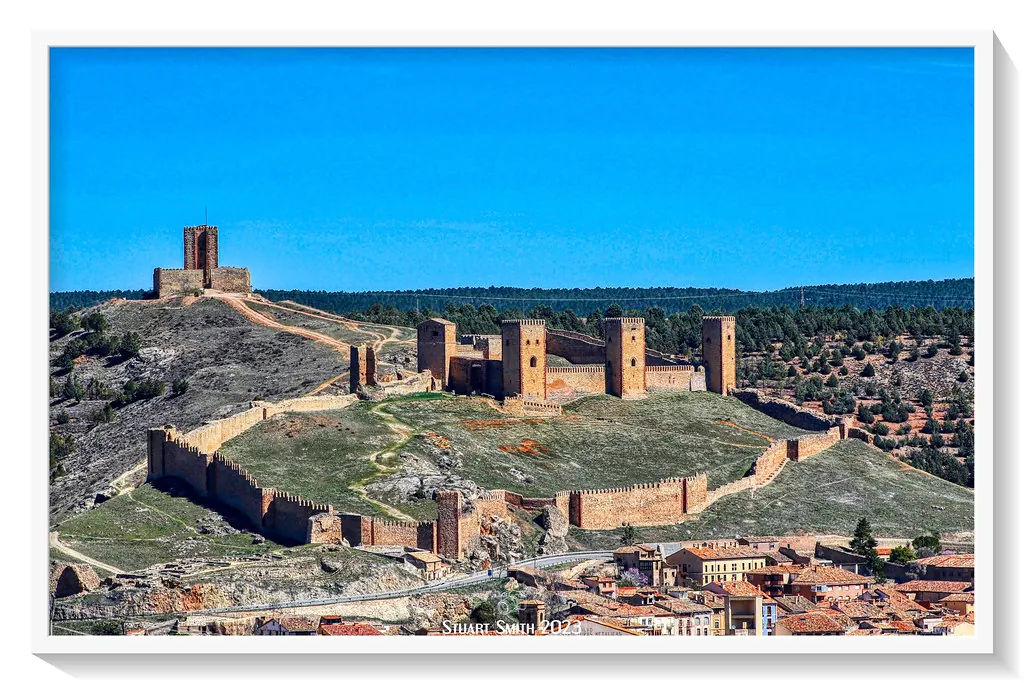
The surroundings are dominated by rocky ground, scattered pines and a good deal of limestone. It is dry, rough terrain. The name “Pedregal” itself refers to stony ground, and the setting lives up to it. The valley feels open and exposed, shaped by geology rather than cultivation.
Early in the morning or at the end of the day, the light hits the stone hard and changes the look of the valley. The same slopes can appear pale and washed out at midday, then take on deeper tones as the sun drops. There is little shade and little distraction. The emphasis is on rock, scrub and sky.
Paths lead out from the village towards other small settlements in the area. Many of these routes began as livestock tracks, used in the past to move animals between grazing grounds. You should not expect clear signposts. If you plan to walk beyond the immediate surroundings, it is sensible to carry a map or GPS. The terrain is open but can quickly become confusing once you leave the cluster of houses behind.
Wildlife is present, although not always visible. Birds of prey sometimes cross the valley overhead. Near the ravines, there may be traces of roe deer or wild boar. The signs are often more noticeable than the animals themselves.
In autumn, some people come to the nearby pinewoods to look for mushrooms. The success of this depends heavily on the year and on rainfall. If you do not know how to identify wild mushrooms properly, it is better not to touch them. The area is not managed as a foraging destination, and there are no facilities linked to this activity.
A Place for a Brief Pause
There is nowhere to eat in Anquela del Pedregal. No café, no restaurant, no grocery shop. For a meal, you need to return to Molina de Aragón or stop in another village in the wider comarca, or district. Anquela del Pedregal is simply a short stop.
The visit consists of parking, walking for a while and looking around. It suits those who are interested in rural landscapes, quiet places and the traces of settlements that have shrunk over time. There are no organised activities and no visitor centre. The appeal lies in its simplicity and isolation.
The village’s fiestas usually revolve around 15 August. On that day, residents who live elsewhere return. There is a small gathering and a modest procession, and little more. For most of the year, the population remains at 28. Do not expect bustle or events outside that brief moment in summer.
Seasons in a Harsh Setting
Winter here can be severe. Strong frosts are common, and snow is not unusual. After snowfall, the dirt track from Molina de Aragón can become much more difficult. Conditions change quickly in this exposed landscape.
Spring and autumn are generally the most comfortable times to visit. Temperatures are milder, and the light across the stone and pines is softer than in high summer. In summer itself, the village remains just as quiet, but the complete lack of services is felt more sharply. There is nowhere to take shelter from the heat except in your vehicle or under the limited shade of the trees.
Before setting out, it is worth accepting what Anquela del Pedregal is and what it is not. It is not a rural tourism hub, nor a revived heritage village. It is a very small hamlet in a tough landscape, reached by a dirt track and walked in a matter of minutes.
For some travellers, that is reason enough to stop. For others, it will be a brief pause on the way to somewhere livelier within the Señorío de Molina.