Full Article
about Castellar de la Muela
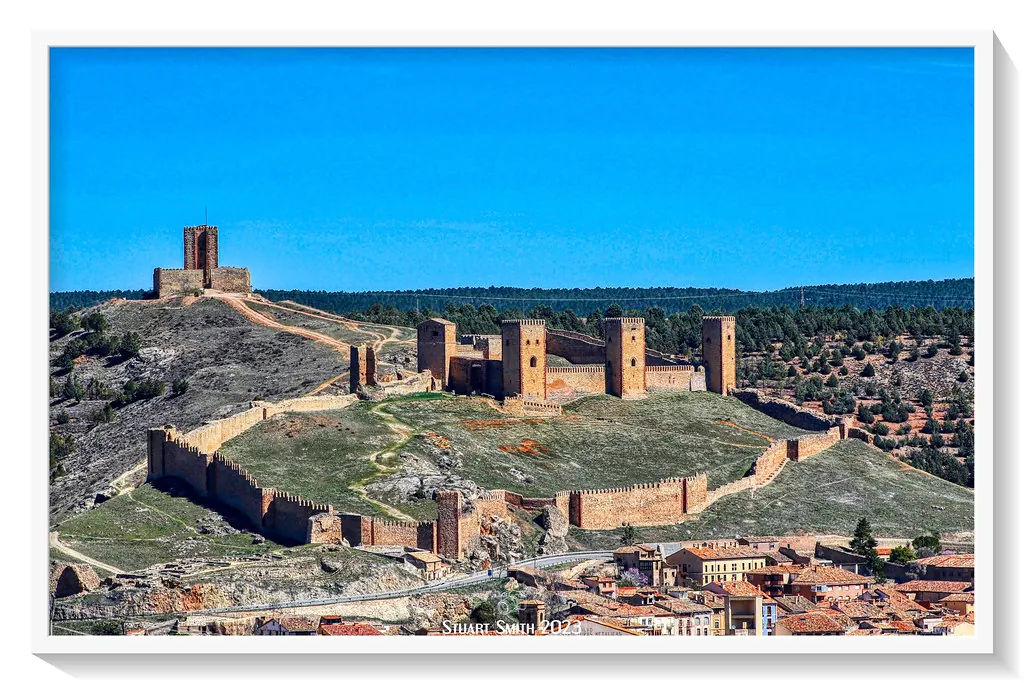
Set at the foot of a hill; a lonely, beautiful landscape typical of Molina.
Hide article Read full article
A village where the car stays outside
In Castellar de la Muela, the car is left at the entrance, on a dirt clearing. There is little else. From that point, the entire village can be crossed on foot in about ten minutes. There are no shops and no bars open all year round. If the wind is blowing, which is common on this high plateau, the visit can quickly turn uncomfortable. In winter, it is worth thinking twice.
Castellar de la Muela stands at 1,223 metres above sea level, in the heart of the Señorío de Molina, a historic district in the province of Guadalajara, Castilla La Mancha. The surroundings are stark. Open paramera stretches in every direction, with limestone rock and low scrub dominating the landscape. The settlement itself consists of a handful of stone houses, narrow streets and an almost constant silence. Only a very small number of residents live here throughout the year.
This is not a place of distractions or services. It is a village reduced to its essentials.
The parish church of the Asunción
The parish church is dedicated to the Asunción. The current building was rebuilt in the mid 20th century after suffering serious damage in previous decades. Its appearance reflects that reconstruction.
The bell tower seems to predate the rest of the structure and is usually cited as the oldest surviving element. It is probably from the 16th century. Beyond this, there are no major monuments or grand architectural ensembles. The church stands as the main point of reference in a village that is otherwise defined by its modest scale.
Walking through the streets does not take long. Stone façades, closed doors for much of the year and the sound of the wind form much of the experience. The setting, rather than any individual building, leaves the strongest impression.
Walking the ravines and old paths
There are no prepared hiking routes laid out with signs or facilities. What exists are old paths shaped by use over time: livestock trails, crossings between low hills and descents towards ravines. Some can be clearly made out on the ground. Others fade quickly among the stones.
A short walk out of the village helps to explain how people once moved through this area. Routes tend to follow gentle gradients suitable for animals, linking saddles in the terrain and connecting Castellar de la Muela with other nearby settlements. The distances are not dramatic, but the exposure is constant. The landscape is open, with long horizons, abundant rock and barely any trees.
The wind plays a central role here. It sweeps across the plateau and shapes daily life. For birds of prey, those air currents are an advantage. With binoculars, it is easy to spot vultures and other raptors taking advantage of the rising air.
Anyone setting out on foot needs to be realistic. The ground is uneven in places and shade is scarce. This is terrain that demands attention rather than speed.
Sheep’s cheese and autumn mushrooms
Sheep farming remains present in several villages in the surrounding area. Milk from these flocks is used to produce cured cheeses, which typically mature for months in cool, dry conditions. Such conditions are common in this part of Guadalajara, and they influence the character of the cheeses made here.
Autumn brings a different seasonal rhythm. When humidity is favourable, níscalos and other mushrooms appear in nearby pinewoods. Níscalos, known in English as saffron milk caps, are particularly associated with Spanish autumn cooking. For residents and people from across the comarca, mushroom gathering is a regular activity at this time of year.
Each season is different, so it is advisable to seek information before heading out to collect them. The quantities and conditions change from year to year, depending on rainfall and temperature. As with much else in this region, timing matters.
A very small population, even in summer
Castellar de la Muela has around twenty inhabitants. In summer, a few more houses open. Families return for a few days from places such as Molina de Aragón, Sigüenza and other towns. Even then, the increase is modest.
Occasionally, religious events and neighbourly gatherings are organised in connection with the village festivities. These are not large celebrations. They mainly bring together people who have a link to the place, whether through family or past residence.
For most of the year, daily life is quiet. There are no crowds and no organised tourist infrastructure. The rhythm is set by the seasons and by the limited number of people who remain.
What to expect, and what not to
Castellar de la Muela is a minimal village. It can be explored quickly. There are no large monuments and no tourist services waiting on arrival.
A visit makes sense for those interested in seeing what an almost empty settlement in the Señorío de Molina looks like today, and for those who want to walk briefly across the paramera. The appeal lies in its scale and its exposure, not in attractions.
Preparation is essential. Bring water, wear comfortable footwear and plan the timing carefully. There is nowhere here to improvise if conditions change. The wind can intensify, and the sense of isolation becomes more pronounced as soon as you step beyond the last houses.
Castellar de la Muela offers a clear picture of rural depopulation in inland Spain. It does so without interpretation panels or curated experiences. The dirt clearing at the entrance, the rebuilt church of the Asunción, the old livestock paths and the sweeping plateau tell the story on their own.