Full Article
about Establés
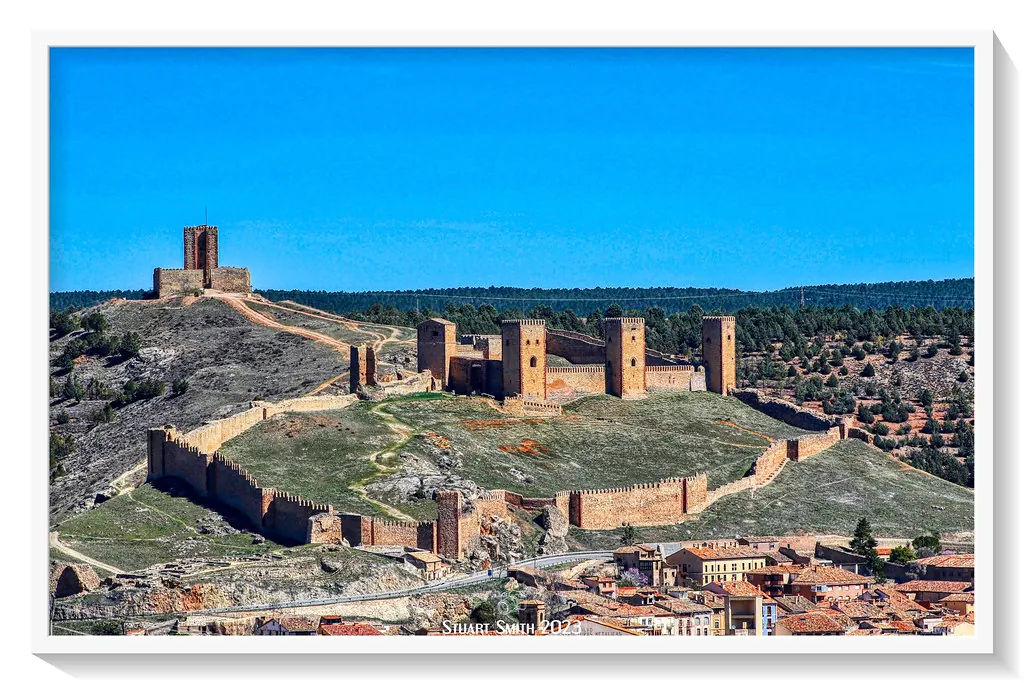
Known for its medieval castle and stronghold tower; a high-plateau landscape.
Hide article Read full article
A Village on the High Plateau
Establés lies at the far northern edge of the province of Guadalajara, within the historic region known as the Señorío de Molina. At more than 1,200 metres above sea level and with around 35 inhabitants, it belongs to that group of small settlements scattered across the molinés high plateau where landscape and climate have shaped daily life for centuries.
Winters here are long. The village reflects that reality in its compact layout and solid stone buildings, designed less for appearance than for protection. Thick walls, modest openings and tightly grouped houses respond to cold and wind rather than any decorative ambition.
A handful of short streets form the core of Establés. Homes sit alongside corrals and former agricultural outbuildings, their functions once closely intertwined. There are hardly any services and little in the way of constant movement. What remains is a small rural settlement that still preserves the structure it had when livestock and dryland farming sustained everyday life.
Beyond the houses stretches the typical landscape of this part of the Señorío de Molina: high plateaus cut by ravines, with junipers, savin junipers and scattered pines. These are trees well adapted to the cold and the dry air of these uplands. Tracks cross the surrounding territory, many of them following old routes between fields or paths that once linked Establés with neighbouring villages.
The Parish Church and the Shape of the Village
The parish church stands in a visible position within the built-up area. It is a simple structure, constructed from thick masonry and with very few decorative features. In settlements as small as this, the church traditionally played a role that went beyond worship. It was a meeting point and one of the few buildings maintained collectively by the community.
Elsewhere, the village retains much of the traditional architecture of the area. Many houses still display stone doorways with single-piece lintels. On some façades it is possible to make out openings that were once haylofts or spaces for storing tools and equipment. Corrals and small vegetable plots, now partly abandoned, help to explain how the domestic economy was organised.
The walk through Establés is brief. In less than an hour it is possible to cover all the streets, pausing to notice details such as dry stone walls and pitched roofs designed to shed snow. The overall impression is of a settlement built with practical intent, closely tied to seasonal rhythms and agricultural work.
Paths and Open Horizons in the Molina Plateau
The area around Establés invites unhurried walking rather than following signposted routes. There are no official itineraries or interpretation panels. What does exist is a network of agricultural tracks and paths connecting with other villages in the area.
Anyone wishing to explore at length would be wise to carry a map or GPS, as some stretches fade into fields or dip into ravines. The terrain is open and the horizon wide, a defining feature of the Señorío de Molina. With a little patience, birds of prey can often be seen gliding above the plateau, and signs of wildlife appear along the edges of the tracks.
At night, the absence of artificial lighting leaves the sky relatively clear. On cloudless evenings, constellations are easy to make out without needing to venture far from the village. The darkness is part of the experience here, as much as the wind and the open land.
Rural Architecture and Traditional Life
A significant number of auxiliary buildings remain standing in Establés, including haylofts, livestock shelters and corrals. They were not conceived as heritage features, yet together they form a coherent picture of how a small livestock-based settlement in this part of Castilla La Mancha once functioned.
Most of these structures are privately owned, so it is sensible to observe them from the street or from public paths. Even so, a slow walk through the village offers a clear sense of how living quarters and workspaces were distributed. The proximity between house, yard and storage areas speaks of a way of life in which family and work were inseparable.
There are no shops or places to eat in Establés. Anyone passing through should bring water or something to eat, or plan to stop in a larger village nearby. The lack of services is not an oversight but part of the demographic reality shared by many settlements in the Señorío de Molina, where populations declined over the twentieth century and have remained small.
Summer Gatherings and Local Festivities
As in many villages in the Señorío, activity increases in summer. During these months, people who still maintain a house or family ties in Establés return for a few days or weeks. The population rises, streets fill again, and local festivities are usually held.
These celebrations are small in scale and organised mainly by residents and returning families. They maintain continuity with the religious and festive traditions that structured the calendar of these villages for centuries. Rather than large public events, they are occasions for reunion and shared memory, rooted in long-standing custom.
Getting There Across the Plateau
The usual route to Establés passes through Molina de Aragón, the principal town of the comarca. From there, secondary roads cross the high plateau towards the northern villages.
The journey runs through very open countryside with little traffic. In winter, snow or ice on certain stretches is not uncommon, so it is advisable to check conditions before travelling and to drive with care. Distances may appear short on a map, yet the landscape and the nature of the roads encourage a slower pace.
Establés does not present itself with attractions in the conventional sense. Its interest lies in its setting, its architecture and its continuity with a rural way of life shaped by altitude and climate. For those prepared to walk its few streets and look closely at stone walls, doorways and open skies, it offers a clear impression of the highlands of the Señorío de Molina and the quiet persistence of its villages.