Full Article
about La Yunta
Border town with Aragón; moorland and farmland setting
Hide article Read full article
A Pause on the Road
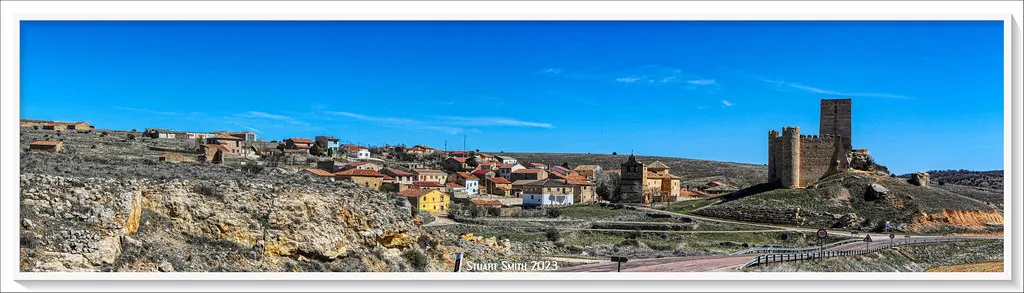
Some villages make you slow down without quite realising it. La Yunta is one of them. You drive along a long, open road through the Señorío de Molina, fields stretching out on either side, and suddenly the village appears. Small, restrained, making no effort to draw attention to itself.
Tourism in La Yunta works differently. This is not a place for ticking monuments off a list. It is somewhere to get a sense of daily life in a settlement of just over eighty residents, where the silence feels a little heavier than usual and space seems to matter more than schedules.
Part of the appeal lies in that contrast. The surrounding landscape is vast and exposed, yet the village itself feels contained and self‑contained. There is no grand entrance, no dramatic viewpoint announcing your arrival. Just a sign, a handful of streets and the sense that things run to their own rhythm here.
The Shape of the Village
La Yunta is small even by the standards of this sparsely populated comarca. A few streets, stone houses with reddish roofs, and the parish church of Santa María defining the outline of the historic centre.
The houses follow the traditional logic of this part of Guadalajara province: thick walls, irregular stonework and interior courtyards hidden from the street. Walking slowly through the village reveals signs of careful maintenance. A reinforced roof here, a freshly whitewashed wall there, a new door fitted into an old frame. It is how many villages like this manage to remain standing without losing their character.
The main street rises gently. There is nothing especially dramatic about it, yet it invites attention to small details. An old iron grille on a window, a bench set against a wall, flowerpots that someone still tends. Everyday elements become part of the experience, particularly in a place where there are few distractions.
The church of Santa María stands as the most recognisable building. It anchors the settlement visually and socially, as parish churches traditionally do in rural Spain. Around it, the houses cluster closely, forming a compact urban centre that quickly gives way to open countryside.
Walking the Parameras
The landscape around La Yunta is pure Señorío de Molina. Wide horizons, open ground and wind. Anyone familiar with this region will recognise the blend of paramera, farmland and low scrubland, where distances appear greater than they really are.
A paramera is a high, flat plateau typical of parts of inland Spain. Here it creates a feeling of exposure and scale. The sky dominates, and the land seems to stretch uninterrupted for miles.
There are no waymarked trails in the style of a natural park. Instead, walking means following long‑established agricultural tracks. Some of these link La Yunta with nearby villages such as Gascueña or Perladera. They are lengthy routes and fairly exposed to the elements, so it is wise to check the weather before setting out.
The environment can feel austere, but it is far from empty. Birds of prey are sometimes visible, circling high above the fields. Larks can be heard among the stones. Now and then an old juniper appears, twisted by years of wind, looking as though it has been there longer than the village itself.
There are also small ravines and areas where water emerges during rainy seasons. Local residents speak of caves and particular spots known to them, although many do not even appear on maps. That mix of openness and local knowledge gives the area its character. It is not a curated landscape with information panels and marked viewpoints. It is working countryside, shaped by agriculture and weather over generations.
Eating in the Area
La Yunta itself does not have restaurants. That is common in villages of this size.
If spending the day here, the usual approach is to bring provisions or head afterwards to a larger town nearby. In this part of Guadalajara, traditional dishes remain closely tied to rural life. Lamb is common, as are migas, a hearty preparation based on breadcrumbs, and game stews during the hunting season. It is robust cooking, the sort that makes sense after a morning walking in the wind.
Food here reflects the climate and the landscape. Winters are cold, distances are long and physical work has historically been part of everyday life. The cuisine matches those conditions, offering warmth and substance rather than refinement.
Summer Festivities
The patron saint festivities are usually held in summer, when many former residents return for a few days. The atmosphere shifts noticeably. A village that is calm for most of the year fills with movement in the square and along the streets.
Traditional games are maintained, along with evening music and the usual religious events. There is nothing elaborate about it, yet these are the kinds of celebrations where everyone knows one another and conversations spring up easily between neighbours and visitors alike.
For a brief period, La Yunta feels fuller and louder. Then the visitors leave, and the village returns to its customary quiet.
Reaching La Yunta
Getting to La Yunta means crossing a large stretch of the Señorío de Molina along quiet roads. Most journeys pass through Molina de Aragón before continuing along regional routes.
Public transport barely reaches this area, so arriving by car is the practical option. The final part of the drive involves several minutes with little more than open fields and the occasional stand of pine trees in view.
When the sign for La Yunta finally appears, the setting makes sense. Few residents, a great deal of surrounding space, and the feeling that time moves according to a different measure here. Not slower, simply different.
In the end, tourism in La Yunta is less about seeing and more about observing. The scale is modest, the landscape expansive, and the experience shaped by quiet roads and wide horizons. For those willing to adjust to that pace, the village offers a clear glimpse of life in one corner of rural Castilla La Mancha.