Full Article
about Molina de Aragón
Capital of the Señorío; impressive castle and medieval old town; cold climate
Hide article Read full article
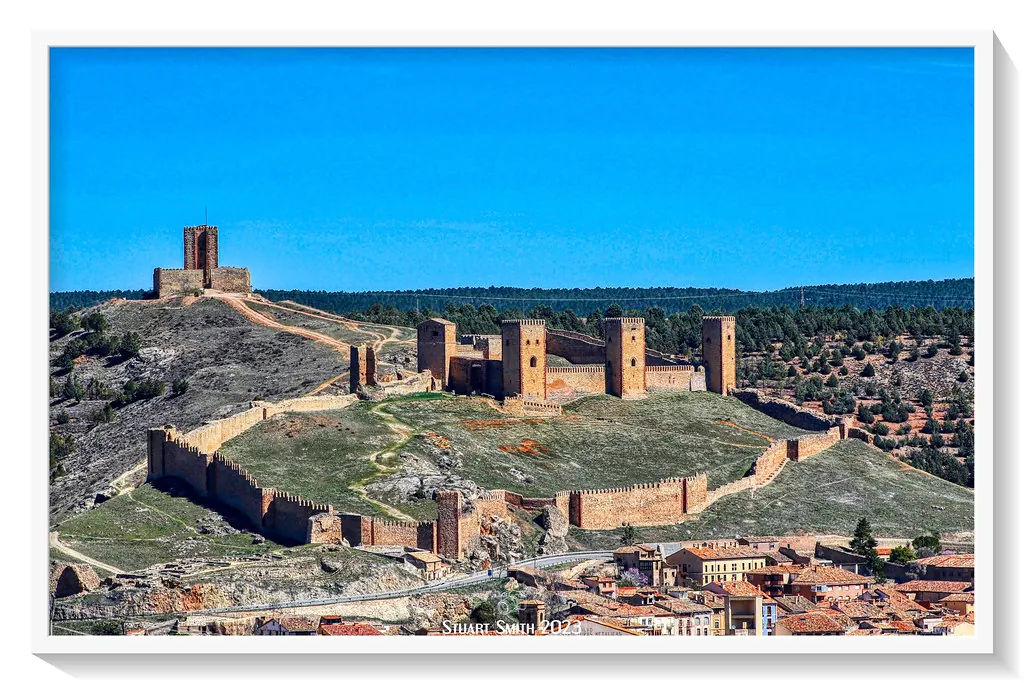
The wind of the Spanish plateau hits as soon as the car door opens. It is a dry wind, scented with rosemary and stone dust, the sort that makes you zip up your jacket even when the sun is high. From the car park the castle is already visible, a dark mass on the hill that dominates Molina de Aragón in the province of Guadalajara, Castilla La Mancha. Any conversation about tourism here ends up circling back to that outline on the skyline.
This is not a delicate or conventionally photogenic fortress. It is vast, rough-edged, clearly built to watch over territory rather than to decorate it. It is often described as one of the largest castles in Spain, and when standing beneath its walls the scale speaks for itself.
The Hill of Many Lives
The walk up to the castle follows the ridge of the hill. The path climbs steadily through dry grass and loose gravel. At the top, there is almost always a current of air.
Long before the medieval fortress took shape, people were already standing here looking out over the same landscape. Celtiberians settled on the hill, the Romans followed, and later Muslim rulers built an alcazaba, a fortified citadel. That structure would eventually evolve into the present castle when Molina became a frontier territory, a place where borders mattered and defence shaped daily life.
In places the walls merge with the town below in a very literal way. Some houses lean directly against the ancient stone, as if the defensive line had slowly been absorbed into the neighbourhood. The boundary between fortress and home is not theoretical, it is physical.
From the top the horizon stretches far in every direction. Bare hills, ravines and patches of pine forest mark the approach to the Parque Natural del Alto Tajo. Off to one side stands the tower of San Gil, slightly tilted for centuries. The lean is visible even from a distance, yet the tower remains part of the town’s silhouette.
The River That Organises the Town
Descending from the castle brings you to the Gallo river. It is narrow and clear, cutting through Molina de Aragón with the steady sound of water brushing against stone. The Gallo is not a large river, yet it gives the town its structure. A walkway runs alongside it for a good stretch, with benches and occasional shade.
In summer the difference between open squares and the riverbank becomes obvious. At midday the larger plazas can grow very warm, while by the water the temperature drops a few degrees. People gather there to talk or simply to let the afternoon pass.
Between the stones, trout can sometimes be seen moving slowly. Traditionally, the Gallo has had a reputation as a good place for fishing when the flow is right.
The historic centre climbs the slope in narrow, slightly irregular streets. Many façades are built from grey stone, with iron balconies and large wooden doors. In the Plaza Mayor stands the church of Santa Clara. Its Romanesque doorway is sober and easy to overlook if you arrive in a hurry.
Food from the Highlands
The cooking in this part of Castilla La Mancha is direct and substantial. Morteruelo appears frequently on menus. This dark, thick pâté-like dish is served on bread and reflects a cuisine shaped by cold months and rural life.
Game dishes are also common in season, especially wild boar or venison. The surrounding sierras and parameras, high plains covered in dry and aromatic pasture, influence what ends up on the table.
Sheep’s cheeses from the comarca have a pronounced flavour that comes from animals grazing on those tough grasses. Honey often makes an appearance as well, usually from the nearby Alcarria region, known for a dense texture and a very distinctive perfume.
This is not light cooking designed for decoration. For much of the year the cold is a serious presence in Molina de Aragón, and that reality is reflected in hearty plates.
When to Go
Summer brings more movement, particularly in August and on some weekends. The castle and the old quarter become noticeably busier and the atmosphere shifts.
In July the town usually celebrates the festival of the Virgen del Carmen. The event is linked to an old brotherhood of knights that still maintains ceremonies and parades. During those days there are more people on the streets and a sense of collective activity.
September tends to be quieter. Mornings unfold slowly, with local residents running errands and terraces occupied by people who have known one another for years.
Winter requires preparation. Molina de Aragón sits at around a thousand metres above sea level, and the cold here is far from symbolic. Wind funnels down the valley and threads through the streets, reinforcing the feeling of altitude and exposure.
As Evening Falls
By dusk the wind often eases. Lights begin to appear on the hillside and the castle remains above, dark against the sky, occupying the entire profile of the hill.
Molina de Aragón does not attempt to soften its appearance. There is stone, silence and a clear sense of being in one of the most sparsely populated areas of the Iberian Peninsula. Some travellers find that severity challenging. Others are drawn to it for exactly the same reason.
Back at the car, the air still carries the scent of thyme and dry earth. It is easy to pause for a moment longer, looking up at the castle before setting off. In Molina de Aragón the scale of the landscape changes the way things are measured, from distance to time, and perhaps even expectations.

