Full Article
about Algarra
One of the highest villages in the province; pure mountain setting with pine forests
Hide article Read full article
A village at the far edge
At the northern tip of the province of Cuenca, close to the border with Aragón, lies Algarra. It forms part of the Serranía Baja, a mountainous area of eastern Castilla La Mancha, and sits at an altitude of around 1,300 metres. Today, only a few dozen people live here.
Like many villages in Spain’s interior, Algarra saw its population fall sharply during the second half of the 20th century. Work opportunities and basic services became concentrated in larger towns and cities, and residents gradually moved away. What remains is a much smaller community, but not an abandoned one.
Life continues, shaped largely by livestock farming and the surrounding woodland. The nearby pine forests still define the landscape, and in many ways they also set the rhythm for those who live here throughout the year.
Getting there is part of the journey
Algarra is not somewhere you pass through by chance. Reaching it involves leaving main routes behind and following secondary roads that wind through ravines and pine-covered hills. The most straightforward approach is usually via the N‑420 or the CM‑2106, passing through places such as Cañete or Villarta along the way.
From the city of Cuenca, the drive takes a little over an hour, depending on the route. There is generally no regular public transport, so travelling by car is the practical option.
The sense of distance is part of the experience. As the road narrows and the landscape opens up, the journey itself signals that this is a quieter, more remote corner of the province.
High plains and pine forests
The surroundings of Algarra combine high plateaus, known locally as parameras, with stretches of pine woodland, especially pine species such as pino laricio and negral. These upland areas have been used for centuries as a source of timber, firewood and grazing land.
Traces of that past remain visible. Stone pens and enclosures still stand in the countryside, reminders of livestock activity that once played a central role in daily life and continues in a more modest form today.
From certain points in the village, especially on clear days, the view extends northwards towards the reliefs that belong to the Sierra de Albarracín. There are few obstacles to block the line of sight, and the horizon stretches for kilometres. The openness of the landscape is one of its defining features, giving a strong sense of space and continuity.
The village and its church
The layout of Algarra follows a pattern common to mountain villages in this part of Spain. Streets are short, houses are built in stone, and roofs are covered with tiles. Some homes have been restored and maintained, while others remain closed or show signs of gradual decline.
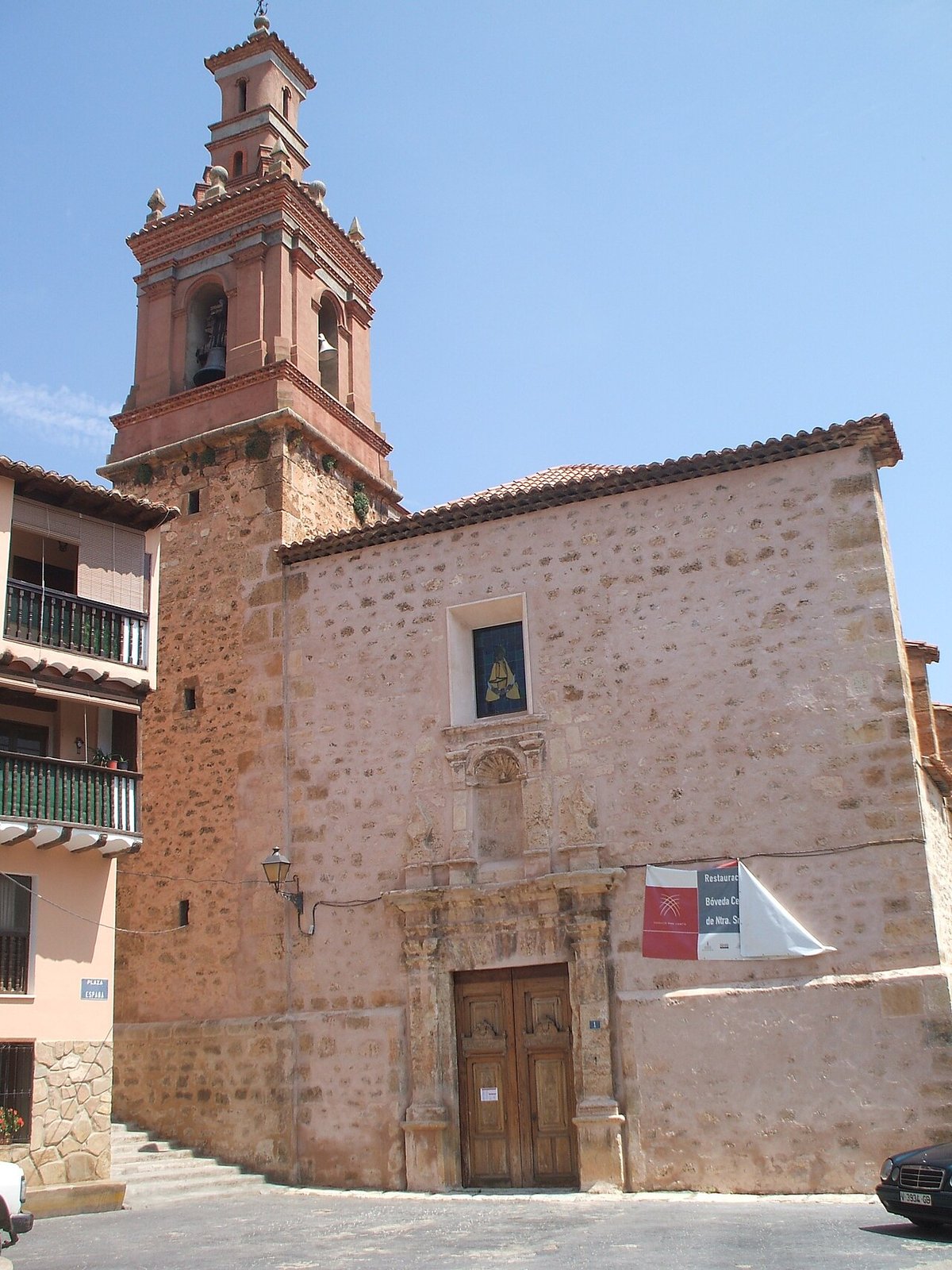
At the centre stands the parish church, dedicated to San Bartolomé. Its origins are generally placed in the 16th century, with later modifications, likely in the 18th century. The building is plain in appearance. The façade has little decoration, and the interior keeps to a simple style, including a modestly sized altarpiece.
Around the church are some of the oldest houses in the village. A number of them retain features typical of traditional architecture in colder mountain areas. These include interior courtyards and wooden galleries or corridors facing south, designed to make the most of sunlight during winter and provide some protection against low temperatures.
Paths into the surrounding hills
Several tracks leave the village and head into the surrounding woodland and hills. Many of these routes are not signposted. They were traditionally used by shepherds, woodcutters and residents travelling between nearby settlements.
Walking along these paths offers a sense of how closely daily life was once tied to the land. The routes follow natural contours, linking grazing areas, wooded sections and small clearings.
Wildlife reflects the relatively low level of human activity in the area. Griffon vultures are often seen circling above the ravines, taking advantage of thermal currents. Other birds of prey are also present. The limited population and lack of intensive development have allowed the landscape to remain largely continuous, without major interruptions.
Seasons and local life
For much of the winter, Algarra is very quiet. The small number of permanent residents carry on with daily routines, but there is little movement beyond that.
Summer brings a change in pace. People with family ties to the village return, reopening houses that remain closed for much of the year. The population temporarily increases, and the streets regain some activity.
The main celebrations are linked to San Bartolomé and usually take place in August. At that time, the church fills again, and gatherings are organised among neighbours and visiting relatives. These occasions reconnect those who have moved away with the place they still consider their own.
Conversations in the village still refer to traditional ways of life that supported generations. Shepherding, mushroom gathering after the rains, and the care of beehives in the surrounding hills are all part of this shared memory. The nearby mountains, where thyme grows in abundance, provide a suitable environment for beekeeping.
Algarra can be explored quickly. There are no shops or dedicated tourist services. What it offers instead is a quiet setting, a small inhabited village, and a landscape of forest and high plains that has changed little in places where many others have already been left behind.