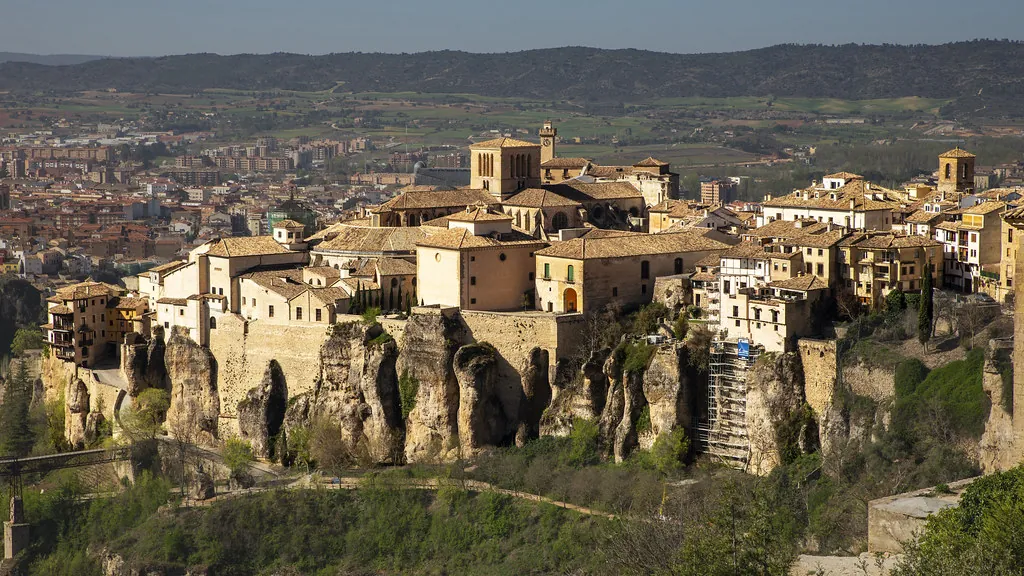
Vista aérea de Beamud
Instituto Geográfico Nacional · CC-BY 4.0 scne.es
Castilla-La Mancha · Land of Don Quixote

Beamud

The church bell tolls twice at midday, yet nobody appears. Forty-eight residents are scattered somewhere among the stone houses that cling to this ...

45 inhabitants · INE 2025
1391m Altitude

Why Visit

Mountain Church of Santiago Stargazing

Best Time to Visit

summer

San Antonio Festival (June) agosto

Things to See & Do
in Beamud

Heritage

  • Church of Santiago
  • Surroundings of the Natural Park

Activities

  • Stargazing
  • Mountain hiking

Festivals
& & Traditions

Fecha agosto

Fiestas de San Antonio (junio)

Las fiestas locales son el momento perfecto para vivir la autenticidad de Beamud.

Full Article
about Beamud

Set high in the sierra; mountain scenery, clear skies

Ocultar artículo Leer artículo completo

The church bell tolls twice at midday, yet nobody appears. Forty-eight residents are scattered somewhere among the stone houses that cling to this ridge at 1,390 m, but the only movement is a red kite drifting on the updraft above the pinewoods. In Beamud, altitude dictates everything: how long the snow lingers on cobbles, how loudly your boots echo, and whether the village bakery—open two mornings a week—has remembered to thaw the dough.

A Vertical Sort of Quiet

Most maps mark Beamud only as a black dot on the CM-2106, the mountain road that wriggles 60 km north-east from Cuenca towards Tragacete. Drivers arrive light-headed, partly from the hair-pin bends, partly from the sudden drop in oxygen. Night-time temperatures here can be eight degrees lower than on the plain below; in January the thermometer frequently dips below –10 °C, and the village’s single fountain ices over. Summer brings relief—highs rarely exceed 26 °C—but the sun is fierce at this height, and afternoon storms build fast over the limestone crests.

The houses respond to the climate without fuss. Walls are a metre thick, windows pint-sized, roofs weighted with slabs of local slate. Many retain the original wooden balcony where hams once cured in the mountain air; a few have been patched with bright Madrid brick, the masonry equivalent of a foreign accent. Nothing is “quaint”—the stone is simply what was to hand when the village repopulated after the Reconquest, and it has lasted.

Walking the two main streets takes ten minutes if you stride, half an hour if you keep stopping to listen. Sound carries oddly: a tractor in the next valley seems to idle beside you, while voices from the bar disappear into the pine-scented wind. The bar, by the way, is called Casa Fermín, opens at seven for coffee and closes when the last customer leaves, usually before ten. A caña costs €1.20; they stock no artisanal gin.

Tracks for People Who Read Maps

Formal way-marking ends at the last lamppost. From here you rely on faded paint blisters, cairns built by shepherds, and the general rule that every path eventually drops into a pine-rimmed ravine or bumps into the CM-2106 again. The most straightforward walk is the 7 km loop south to the abandoned hamlet of Los Bogares: follow the concrete track past the cemetery, fork right at the grey water deposit, and continue until the tarmac crumbles into a stony pista. Griffon vultures patrol the cliffs on your left; wild rosemary brushes your shins. Allow two hours, carry a litre of water—there is none en route—and don’t trust phone coverage.

Ambitious hikers can continue another 10 km to the Collado del Buey refuge, a stone bothy at 1,720 m listed on Lonely Planet’s Spanish “Lapland” bike-packing circuit. The shelter has four walls, a roof, and nothing else; cyclists treat it as the final emergency stop before nightfall. Snow can block the track from December to March, and the gate beside the barranco is often locked until the forest rangers decide conditions are safe.

Autumn brings a different traffic. From mid-October, cars with Madrid plates appear at dawn, boots in the boot, knives sheathed in mushroom bags. Níscalos (saffron milk-caps) fetch €20 a kilo in the Cuenca market, so locals are twitchy about strangers wandering off the path. Picking is legal for individual consumption up to 3 kg per day, but you need a permit from the provincial office first; the forms are online only in Spanish and must be printed—phone screenshots don’t count.

Eating What the Woods Provide

There is no restaurant, only Fermín’s tiny kitchen. If you ask the previous evening, his wife Conchi will roast a joint of mountain goat or serve morteruelo, the pâté-like hunters’ stew thickened with liver and breadcrumbs. Expect to pay €12 for a plate; she needs head-counts because the freezer is the size of a post-box. Vegetarians get a tortilla the diameter of a bicycle wheel, plus whatever salad the garden has produced. Dessert is usually sliced orange sprinkled with cinnamon.

Self-caterers should shop in Cuenca before the climb. The village receives a mobile grocer on Thursdays: white van, cracked loudspeaker, prices scrawled in felt-tip. He stocks UHT milk, tinned tuna, rubbery chorizo and, if you catch him before the weekend, a box of manchego that has travelled so far uphill it tastes more of car air-freshener than ewe’s milk.

When the Calendar Fills Up

For ten months Beamud slumbers, then August detonates. Former inhabitants drive up from Valencia, unshutter second homes, and string festoon lighting between the plane trees. The fiesta honouring Nuestra Señora de la Asunción begins with a sung mass in the sixteenth-century church—still unpainted, still smelling of candle smoke and damp stone—and ends with a communal paella that requires a three-metre diameter pan borrowed from the army reserve. Visitors are welcome to help stir, but bring your own glass; the village owns only thirty, and they disappear fast once the verbenas start.

September is quieter but more photogenic. Shepherds trail flocks of sheep down from the high paramo to winter pastures, the air sharp enough to make fleece steam. You will hear the bells before you see the animals, a metallic cascade echoing off the limestone amphitheatre. Stand on the south-east corner of the cemetery wall for the best angle—morning light only, the ridge throws deep shade after noon.

Getting Here, Staying Warm

Public transport stops at Cuenca. From Monday to Friday a regional bus leaves the capital at 14:15 and reaches the turn-off at Beteta, 12 km below Beamud, at 15:30. There the schedule becomes theoretical; ring the village taxi (€20 cash, phone essential) or thumb a lift—farmers are sociable if you speak enough Spanish to explain why you are loitering beside a pine plantation. Hire cars make life simpler: take the A-40 out of Cuenca, switch to the CM-2105 at Villalba de la Sierra, then grit your teeth for the final 22 km of switchbacks. Petrol stations are non-existent beyond Tragacete; fill the tank and the spare can.

Accommodation is limited to three village houses registered as casas rurales. All sleep four, charge €70–90 per night, and insist on two-night minimum stays at weekends. Heating is by pellet stove; instructions are in Spanish and the fuel runs out at dusk on Sundays—bring a fleece. There is no mobile data worth the name; the council installed fibre in 2021 but the cable keeps shearing on the rocks. Treat disconnection as part of the tariff.

Leave the Postcard at Home

Beamud will never be a “destination.” The silence is profound, the facilities rudimentary, and the weather can turn vindictive within an hour. Yet for travellers who prefer their mountains ungroomed and their villages alive rather than curated, that is precisely the point. Arrive with provisions, decent boots and no agenda beyond walking until the only sound is your own heartbeat echoing off 300-year-old stone. When the cold drives you indoors, Fermín will pull the shutter and pour a resol—anise and coffee—while outside the fog swallows the road you came in on. Tomorrow you can leave; the village won’t notice. It will still be here at 1,390 m, waiting for the next engine note to fade into empty air.

Key Facts

Region
Castilla-La Mancha
District
Serranía Media
INE Code
16031
Coast
No
Mountain
Yes
Season
summer

Livability & Services

Key data for living or remote work

2024
HealthcareHospital 28 km away
Housing~5€/m² rent · Affordable
CoastBeach 19 km away
January Climate5.1°C avg
Sources: INE, CNMC, Ministry of Health, AEMET

Planning Your Visit?

Discover more villages in the Serranía Media.

View full region →

More villages in Serranía Media

Traveler Reviews