Full Article
about Campillos-Sierra
High-mountain village surrounded by unspoiled nature; perfect for rural tourism
Hide article Read full article
A hillside village of stone and quiet
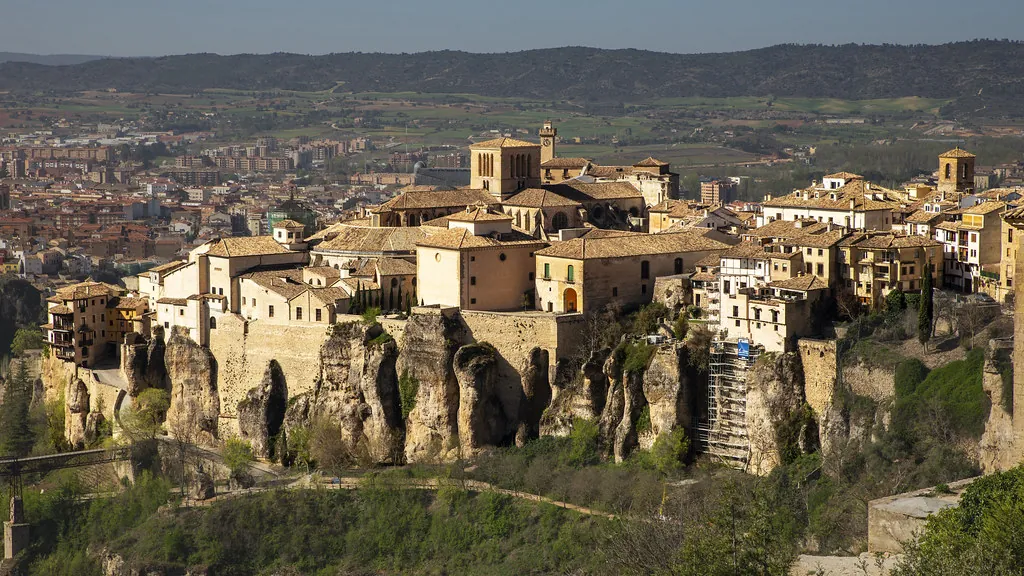
The path climbs through black pine and pale rock. Early in the day the resin smells sharp and the ground still holds the night’s cold. From a clearing, Campillos‑Sierra comes into view: a small cluster of stone houses pressed into the slope, reddish roofs, and a thin thread of smoke from a chimney when winter bites. Around 28 people live here today, so the silence is not just a lack of noise. It settles properly, like another layer of the landscape.
The streets are narrow and uneven, with worn slabs underfoot and thick masonry walls on either side. Many of the houses were built with the long cold of the Serranía in mind: solid walls, small windows, and wooden doors that still creak when opened at dawn.
The road in
Reaching Campillos‑Sierra means taking the journey slowly. The road winds through pine forest, with stretches where two cars barely pass and a careful pace is needed. At points the trees open up to reveal rounded hills covered in deep green, broken by blocks of limestone that rise like grey backs.
From the upper part of the village, the view widens. Pine canopies fill almost the entire horizon, and it becomes difficult to tell where one stretch of woodland ends and the next range begins.
A small place in the Serranía Media
Campillos‑Sierra belongs to the Serranía Media of Cuenca, an area of scattered villages and elevations that easily exceed a thousand metres. There is no tourist infrastructure in the usual sense. What exists are old paths, some barely marked, once used to connect neighbouring villages or to reach small plots of land and grazing areas.
The parish church, built in simple stone and probably dating from the 18th century, remains a focal point at certain times of the year. Life gathers here on specific occasions, even in a place where daily rhythms are otherwise quiet.
Walking among the pines
The surrounding landscape is what gives meaning to coming here. Pine forest covers entire hillsides, interrupted by clearings of exposed rock where the wind sounds different, drier.
Tracks of wild boar are often visible in the mud along the paths. Above the slopes, birds of prey such as eagles and vultures glide on the thermal currents that rise at midday. In spring the scent of the hills changes, with damp earth, thyme and warmed pine in the air.
The paths are not systematically signposted. For longer walks, it is sensible to carry a route on a mobile or have a simple map of the area. Letting someone know your plan is also a good idea if walking alone, as it is possible to go a long time without seeing anyone.
In autumn, mushroom picking is a popular activity across the Serranía. Before collecting anything, it is important to check local rules and be certain about which species are well known.
Seasons that shape the landscape
The seasons are strongly felt in this part of Cuenca.
Winter can bring snow, slowing access but leaving the landscape clean and very quiet, with the pine forest covered in white and footprints clearly marked along the paths. Summer brings long, dry evenings and a golden light that lingers between the trees as the sun drops.
In August or September, the village fiestas may take place. These are days when former residents and relatives return, and the village briefly fills with voices in the streets and cars parked where there is usually only stillness.
Food from the Serranía
The cooking of this area revolves around what has traditionally been available: lamb, cured sausages, slow stews prepared over time, and mushrooms from the pine woods when in season. These are dishes shaped by cold weather and long working days outdoors.
In nearby villages, there are houses where this kind of traditional cooking is prepared in a straightforward way.
A place where time can be heard
Very little happens in a visible sense in Campillos‑Sierra, and perhaps because of that, small details stand out more clearly. A door striking a wall in an empty street, the distant sound of a tractor, the crack of dry pine cones underfoot.
Towards evening, the wind sometimes moves through the pines and descends into the village as a continuous murmur. It is the kind of place where standing still for a while is enough to understand how the Serranía really sounds.