Full Article
about Cuenca
UNESCO World Heritage city perched above the gorges; striking medieval old town and nature
Hide article Read full article
A city shaped by rock and height
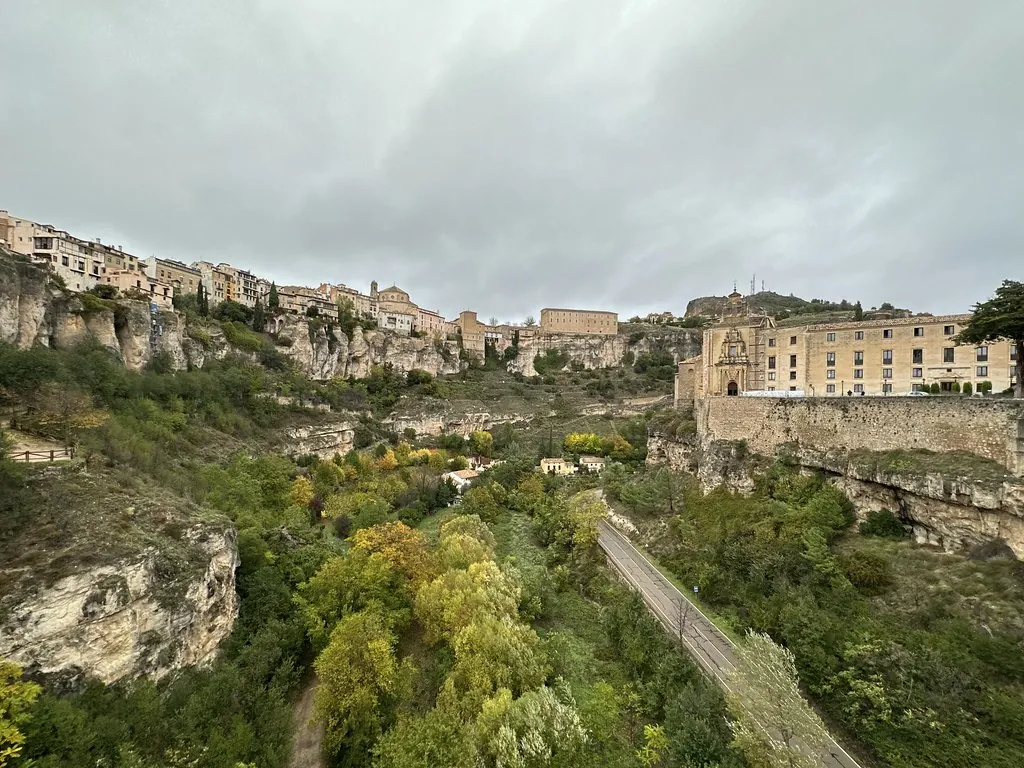
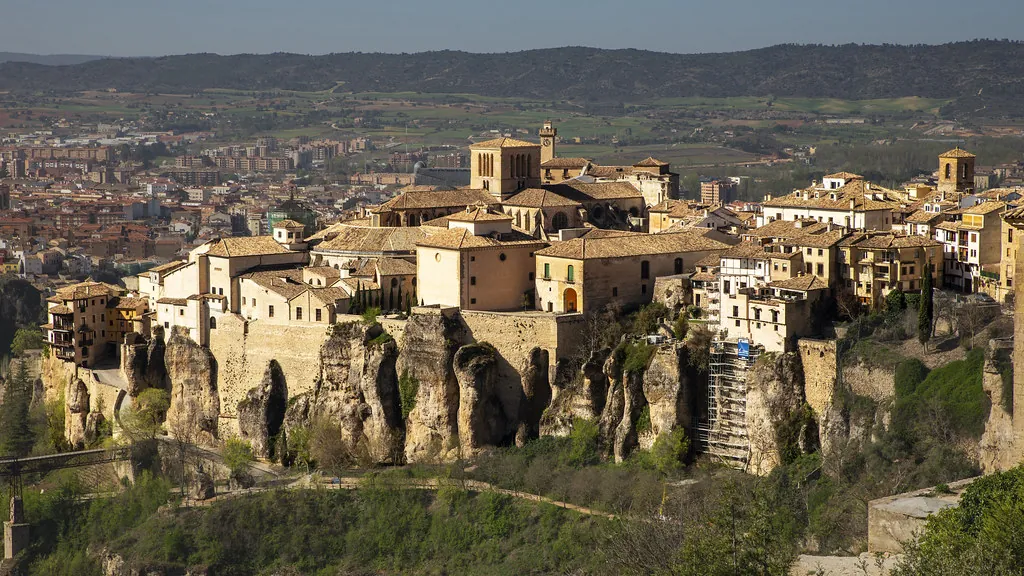
From the bridge of San Pablo, Cuenca looks almost like a trick of the eye. Houses cling to the cliff as best they can, some jutting out over empty space, while below the river Huécar traces a green line between pale limestone walls. This unusual layout was never planned as a spectacle. The city developed on a rocky spur set between two deep gorges. If there had been an easier stretch of flat land nearby, its history would likely have taken a different course.
Organised settlement on this hill is usually placed in the Andalusi period. Arabic sources refer to Kunka, a name often linked to the rock on which the city stands. A fortress rose here to control the natural passage between the Meseta and the eastern coast. When Alfonso VIII captured the town in 1177, that strategic position still mattered. Christian walls followed, and soon after came the cathedral. Santa María and San Julián began to take shape in the late twelfth century, at a time when Gothic architecture was just beginning to establish itself in Castile.
Streets that refuse to stay level
Walking through Cuenca means accepting the slope. Streets climb or descend and rarely stay flat for long. In the upper area, around the former castle, the layout still reflects its Andalusi past. Narrow lanes twist unexpectedly, and small squares appear without warning. Further down, the modern city has tackled the uneven terrain with escalators linking different neighbourhoods.
Between these levels runs the spine of the old town. Calle Alfonso VIII stretches long and narrow from the Plaza Mayor towards the castle district. The houses here are tall and slim, a direct response to the limited space available on the rock. Many stand right on the edge of the gorge.
Only three of the famous Casas Colgadas remain today. There were once more, but time took its toll through fires, rebuilding, and demolition. The surviving buildings sit above the Huécar gorge and are usually dated to the fifteenth and sixteenth centuries, though they have been heavily altered since. Since the mid twentieth century, they have housed the Museo de Arte Abstracto Español, with works linked to artists such as Zóbel, Torner and Saura. The meeting of contemporary art and medieval architecture feels more natural than it might sound.
Layers in stone: the cathedral and its setting
Cuenca’s cathedral is not among the largest in Spain, yet it stands out as one of the earliest clearly Gothic buildings in the Kingdom of Castile. Construction began soon after the Christian conquest, at a time when French influence was strong in religious architecture.
What stands today is the result of many phases. Romanesque capitals survive in some areas from the earliest stages, while other sections show later Gothic expansions, Renaissance additions, and Baroque changes. The current façade is relatively recent, rebuilt in the twentieth century after the previous one collapsed at the start of that century.
In the cloister, the search for light becomes especially clear. Buildings that were originally designed with thick walls gradually opened up, and the large flared windows of the sixteenth century reflect that shift towards brighter, more open spaces.
From around the cathedral, the geography of Cuenca comes into focus. The line of the old walls follows the edge of the precipice, the castle hill rises in the distance, and the gorges of the Júcar and Huécar frame the landscape. In the Plaza Mayor, the Baroque town hall, with its curved façade and arcades, balances the surrounding buildings and gives the square its distinctive shape.
Cooking from the land
Traditional cooking in Cuenca is closely tied to small game and to the resources of an inland region. Morteruelo is one of its most recognisable dishes, a thick paste made from game meat and pork. It developed as a way to use and preserve meat for longer periods. Served on bread, it has a dense texture, closer to a warm pâté than a stew.
Zarajos take a different approach to the same idea of using the whole animal. Made from lamb intestines that are wrapped and grilled, they appear frequently in the centre, especially at weekends.
Alongside these, dishes from the wider Manchego tradition remain common. Pisto with egg offers a simpler combination, while ajoarriero, prepared with cod and potato, has historical links to the muleteers who once crossed the province along old drove roads and trade routes.
When the pace changes
Cuenca shifts noticeably depending on the time of year. During Semana Santa, the city fills with visitors. Processions move through the steep streets of the old town and set the rhythm for several days. In September, the festivities of San Mateo bring another surge of activity, deeply rooted among local residents and centred on the historic quarter.
Outside these periods, particularly on weekdays and in quieter months, the atmosphere changes. The scale of the old city becomes easier to grasp. Neighbours sit on benches in the square, students cross the bridge of San Pablo towards university buildings, and the streets grow calmer as evening approaches.
The viewpoints around Cuenca help make sense of its setting. From them, the relationship between the city, the rock it stands on, and the surrounding gorges becomes clear.