Full Article
about Mariana
Municipality near Cuenca; gateway to the Serranía
Hide article Read full article
The first light falls on the roof tiles and takes its time reaching the street. In Mariana, that is noticeable. The village sits close together, its stone houses and whitewashed walls still holding the night’s chill. At that hour there is barely a sound: a door opening somewhere, wind brushing the nearby pines, a car starting up slowly. Tourism in Mariana begins like this, without staging and without hurry.
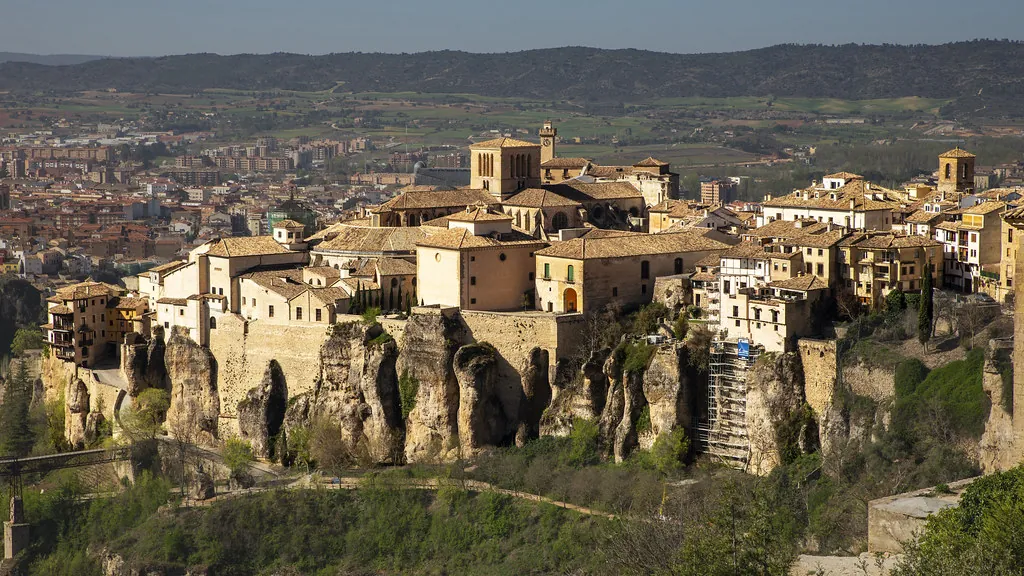
This small municipality in the Serranía Media, in Castilla La Mancha, has around 330 residents. It lies only a few kilometres from the city of Cuenca, yet the atmosphere shifts quickly once the road starts to climb between holm oaks and low scrub. There are no headline attractions and no streets designed for rushing from sight to sight. The village moves at its own pace, closer to daily life than to any polished idea of a tourist destination.
Streets that follow the slope
Mariana can be covered in a short time, although it makes more sense to slow down. The streets are not straight. They rise and dip along the hillside, turning gently to reveal enclosed courtyards and wooden gates darkened by years of weather.
At the centre stands the Iglesia de la Asunción. It is a restrained building, the kind that seems simply to have always been there. The walls combine exposed stone with whitewashed sections. At certain moments in the late afternoon, the façade takes on a soft orange tone, especially when the sun enters the square from the side.
Walking without a fixed route brings small details into view: slightly twisted iron grilles, vegetable plots pressed up against houses, walls where repairs in different types of stone are still visible. Many homes have been renovated in recent years, yet they retain their original form. The overall impression is of continuity rather than reinvention.
There is no defined circuit or sequence of sights. The village reveals itself in fragments, in corners and slopes. A short climb can open up a new angle over the rooftops. A turn downhill leads back towards the centre and the church square. It is compact, but not flat, and that gives each walk a different rhythm.
The landscape that frames Mariana
The real setting for the village is the surrounding hillside. From the edges of Mariana, low ridges covered in pine forest come into view, along with open patches where traces of old terraces remain. Limestone rock appears frequently in embankments and small cuttings, a reminder of the geology that shapes much of this part of inland Spain.
Towards sunset, the landscape shifts in character. The lower light draws out the ochre tones of the soil and the dark green of the holm oaks. When the wind picks up, the scent of resin and dry earth reaches the first houses. The change is gradual but noticeable, as if the day were folding in on itself.
The proximity of this landscape is constant. There is no clear boundary between village and countryside. A few steps from the last row of houses, tracks and open ground begin. The sense of space contrasts with the compact layout of the streets, offering a wider horizon after the narrow slopes.
Unsignposted paths and everyday routes
Several agricultural tracks and footpaths branch out from the surrounding area. They are used by local residents and are not usually marked as official walking routes. Even so, many lead towards gentle ravines, stretches of pine woodland or former cultivated plots now covered in scrub.
The terrain includes slopes, but in general these are straightforward tracks to walk. It is advisable to carry water and to navigate with a map or a mobile phone, as some junctions are unclear. The paths do not always indicate where they lead, and the forks can look similar.
In spring, birds are easy to hear among the pines. With some luck, birds of prey can be seen circling above the clearings. The experience is simple and direct: earth underfoot, resin in the air, the sound of movement in the trees. There are no information panels explaining what you are seeing. The setting speaks for itself.
These routes reflect everyday use rather than organised tourism. They connect old fields, wooded patches and small changes in elevation. Walking them offers a sense of how closely the village remains tied to its immediate environment.
Autumn rain and the scent of mushrooms
When the first autumn rains arrive, the surrounding hills take on a different smell. The soil darkens and mushrooms begin to appear among the pine needles. Some residents head out to look for níscalos, a type of saffron milk cap common in Spanish pine forests, along with other species they know well.
It is not an organised activity or something displayed for visitors. It forms part of the local routine. Anyone thinking of collecting mushrooms should check the regulations for the area beforehand and, above all, be certain about identifying the species. The knowledge tends to be personal and passed on quietly rather than advertised.
Autumn also softens the light and the temperatures. The forest floor becomes damper, the colours deeper. The change is felt in the air and underfoot, and it alters the character of even familiar paths.
August festivities and the rhythm of the year
The main celebration is usually held in August, around the feast of the Virgen de la Asunción. During those days the village fills out a little. People who live elsewhere return, and the streets take on a different movement, particularly at night. The change is noticeable but temporary, a brief swell in a place that otherwise remains measured.
For the rest of the year, life is quiet. In winter the days are short and the cold is clear, as the altitude is around 950 metres above sea level. Morning fog sometimes appears, and the streets take time to dry. The stone and whitewash that hold the night chill in summer mornings can feel sharper in the colder months.
Spring and autumn are often the most pleasant times to visit. The countryside is more active, and temperatures allow for walking in the surrounding hills without the stronger heat of summer. Even then, the overall tone does not shift dramatically. The village continues at its own speed.
Mariana does not try to present itself as anything other than it is. It is a small village near Cuenca where quiet mornings and the nearby hills still set the pace of the day. Anyone arriving notices it quickly. Here, things unfold slowly, and that is the point.