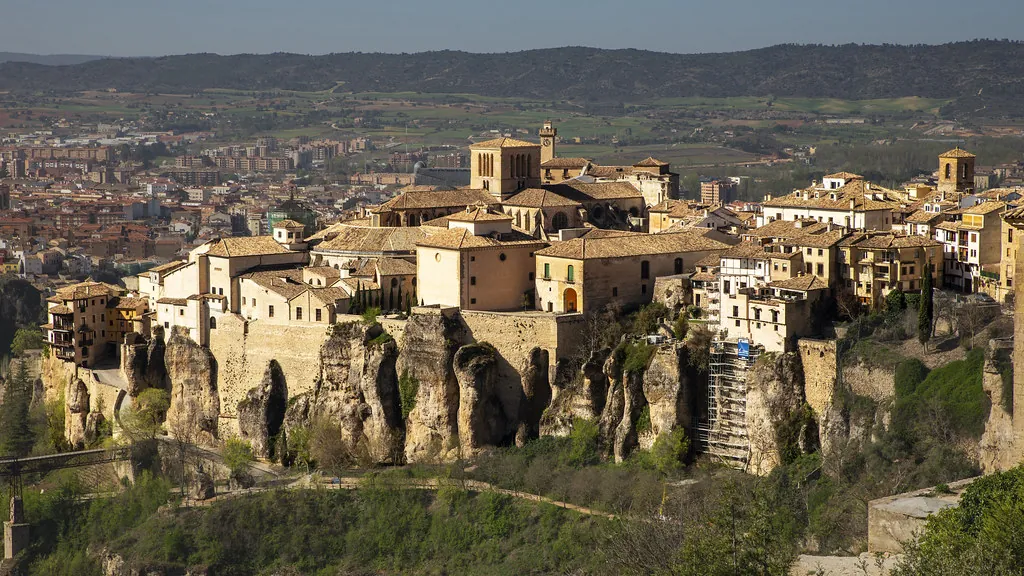
Vista aérea de Monteagudo de las Salinas
Instituto Geográfico Nacional · CC-BY 4.0 scne.es
Castilla-La Mancha · Land of Don Quixote

Monteagudo de las Salinas

The stone houses appear gradually through the windscreen, huddled against a ridge at 1,000 metres. Monteagudo de las Salinas doesn't announce itsel...

126 inhabitants · INE 2025
1000m Altitude

Why Visit

Mountain Monteagudo Castle Climb to the castle

Best Time to Visit

summer

San Isidro Festival (May) agosto

Things to See & Do
in Monteagudo de las Salinas

Heritage

  • Monteagudo Castle
  • Church of San Pedro

Activities

  • Climb to the castle
  • MTB trails

Festivals
& & Traditions

Fecha agosto

Fiestas de San Isidro (mayo)

Las fiestas locales son el momento perfecto para vivir la autenticidad de Monteagudo de las Salinas.

Full Article
about Monteagudo de las Salinas

Town with ruined cliff-top castle; history tied to the saltworks

Ocultar artículo Leer artículo completo

The stone houses appear gradually through the windscreen, huddled against a ridge at 1,000 metres. Monteagudo de las Salinas doesn't announce itself with dramatic gates or tourist signs—it simply materialises, a cluster of terracotta roofs where mobile signal drops to one bar and the temperature falls several degrees from the valley below.

This is Spain's quiet interior, where the Serranía Media's dry plains meet sudden gorges and nights remain properly dark. Just over a hundred residents remain in a village whose name tells its story: sharp mountains (monte agudo) and salt pans (salinas) that once funded generations. The salt works have fallen silent, but their memory lingers in place names and low stone walls that once channelled brine across the hillsides.

Stone, Salt and Silence

The village proper reveals itself slowly. Streets narrow and climb, following the ridge's contours rather than any planner's grid. Houses built from local stone blend into the bedrock, their wooden balconies and Arab tiles showing generations of practical adaptation. There's no grand plaza here—just a parish church whose bell tower serves as navigational aid for walkers returning from the surrounding pinewoods.

Inside the church, simple rural architecture replaces baroque excess. Thick walls keep summer heat at bay, while small windows frame views across parameras—vast high plains that stretch towards distant Cuenca. The building's modest scale reflects genuine community use rather than medieval one-upmanship. Sunday mass still draws regulars, though numbers dwindle with each passing year.

Wandering the lanes reveals details easily missed at driving speed. Stone doorways carved with dates from the 1800s. Corrals attached to houses where families once kept goats for milk and meat. A communal washing trough fed by mountain springs, now photographed by occasional hikers rather than used for Monday's laundry. These fragments speak of self-sufficient lives that smartphones and supermarkets haven't entirely erased.

Walking Country

Monteagudo's greatest asset lies beyond its stone perimeter. The municipality spreads across broken country where griffon vultures ride thermals above deep barrancos. Footpaths radiate from the village like spokes, used for centuries by shepherds moving livestock between seasonal pastures. Maps remain basic—mobile apps show blank spaces—so navigation relies on landmarks and occasional cairns.

A straightforward circuit heads south along forest tracks, climbing gently through aromatic scrub to a viewpoint overlooking the salt pans' remains. What appears as random stone rectangles actually marks industrial heritage: shallow pools where water evaporated leaving precious salt crystals. The operation closed decades ago, unable to compete with mechanised extraction elsewhere. Interpretation panels? None exist. Local knowledge or imagination must fill gaps.

More ambitious walkers can tackle the ridgeline proper, following sheep trails towards neighbouring villages twelve kilometres distant. Spring brings wild asparagus and orchids; autumn paints the landscape ochre and gold. Summer walking starts early—by eleven the sun pounds relentlessly, sending sensible hikers back to village shade. Winter transforms everything. At 1,000 metres, snow arrives properly, cutting road access for days while transforming familiar paths into pristine white corridors marked only by animal tracks.

What to Expect When You Stop

Overnight options remain limited. Hotel El Romeral provides basic doubles from €45, though TripAdvisor reviews warn of thin walls and variable hot water. Better bet is Casa Rural Rincón de Sandra, where spotless rooms in a converted village house earn consistent five-star ratings. Self-catering cabins scattered through surrounding pine woods offer privacy for families willing to drive five kilometres for bread.

Food follows mountain tradition—robust dishes designed for physical labour and cold nights. Gachas, a thick porridge of flour and water enriched with pork fat, appears on winter menus alongside wild boar stew when hunters succeed. Local cheeses range from fresh and mild to aged specimens that pair perfectly with regional red wine. Don't expect vegetarian options beyond tortilla española; this remains meat-eating country where dietary requirements puzzle older residents.

The village shop doubles as bar and social centre. Opening hours shift with seasons and owner's family commitments—arrive expecting flexibility rather than UK-style convenience. Stock up in Cuenca before driving up. The provincial capital lies eighty kilometres west, a journey taking ninety minutes via winding CM-212 and local roads that demand concentration. Public transport? Non-existent. Hire cars essential, preferably something with decent ground clearance for the final approach.

When the Village Wakes

August transforms everything. Fiesta week draws former residents back from Madrid and Valencia, temporarily swelling numbers tenfold. Suddenly the silent plaza hosts evening concerts, communal paellas feed hundreds, and teenagers who've grown up elsewhere negotiate village dynamics with cousins seen annually. Book accommodation months ahead—or avoid completely if seeking solitude.

Religious festivals throughout the year maintain community rhythm. Spring processions mark agricultural cycles; autumn services celebrate harvest survival in harsh terrain. These events happen for locals rather than visitors, but respectful observation reveals genuine community hanging on through sheer determination. Photography during processions? Ask first. Many participants view cameras as intrusive rather than flattering.

Winter brings different challenges. When snow blocks access, the village becomes temporarily self-reliant again, relying on stored provisions and neighbourly cooperation. Power cuts last hours rather than minutes; mobile coverage disappears entirely. For some visitors, this digital detox proves therapeutic. Others flee within twenty-four hours, desperate for connectivity and choice.

Monteagudo de las Salinas won't suit everyone. Those seeking boutique hotels, Michelin stars or curated experiences should stay on the coast. But for travellers wanting to understand how Spain's interior survives as young people depart and services shrink, this stone village offers unfiltered reality. Come prepared—bring cash, download offline maps, pack walking boots—and discover a place where silence still carries value and the mountain dictates terms human residents simply accept.

Key Facts

Region
Castilla-La Mancha
District
Serranía Media
INE Code
16131
Coast
No
Mountain
Yes
Season
summer

Livability & Services

Key data for living or remote work

2024
Connectivity5G available
TransportTrain nearby
Housing~5€/m² rent · Affordable
Sources: INE, CNMC, Ministry of Health, AEMET

Planning Your Visit?

Discover more villages in the Serranía Media.

View full region →

More villages in Serranía Media

Traveler Reviews