Full Article
about Olmeda del Rey
Quiet village where the plain meets the sierra; vernacular architecture
Hide article Read full article
By mid-morning, the stone of the church still holds the night’s cool. In Olmeda del Rey, the day unfolds slowly. A door opens here, a metal shutter rattles there, and the sound carries along the pale façades of Calle Mayor.
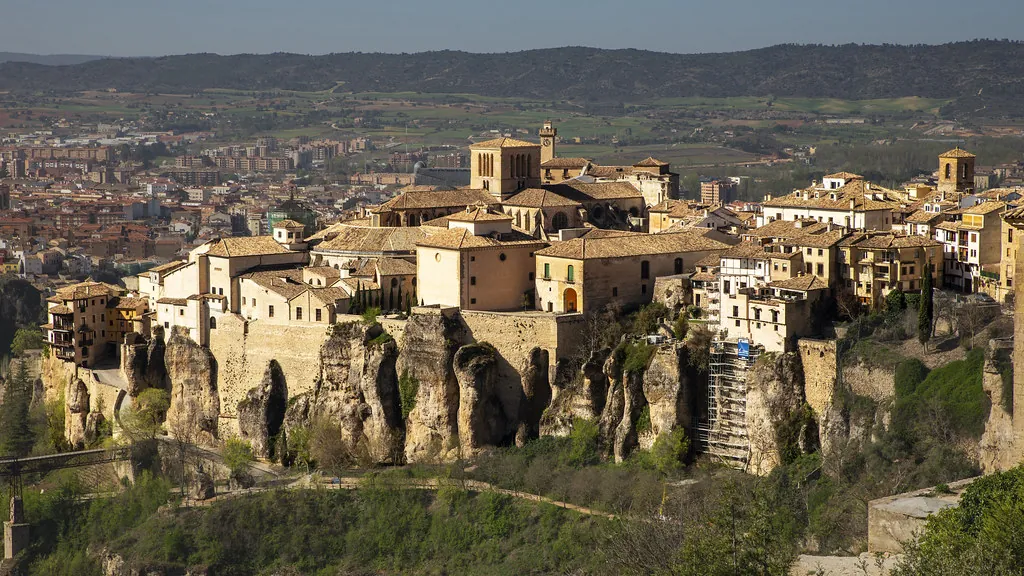
At the centre of the village stands the church of Nuestra Señora de la Asunción. Its masonry tower rises above the rooftops and acts as a clear point of reference when approaching by road. It is not a grand or imposing building. Inside, there is often a faint mix of candle wax and old damp in the air. The Baroque altarpiece in the main chapel adds a touch of colour to an otherwise restrained interior.
The village core
From Calle Mayor, a short slope leads down to the square. A few benches remain, along with a stone well that now serves more as a reminder of the past than as a water source. At certain times of day, hardly anyone passes through.
The houses follow the practical logic typical of villages in the Serranía Media, a region of gentle hills in this part of Castilla-La Mancha. Thick walls help regulate temperature, small windows limit the heat, and wooden balconies creak when opened. Streets such as Calle de la Fuente or Calle Alta show clearly how the layout adapts to the terrain. There are no sweeping views or wide avenues. Instead, the space is shaped by tight corners and gradual slopes.
In the afternoon, the light falls at an angle and brings out the irregular texture of the stone. It is a good time to walk without hurry. In summer, the middle of the day is best avoided, as the sun falls directly onto the more exposed streets.
The surrounding landscape
A few kilometres beyond the village centre, cereal fields begin to spread out. In spring, the green is vivid and the wind moves across it like water. By summer, the colour shifts to a dry gold, rougher in tone and texture.
Among these fields, patches of pine and holm oak appear. These mark the areas where the Serranía Media starts to take shape. There are no high mountains, but there are low hills and shallow ravines that break up the flatness of the land.
On clear days, the horizon stretches a long way. At sunrise, mist sometimes settles in the valley bottoms, leaving the village slightly above it, with rooftops emerging through the haze.
Dirt tracks and scrubland
The most natural way to explore the surroundings is on foot, following agricultural tracks. Some begin right at the edge of the last houses. Others lead into pine woods and towards old livestock enclosures, some partially collapsed.
There is no tourist signage or interpretive panels. It is sensible to bring water and check the route in advance, especially in summer. When the wind drops, the heat can become intense.
In the scrubland, small springs and damp areas appear here and there. Some, like the well-known Fuente del Cárdeno, continue to serve as reference points for locals when they go out for a walk or to check their land.
Autumn: mushrooms and quiet
With the first autumn rains, the pine woods take on a different scent. Damp earth and resin mix in the air. This is when some locals head out in search of mushrooms.
Níscalos, a type of saffron milk cap common in Spain, are among the varieties that appear, along with others typical of the area. Each year is different. For those unfamiliar with the terrain or the species, it is wiser to seek advice beforehand or simply enjoy a walk.
Autumn is also a good time for observing birdlife. Birds of prey can be seen gliding above the hills, using the air currents. Lower down, among the shrubs, the sounds of goldfinches and magpies carry through the stillness. On quiet days, there is little else to hear besides the wind.
Summer and return
For much of the year, Olmeda del Rey moves at a very slow pace. In summer, that changes. Families with roots in the village return, and the streets regain some movement.
The patron saint festivities take place in August, centred around the church and Calle Mayor. There are processions, afternoon music, and shared meals between residents and those who return for a few days.
Outside these dates, the rhythm settles again. That is part of the point. This is not a place defined by a long list of activities. What draws people here is simpler: a walk along a quiet street, the sound of the countryside, and the gradual shift of light over the rooftops and fields that surround the village.