Full Article
about Piqueras del Castillo
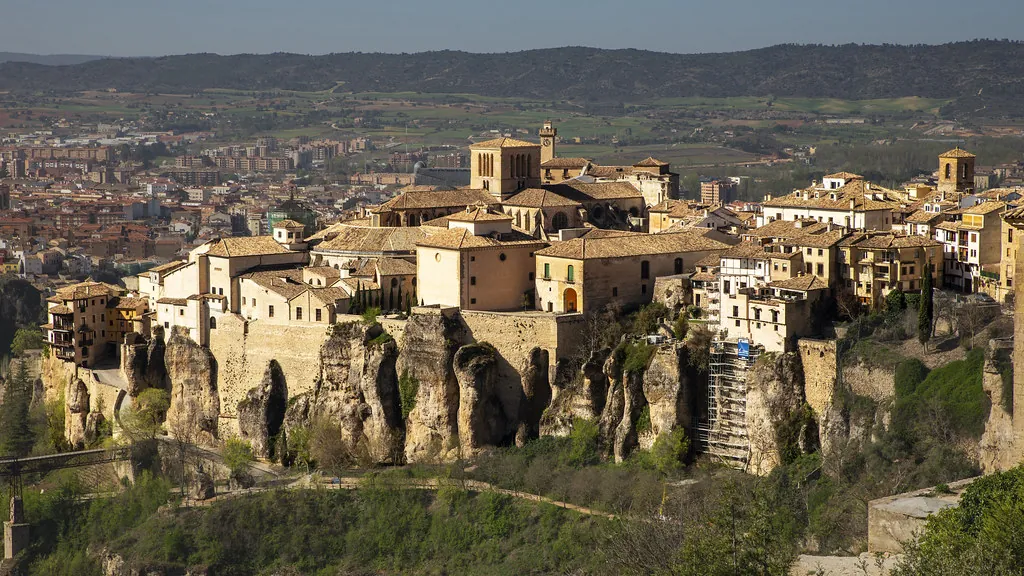
Village dominated by the ruins of an Arab castle; panoramic views
Hide article Read full article
First light over the village
Early in the morning, when the sun still slips low through the holm oaks, Piqueras del Castillo barely announces itself. The road narrows, the tarmac turns uneven, and then a small cluster of red-tiled houses appears among pale earth and stone walls. At that hour, sound is scarce. A bird moves somewhere in the pines, wind brushes the branches, and, with a bit of luck, a wooden door opens with a dry creak.
The village sits at around 900 metres above sea level, and that height shows in the air. Even on warm days it feels fresher than expected. Many of the houses are built from masonry and adobe, with repairs that reflect whatever materials were available at the time. Cement patches, dark beams and heavy doors speak of winters that have left their mark.
Nothing here feels arranged for display. The setting remains practical and grounded, shaped by use rather than appearance.
The hill where the castle once stood
The name Piqueras del Castillo points to a medieval fortification that has almost entirely disappeared. Old documents refer to the castle and to the hill where it stood, a rise that overlooks a wide stretch of the Serranía Media landscape.
The climb towards that hill, now more of a low ridge covered in scrub, helps explain why people settled here. From this height, the land opens into long views over ravines and patches of pine forest. The position makes sense even without visible walls.
No standing structures remain to define the site clearly. What persists is a sense of place, along with scattered traces hidden among vegetation. The castle survives more in memory and written record than in stone.
Streets that keep things simple
The centre of Piqueras del Castillo is small enough to cross in a matter of minutes. Streets are either unpaved or covered in worn asphalt. Stone walls enclose corrals, and inside many yards there are still stacks of firewood and farming tools.
The parish church, usually dedicated to San Bartolomé, follows the same restrained approach seen elsewhere in the village. It consists of a single nave, a wooden roof structure and a modest bell tower. On quiet days, the sound of the bell lingers for a few seconds above the rooftops before fading.
Space is limited, and the layout reflects that. It makes sense to arrive without rushing and leave the car at the entrance if the streets look too narrow. In places like this, one badly parked vehicle can block access completely.
There is no attempt to reshape the village into something else. The layout, materials and rhythms remain tied to everyday life rather than presentation.
Walking into the surrounding landscape
The area around Piqueras del Castillo mixes pine woods with patches of juniper and sabina growing among granite rock. The ground changes with the seasons. Spring brings low plants and discreet flowers, while summer is defined by the dry scent of resin and dust rising from the paths.
Several rural tracks begin at the edge of the village and fade into the hills. Signposts are not always present, but many of these routes follow old shepherd paths. Walking them feels calm and open-ended. A bend in the path might reveal a clearing, a flock of sheep, or the distant sound of a bell.
The sky often carries movement. Griffon vultures circle on rising air currents, and kestrels or booted eagles glide over the ravines. At dawn or towards evening, encounters with wildlife become more likely. Roe deer sometimes appear, and wild boar leave their traces along the tracks.
Season matters here. Spring and autumn tend to be the most comfortable times for walking. Summer brings strong sun across exposed areas, with little shade beyond the pine woods.
The landscape does not impose a route or a fixed experience. It invites slow movement and attention to small changes in terrain, light and sound.
Food shaped by the land
Cooking in this part of the sierra remains closely tied to the countryside. In nearby villages, dishes such as migas are common. This simple preparation uses dried bread and olive oil. Lamb raised in the hills also appears regularly, reflecting the local livestock tradition.
Another familiar dish is gazpacho manchego, also known as galianos. It is made with game or farm-raised meat and reflects older ways of cooking tied to hunting and rural life.
There is no emphasis on elaborate presentation. Menus tend to follow what has been cooked here for generations, with continuity rather than reinvention guiding the table.
A place that moves at its own pace
August brings a shift in rhythm when the fiestas of San Bartolomé take place. At that time, the village becomes livelier as residents who live elsewhere return. Conversations stretch into the evening, and the central spaces fill with voices and movement.
For the rest of the year, Piqueras del Castillo moves slowly. It is not a destination built around major monuments or long itineraries. The experience is quieter and more diffuse.
Time here is better understood through small moments. A pause beside a sun-warmed wall, the sound of wind moving through the pines, or the gradual change of light across the sierra all shape the day. Schedules matter less than the natural rhythm of the surroundings.
Piqueras del Castillo does not try to stand out. Its character comes from continuity, from the way it holds on to its scale and habits. The result is a place where very little competes for attention, and where the passage of time feels closely tied to the landscape itself.