Full Article
about Valdetórtola
Municipality made up (Valdeganga
Ocultar artículo Leer artículo completo
The church bell strikes seven and the village bakery pulls down its metal shutter with the same metallic clack it has made since 1983. By twenty past, the single street lamp outside the bar flickers off and the day’s first tractor coughs into life. Valdetórtola, population 127, is awake. Anyone expecting a languid Mediterranean lie-in has come to the wrong postcode.
At 900 m on the southern flank of the Serranía Media, the settlement sits high enough for the air to carry a sharp edge from October to April. Frost feathers the cereal stubble and the pine woods on the ridge hiss whenever the wind shifts. Summer, by contrast, is a dry, golden endurance test; thermometers brush 35 °C and the only reliable shade is inside the stone-walled houses, their walls half a metre thick and originally designed for grain storage as much as for people.
A map, boots and a polite question
There is no tourist office, no yellow-arrowed footpath network, no ticket booth of any kind. What Valdetórtola offers instead is a lattice of old mule tracks that fan out into holm-oak dehesa and umbrella-pine plantations. The most useful walking guide is the retired farmer in the checked shirt who has already asked, twice, where you parked. Ask him which camino leads to the ruined choza on the skyline and he will draw the route in the dust with a stick, adding that the gate on the far side sticks unless you lift it. Free, accurate, accompanied by a weather forecast – more reliable than any app.
Expect to share the path only with crested larks and the occasional Bonelli’s eagle sliding overhead. A circular hike to the stone aqueduct above the River Marquesado takes two hours; extend it another hour eastwards and you drop into the neighbouring hamlet of Talayuelas, whose only bar serves a plate of migas fried in proper mountain olive oil for €6. Mobile reception is patchy, so download the IGN 1:25,000 map before leaving the rental car.
Stone, adobe and the smell of sheep
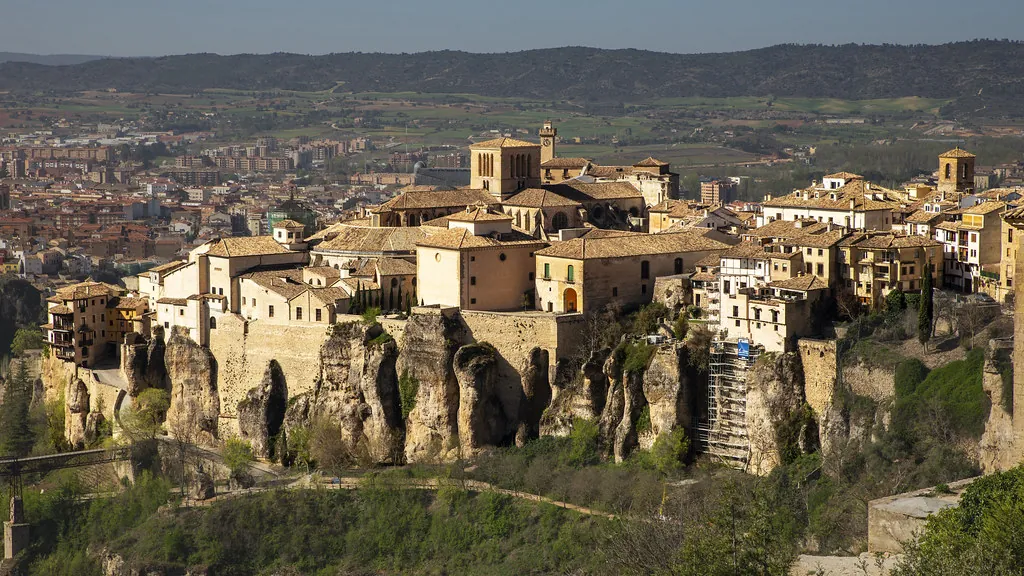
The village’s architecture is honest rather than pretty. Houses rise straight from the lane, their lower courses in mottled limestone, the upper storeys in ochre adobe that softens under winter rain. Balconies are narrow, just wide enough for a geranium pot and the morning coffee. Several roofs still carry the original Arab tiles, curved like half-moons; when one slips, the owner wedges it back with a sliver of slate rather than calling a roofer from Cuenca. The effect is utilitarian, occasionally scruffy, entirely authentic.
Inside the single-aisle parish church the temperature drops ten degrees. Walls are bare plaster, the timber roof beams are blackened by centuries of candle smoke, and the only ostentation is a 17th-century gilded tabernacle whose door no longer closes properly. Mass is held every Sunday at eleven; visitors are welcome but the priest expects you to join the offertory queue like everyone else.
Eating what the land had left over
Gastronomy here evolved from scarcity. Morteruelo, a pâté of game liver and breadcrumbs, was a way to stretch one partridge across four workers. Gachas, a thick paprika-spiced porridge, started life as shepherd fuel. Today the dishes appear on family tables rather than restaurant menus, so if you want to taste them you have two choices: be invited, or rent one of the self-catering cottages and cook. The tiny Consum in the next village stocks local morcilla and goat’s cheese at half Madrid prices; the butcher will dice shoulder of mutton to your specification while recounting whose grandson has emigrated to Leeds.
There is no hotel. Accommodation is strictly rural: Finca Buenavista sleeps twelve round a chlorine-free pool, VRBO ref. 10123868ha offers stone walls and Wi-Fi that copes with email but not Netflix. Expect to pay £110–£140 a night for a three-bedroom house in May; prices dip outside school holidays and plummet in January when night frosts glaze the windscreen. Bring slippers—stone floors are cold at dawn.
When the plaza becomes the universe
Festivity is low-key by design. The fiesta patronal, around 15 August, borrows a sound system from Talayuelas, hires a cuarteto to play pasodobles and sets up a bar under plane trees. The highlight is the toro de fuego: a framework of fireworks wheeled through the streets by adolescents who have waited all year for permission to set light to something legal. Accommodation owners warn that beds sell out six months ahead, not because hordes descend but because every returning grandchild needs a mattress. Book early or come a week later when the village exhales and you have the plaza to yourself again.
Winter visitors should pack chains; the CM-210 is cleared after snow but not before the school bus has made its morning run. Spring, by contrast, is the cheat code: almond blossom dusts the fields with white, daytime temperatures hover around 18 °C and the night sky is so dark you can track the ISS with the naked eye. September brings the mondi, the communal mushroom hunt; outsiders may join if they bring their own knife and basket, and if they accept the unspoken rule: what you find, you share.
Getting here, and knowing when to turn back
The closest airports are Madrid-Barajas (1 h 50 min) and Valencia (2 h 10 min). From the A-3 motorway you peel off at Motilla del Palancar, then snake uphill on the CM-210 for 28 km. The final 5 km are paved but narrow; meet a combine harvester and someone has to reverse. There is no petrol station in Valdetórtola; fill up in Motilla and top up the windscreen washer—dusty tractors coat your hire car in a fine grey film within minutes.
Leave the village before midnight and the darkness feels absolute. Headlights pick out the red reflectors of hunting signs, nothing else. The compensation is the return journey next morning: crest the last ridge and Valdetórtola appears below, a cluster of terracotta roofs still in shadow while the surrounding cereal fields glow gold. It is not spectacular, not “breathtaking”, simply a reminder that somewhere between the motorway and the sky rural Spain continues to keep its own appointments. Turn up on time and you are, briefly, part of the schedule.