Full Article
about Albendiego
On the rural Romanesque route; noted for its unfinished, highly artistic hermitage.
Hide article Read full article
A place that keeps its distance
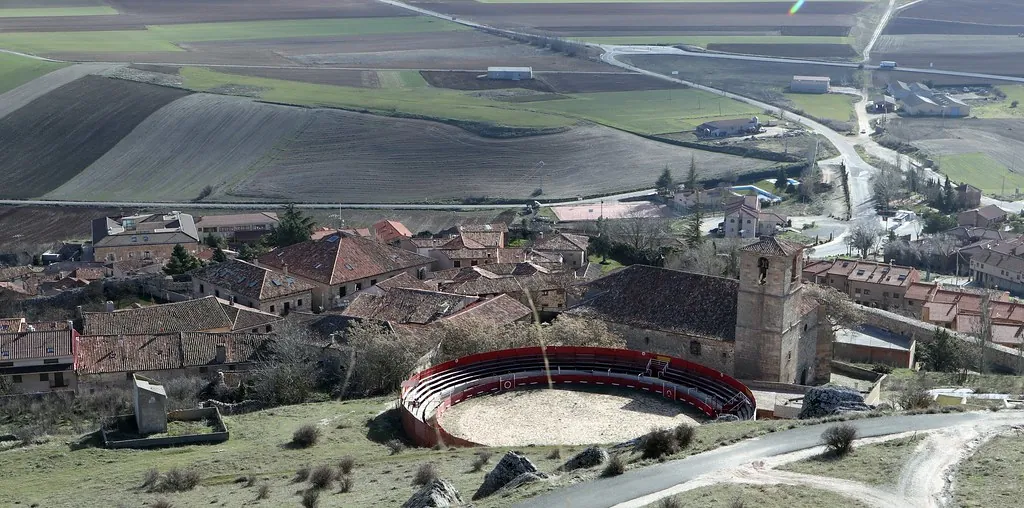
Albendiego is the kind of place where you arrive and briefly wonder if you have taken a wrong turn. A handful of houses, silence, and a lot of mountains around you. That is about it. Tourism in Albendiego does not work like it does in better known villages of the Sierra Norte in Guadalajara. There is no weekend buzz, no streets lined with terraces. The appeal sits somewhere else entirely.
With fewer than fifty residents and set at over 1,200 metres above sea level, the village moves at its own pace. Livestock, a bit of farming, and the feeling that time passes more slowly than in any city. It is not a place where things “happen”, yet that is exactly why many people come.
The landscape takes the lead. In spring everything turns properly green, the kind of pasture green that looks freshly washed. Summer shifts the palette to dry, golden tones. Winter can bring snow, and even the access road makes it clear you are deep in the mountains.
At night, when the sky is clear, the view overhead is striking. There is hardly any artificial light, so the stars appear with a clarity that has all but disappeared in urban areas.
Santa Coloma, the reason people come
Most visits to Albendiego centre on the ermita de Santa Coloma. It stands just outside the village and can be reached on foot in a few minutes, with no chance of missing it.
Usually dated to the 12th century, it is a notable example of rural Romanesque architecture. It is not large or imposing. In fact, the first impression is often that it feels too small for its reputation. Then the details begin to draw attention.
The apse is the standout feature. Three windows fitted with finely worked stone latticework appear unexpectedly elaborate for such a modest building. They invite a closer look, the kind that makes you pause and wonder how they were carved so many centuries ago.
Inside, there are still traces of wall paintings. They are not always easy to make out, yet religious figures and areas of colour can be distinguished, holding up remarkably well over time.
The walk to the ermita adds something of its own. Leaving the village, crossing a stretch of meadow, and then seeing the church appear with the mountains behind it is a simple sequence, but an effective one.
The shape of the village
Albendiego can be walked in ten minutes. Quite literally.
The houses follow the typical style of this part of Guadalajara: stone, wood, and thick walls built to withstand long winters. There are no large squares or commercial streets. Instead, short lanes, small enclosures and the occasional kitchen garden define the layout.
The parish church is more restrained than the ermita. It serves its purpose without drawing much attention. Historically, Santa Coloma took centre stage centuries ago and has kept it ever since.
Around the village centre, open meadows appear where sheep or goats are often seen. Juniper and holm oak trees are common in this stretch of the Sierra Norte. Climb to a nearby high point and the sense of being on a frontier becomes clearer, with the provinces of Soria and Segovia not far away.
Walking out into the sierra
Much of what makes Albendiego interesting lies beyond the village itself.
Rural tracks connect it with nearby places such as Condemios de Arriba and La Cabrera. These are simple routes, used for generations as a way of moving between villages. Not all of them are signposted as official trails, so carrying a map or GPS is sensible.
The terrain alternates between open pasture and areas of low scrub. Vultures are often seen circling above the ravines, and towards dusk it would not be unusual to come across a fox if there are few people about.
In summer, setting out early in the morning or waiting until late in the evening changes the experience noticeably. The heat drops and the silence becomes almost complete.
A short stop, or part of a longer route
Albendiego is very small, so expectations need to be realistic. It is not always possible to find bars open or places to eat within the village itself.
Many visitors follow a similar plan: stop to see the ermita, take a short walk through the village, and then continue on to other villages in the Sierra Norte where there is more activity.
With a bit of planning, it fits easily into a day out in this part of the province: Albendiego, a walk in the mountains, and a meal in a nearby village.
No gloss, no staging
Albendiego does not try to be anything other than what it is. There are no staged corners or signs designed for quick photos. It is simply a very small village with a distinctive Romanesque ermita and a mountain landscape that has changed little over time.
For those drawn to quiet places that can be taken in over an unhurried morning, it works well as part of a route through the Sierra Norte of Guadalajara. And even for a brief stop, the visit to Santa Coloma alone makes the detour worthwhile.