Full Article
about Alcolea de las Peñas
Tiny rural hamlet of reddish-black stone; sparsely populated, very quiet.
Hide article Read full article
A village that simply carries on
Some villages feel like stage sets. Then there is Alcolea de las Peñas, which feels more like walking into your grandparents’ house and noticing that almost everything is still where it was decades ago. Nothing has been arranged to impress visitors. It is simply still there.
This tiny settlement lies in the Sierra Norte de Guadalajara, in Castilla La Mancha. It is small even by the standards of the area, with barely half a dozen registered residents. People do not come here to tick off attractions or fill an itinerary. They come to look around and wonder how daily life was organised in a place so small and so removed from anywhere else.
The scale is the first thing that stands out. A handful of streets, a few houses, rock all around. It does not take long to walk from one end to the other. The appeal lies elsewhere, in the atmosphere and in the sense that very little has shifted over time.
Stone houses and limestone giants
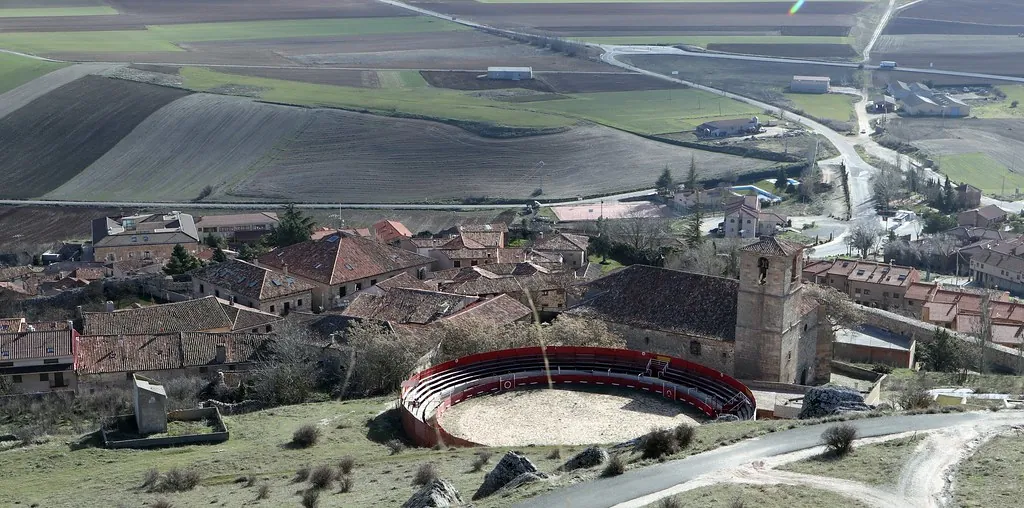
Alcolea de las Peñas gathers itself along a few streets that climb gently up the hillside. The houses are built from stone, with thick walls and small windows that make it clear winters here are harsh. There are no grand squares or monumental buildings. Everything looks functional, constructed with the materials that were available locally.
The small church of San Martín serves as the village’s reference point. It is simple and undecorated. Rather than trying to impress, it feels like a practical meeting place, a building meant to serve the community more than to dazzle it.
Yet the true character of the place comes from the peñas, the large limestone rocks that surround the village and give it its name. Some of these blocks are enormous. A few have unusual shapes, as if they had been dropped there at random. At sunset their colour shifts noticeably, moving from pale grey to warmer tones as the light fades. There is no organised spectacle. The change just happens as the day ends.
Holm oaks and junipers grow among the rocks, scattered across uneven ground. The terrain is irregular, with slopes and stretches of bare stone where it pays to watch your footing. There are no signposted walking routes with panels and arrows. Visitors need to find their way in a more old fashioned manner or rely on GPS.
Anyone with an interest in geology will find plenty to examine. The limestone walls show cuts, cracks and hollows that hint at the immense span of time that shaped them. No explanatory boards break it down for you. Observation and curiosity do the work.
What time here really looks like
A visit to Alcolea de las Peñas is usually brief. That suits the village just fine.
Most people stroll through the streets, then head out towards the surrounding rocks for an unhurried walk along nearby paths. The plan is simple: walk for a while, sit down somewhere quiet, and listen to the silence. The absence of noise becomes part of the experience.
Birds of prey are often easy to spot. Griffon vultures circle above the peñas, riding the air currents. Binoculars help, but even without them it is worth glancing up from time to time.
After dark, the sky has its own appeal. The area has very little artificial lighting, and it shows once night falls. It is one of those places where more stars become visible than many people are used to seeing.
There are no places in the village itself to eat or to stay overnight. Most visitors stop for a while and then continue on to other villages in the surrounding comarca where there is more activity. Alcolea functions as a pause rather than a base.
Very small, still inhabited
With around seven residents according to the latest figures, daily life in Alcolea de las Peñas is quiet to say the least.
Even so, there are moments in the year when the village becomes livelier. Traditional celebrations linked to the religious calendar still take place. As in many nearly empty villages across rural Spain, summer brings back descendants and relatives who reopen family houses for a few days. Streets that are silent for much of the year see a little more movement during those periods.
For the rest of the time, silence dominates. There is also the sense that the village continues to endure, even with so few people. It has not turned into a museum piece or a reconstructed heritage site. It remains a lived-in place, however lightly.
That persistence shapes the atmosphere. The buildings are not curated exhibits. They are simply part of everyday life, maintained as needed, used when required.
Reaching the edge of the map
Getting to Alcolea de las Peñas means accepting a fair stretch of secondary roads through the Sierra Norte de Guadalajara. The final kilometres are narrow and winding, which is typical for this part of the province.
It is wise to set off without rushing. Distances are not vast, but services are spread out across different villages. This is not an area where everything sits around a single main road.
The simplest approach is to include Alcolea as part of a wider route through the comarca. Stop, walk among the peñas, look around the village at a calm pace, then continue your journey. Places like this do not demand hours of sightseeing to make sense. A short visit and a bit of curiosity are enough to grasp what they are about.
Alcolea de las Peñas does not offer spectacle or a packed schedule. It offers stone, silence and a glimpse of how life persists in one of the quieter corners of Castilla La Mancha.