Full Article
about Alcolea del Pinar
Historic communications hub; famous for a house hand-carved into living rock
Hide article Read full article
The village you drive past on the A-2
You know those places you see on a road sign and think, "Maybe next time"? Alcolea del Pinar is one of those. Most people encounter it as a name on the blue motorway signs between Madrid and Zaragoza. I stopped because I needed coffee and a leg stretch, and the exit appeared at the right moment. What I found was a village that feels like a deep breath of cold, quiet air.
Perched at over 1,200 metres, with about three hundred people, it doesn't announce itself with postcard views. You approach through combed lines of pine trees and open fields, and the village materialises slowly. The mountains of the Sistema Ibérico sit on the horizon like a distant wall. Nothing here shouts for your attention. It’s more like finding a functional, no-frills bar where everything has its place.
A centre of gravity made of stone
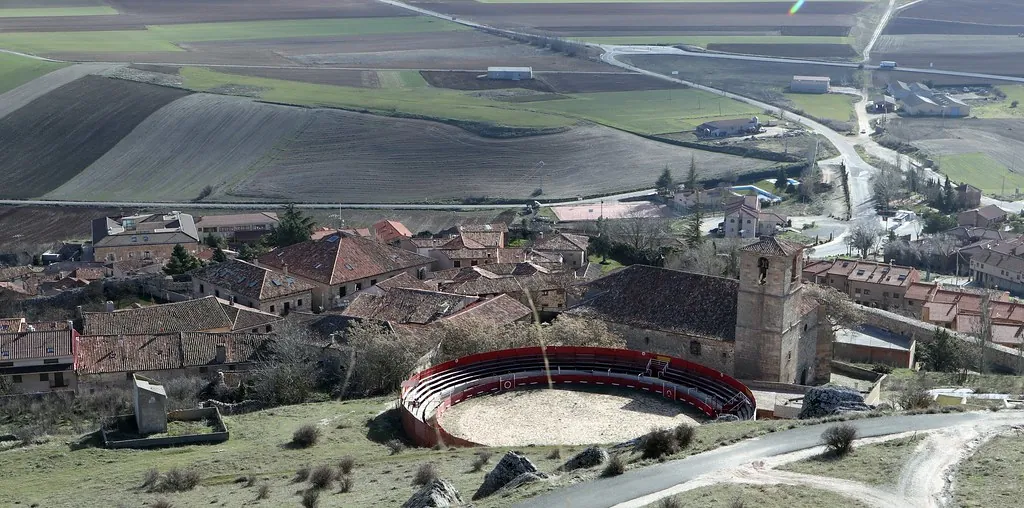
The Iglesia de San Juan Bautista isn't just a church; it's the village's anchor. Built to withstand centuries of high-plateau winters, with medieval roots and later additions, it has a stubborn solidity. The clock tower seems to keep time for the whole place, not with urgency, but with a steady rhythm.
The old quarter spreads out from there. The streets are lined with stone houses wearing their age plainly: wooden doors that don't hang quite straight anymore, iron balconies holding geraniums that have seen better days. It’s not pretty in a polished way. It feels lived-in, like a well-worn tool that still does its job perfectly well.
The main square is the size of a decent living room. Sit on a bench for a bit and you'll witness the local traffic: someone crossing to buy bread, an old man catching the last sun of the day, a brief chat about the weather. Life moves at the pace of a stroll.
Where the pines take over
The truth about Alcolea is that its streets are just an introduction. Walk five minutes in any direction and you're in the pine forest. The ground is pale, covered in needles, and the air smells cleanly of resin. This isn't hiking territory for epic adventures; it's for walking without thinking too much. Wide tracks lead you under the trees for as long as your legs want to go.
This landscape has different modes depending on the season. Autumn brings mushroom pickers with their woven baskets; winter can bury it all under a thick, silencing snow. At night, especially if there's no moon, you get that shock of starry sky you forget exists when you live in a city with streetlights.
The simple maths of a visit
What do you do here? You walk. You sit in the square. You notice how quiet it gets after dark. In late June, for the fiestas of San Juan Bautista, people who moved away come back. The population doubles or triples for a weekend. There’s a procession, music from a modest sound system set up in the street, and gatherings that last until dawn cools everything down again. It’s not a spectacle; it’s more like the whole village becomes one big family reunion.
The local food follows suit: lamb from nearby pastures, stews that stick to your ribs, and in autumn, whatever mushrooms were found in the woods that week.
A practical footnote if you're driving
Finding it is easy: it's right off exit 104 of the A-2 motorway. Missing it is even easier if you're not paying attention. Remember this is high ground. Summer days can be warm but pack a jacket for the evening; when the sun drops here, so does the temperature like someone opened a fridge door. If you need more services or fancier dining options, Medinaceli isn't far by car. A lot of people visit both in one trip, which makes sense. But Alcolea works best as its own thing: a pause, a stretch of your legs, and an hour or two spent listening to pine trees instead of traffic