Full Article
about Algora
On the A-2 motorway; gateway to the hills and a travelers’ stop.
Ocultar artículo Leer artículo completo
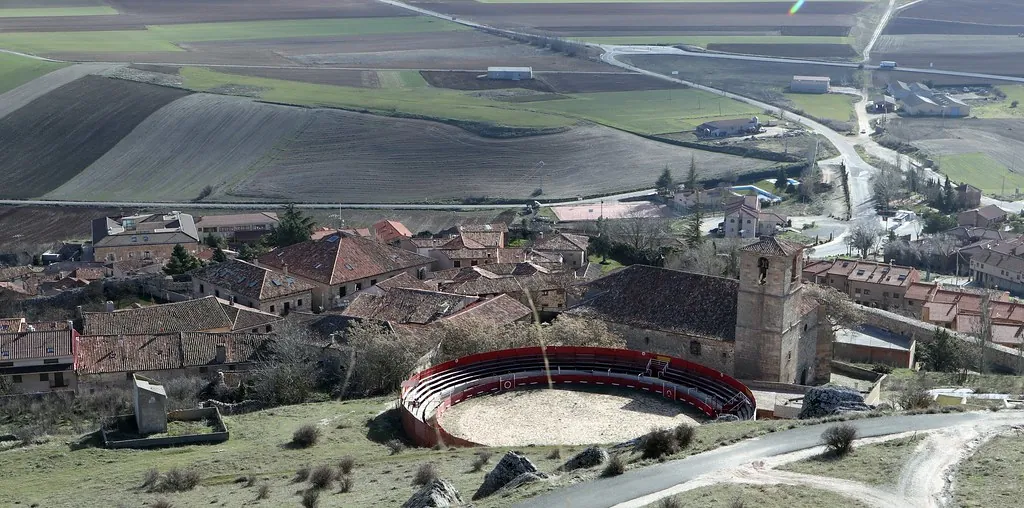
The church bells ring at 1,118 metres above sea level. Most visitors hear them only because they’ve pulled off the A-2 at kilometre 112, stretching stiff legs after the haul from Santander or Zaragoza. Below the service-area forecourt, a narrow road corkscrews uphill for three kilometres until the tarmac levels out and Algora appears: ninety souls, stone houses the colour of toast, and a wind that smells of thyme even in December.
What the map doesn’t say
Sat-navs give the village a courteous 500-metre dot, but scale is deceptive up here. The parish church looks close enough to touch from the motorway slip road; in reality it sits on its own ridge, separated from the petrol pumps by a lane barely wide enough for a Tesco delivery van. Lorries can’t make the turn, which is why the 24-hour café does a brisk trade in churros and calamares rolls while the pueblo itself stays silent. If you need cash, fill up before you climb—there isn’t an ATM for 25 km.
The altitude matters. In July the meseta below simmers at 38°C; Algora’s evenings drop to a civilised 22°C. Come January the same thermometer can read –6°C at breakfast, and the stone houses huddle like sheep. Snow is not postcard decoration; it is an annual reality that can seal the access road for an afternoon. Carry a blanket in winter, and download offline maps—mobile data flickers in and out like a tired torch.
A twenty-minute lap that takes all afternoon
You can walk every street in twenty minutes, yet the place encourages dawdling. Start at the church, finished in 1634 with funds so tight the tower is shorter than the nave. Step inside and the air smells of candle wax and timber; the altar rail is a simple iron bar, no gilded excess. Outside again, notice how roofs are weighted with stones against the wind, and how every third doorway hides a bread oven the size of a garden shed. These details accumulate: they don’t shout, but they reward attention.
From the tiny plaza a farm track heads south between dry-stone walls. After ten minutes the village sinks behind the crest and you are alone with skylarks and the occasional tractor whose driver raises two fingers from the wheel in silent greeting. The path links to an old grain mill 4 km on; turn back sooner if the sky looks heavy—clouds form quickly at this height and the path turns slick as ice once wet.
Birds, bikes and the long-distance itch
Serious hikers use Algora as a cheap dormitory on the GR-86, a 200-km traverse of the Guadalajara sierras. Day-trippers can borrow a slice of that freedom by following the signed section west towards Valdepeñas de la Sierra: six kilometres of gentle ups and downs, kites wheeling overhead, wheat stubble crackling underfoot. Mountain bikers favour the same ridge; the hire shop is 35 km away in Guadalajara, so bring your own or make friends with the Dutch couple who keep a second home here and own three spares.
Birders rate the area more highly than the village admits. At dawn the terraces echo with the churr of Dartford warblers; midday thermals lift golden eagles above the cereal fields. A pair of binoculars and a seat on the cemetery wall will usually add red-billed chough and black-shouldered kite to a British list without trying too hard.
Calories and caffeine: where to find them
Algora has no pub, no tapas strip, no Sunday roast. The single shop opens for forty-five minutes on weekday mornings and stocks UHT milk, tinned tuna and local honey so thick you need a teaspoon to coax it from the jar. Plan accordingly. The motorway services—yes, those fluorescent lights you just escaped—remain the most reliable kitchen for twenty-five miles. Their bocadillo de calamares is surprisingly delicate: rings fried to order, stuffed into a baguette with nothing more than a squeeze of lemon. Breakfast churros arrive curled like old telephone wire; the chocolate is darker than anything Cadbury ever attempted, so order the small cup unless you enjoy heart palpitations.
If you crave a sit-down menu, drive fifteen minutes east to Cifuentes, where Casa Candi does a three-course comida del día for €13 including wine. The migas—fried breadcrumbs with garlic, grapes and chorizo—taste even better when you have walked there across the hills and back.
When to come, when to stay away
May and late-September offer the kindest compromise: daylight until eight, fields green from either the last spring rain or the first autumn storm, and villagers inclined to linger outside the church after mass. August fiestas bring the population back to maybe 250; brass bands play until two in the morning, but beds are non-existent unless you booked the motel in June. Winter is magnificent if you own decent thermals and a car with snow tyres; otherwise the silence can feel more lonely than romantic.
British half-term weeks coincide with Spanish working days, so you may share the ridge only with a shepherd and two spaniels. Conversely, the August exodus from Madrid means the A-2 queues from kilometre 80 eastwards; allow an extra ninety minutes if you land at Barajas and turn straight onto the motorway.
Beds, walls and misleading Wi-Fi
Accommodation is binary. Option one: Motel 112 Algora, whose rooms overlook the carriageway yet are oddly peaceful behind triple glazing. €55 buys a spotless double, a shower with more pressure than most London hotels, and a vending machine coffee at dawn. Option two: scattered rural cottages advertised under “Algora” on Airbnb—always zoom the map. Many sit nearer to the province of Teruel than to the village itself; a charming stone hut can translate into a forty-minute cliff-edge drive after dark.
A third, unofficial, option is to ask. The village mayor doubles as the parish treasurer and holds a spare key to a house owned by his cousin in Catalonia. If you speak enough Spanish to explain you’d like to leave the place exactly as you found it, a rate of €30 cash may secure two rooms and a kitchen with a kettle that whistles in B-flat. Don’t expect Wi-Fi; the password is written on the underside of the router, and the router is usually unplugged to save electricity.
Leaving without rushing
Sunset throws long shadows up the cereal terraces; by the time the bells ring nine o’clock the temperature has dropped ten degrees. Start the engine and you’ll rejoin the motorway within four minutes, the village lights shrinking to a yellow smear in the rear-view mirror. Algora rarely makes anyone’s “top ten” list, and that is precisely its virtue. It is a place to remember that Spain still has space where the loudest noise is your own breathing—and to appreciate how quickly that space disappears once you drop back below 800 metres and the lorries start overtaking again.