Full Article
about Angón
Remote enclave in the mountains; known for its total quiet and oak-covered landscapes.
Hide article Read full article
Early in the morning, before the sun has fully cleared the low ridges of the Sierra Norte, Angón is almost completely still. Wind moves through the branches of the oaks. Now and then a wooden door knocks softly in the breeze. The air is cool and carries the scent of damp stone. From one of the masonry houses, dark beams visible beneath the roof tiles, the outline of Cerro de la Muela rises in the distance.
Very few people live here. The official register hovers around eight residents, and that absence of movement is immediately noticeable.
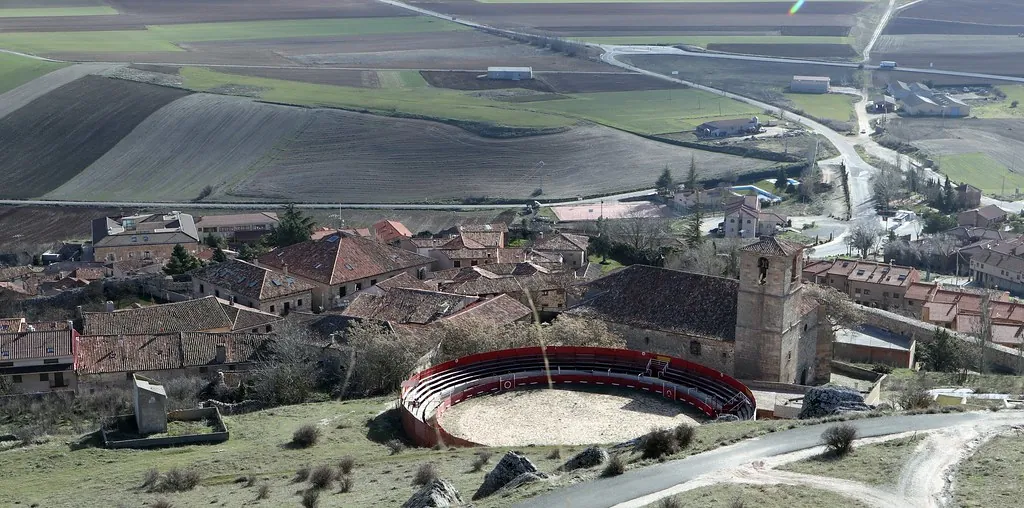
Set at close to 1,000 metres above sea level, in the Serranía de Guadalajara in northern Castilla La Mancha, Angón is one of the smallest settlements still holding on in the Sierra Norte. Its streets are short and narrow, some more like old tracks gradually enclosed by houses over time. Most walks through the village end at the church of San Pedro, a solid building with thick walls and a simple bell tower, generally attributed to the 16th century. It is not large, but it feels sturdy, like many churches built in places where winter has real weight.
Stone streets and houses that keep their shape
A walk through Angón is about noticing small details. Wooden gates fitted with old ironwork. Roofs covered in curved terracotta tiles, with moss spreading across the shaded sections. Former stables with slightly widened entrances so animals could pass through more easily.
Some façades still show layers of old whitewash worn thin by time, revealing the uneven stone beneath. There are no information boards and no marked routes. The whole village can be covered in ten or fifteen minutes, yet it rewards a slower pace. Courtyards, corrals and corners reveal wooden dovecotes and large fireplaces that once heated entire homes through the long winter months.
The layout has grown organically. Nothing feels planned or restored for display. Angón simply remains as it was shaped, gradually, by those who lived and worked here.
Oak woods and open ground
Step beyond the last houses and the landscape shifts quickly. Around Angón, Pyrenean oak woods dominate the slopes, broken up by open meadows that in spring fill with tall grass. By autumn the hills turn reddish and the ground is carpeted with dry leaves that crackle underfoot.
Dirt tracks lead away from the village in several directions. In the past, they were used to connect Angón with other settlements in the sierra. They are not signposted, and it is easy to lose one’s bearings if wandering too far into the hills. Anyone planning to explore at length should carry a map or GPS.
From higher ground nearby, the terrain can be seen rolling away to the north, with rocky formations rising above the tree line. The sense of space is clear, especially on bright days when the air is sharp and visibility stretches across the folds of the land.
San Pedro: a simple presence
The church of San Pedro is one of the few communal buildings in Angón. From the outside, grey stone dominates. The small tower barely rises above the neighbouring rooftops.
Inside, the atmosphere is plain. When the door stands open, light filters in through narrow windows and falls directly onto the rough walls. Even on mild days, the interior can feel cool. In the early morning or towards evening the light changes noticeably, entering at a lower angle and drawing out the irregular texture of the stone.
There is no elaborate decoration described here, no grand scale. Its presence is steady rather than imposing, reflecting the size and character of the village itself.
Wildlife and quiet in the hills
The oak woods around Angón are home to a variety of wildlife. Birds of prey are often seen circling above the slopes. Buzzards are common, and sometimes medium-sized eagles ride the rising air currents typical of these mountain ranges.
Among the shrubs, warblers and other small birds move quickly, more often heard than seen. Their calls punctuate the quiet, especially in spring and early summer.
In autumn, if the wind drops, the roar of red deer during the rut can carry from denser sections of woodland. This usually happens at dawn or as evening approaches. Roe deer and foxes also inhabit the area, although they tend to remain out of sight.
The dominant impression, though, is silence. It is a silence shaped by wind, distant bird calls and the soft movement of leaves rather than by traffic or machinery.
A village without services
Angón has no shops and no bars open on a regular basis. Anyone wanting to buy food or sit down for a meal needs to travel to other villages in the area. There, products typical of the sierra can usually be found: honey, lamb and, in autumn, wild mushrooms.
The most animated gatherings of the year tend to take place at the end of August, when former residents or relatives with ties to the village return. For a short period, the streets that are quiet for most of the year fill with conversation again. Outside those days, life here remains very calm.
This lack of services is not presented as a complaint, simply as a fact. Angón is a place with very few inhabitants, and its rhythm reflects that reality.
When to go
Spring and autumn are generally the most pleasant seasons for walking in the surrounding countryside. In spring, the oak woods leaf out vigorously and the meadows are dotted with small wildflowers. In autumn, the hills change colour and mornings often begin with light mist settled in the valley bottoms.
Winter can bring snow and ice to the roads of the sierra. If that happens, travel requires care and it is advisable to check the condition of access routes beforehand, as some local roads can become difficult when temperatures drop below freezing.
At any time of year, Angón remains defined by its scale. A handful of houses, a 16th-century church, oak woods stretching beyond the last stone wall. It is a village where little happens in the conventional sense, and where that absence is precisely what shapes the experience.