Full Article
about Anguita
Rich in archaeology with Celtiberian hillforts and Roman remains; historic crossroads
Hide article Read full article
Where the Señorío de Molina Meets the Sky
Tourism in Anguita begins with its location. The village stands in the upper part of the Señorío de Molina, at the eastern edge of the province of Guadalajara, in Castilla La Mancha. This is a land of open high plains and sudden ravines where wind and winter carry real weight. At more than 1,100 metres above sea level and with a population of around 150, Anguita has the scale of a place that never grew beyond what was strictly necessary.
Its setting was no accident. The valley of the river Tajuña, still narrow at this point, forms a natural corridor between flat-topped rock formations and dry hills. For centuries it served as a route between Castile and Aragón. That explains the historic presence of fortifications in the area and the strategic importance this territory held during the Middle Ages.
Today, landscape remains the dominant force. Around the village lie broad parameras, patches of juniper and low scrub, and ravines that cut abruptly into the plateau. The climate follows the logic of altitude. Winters are long, frosts are frequent, and summers tend to be milder than in areas such as La Alcarria or the Henares valley.
Stone Streets and the Church of San Juan Bautista
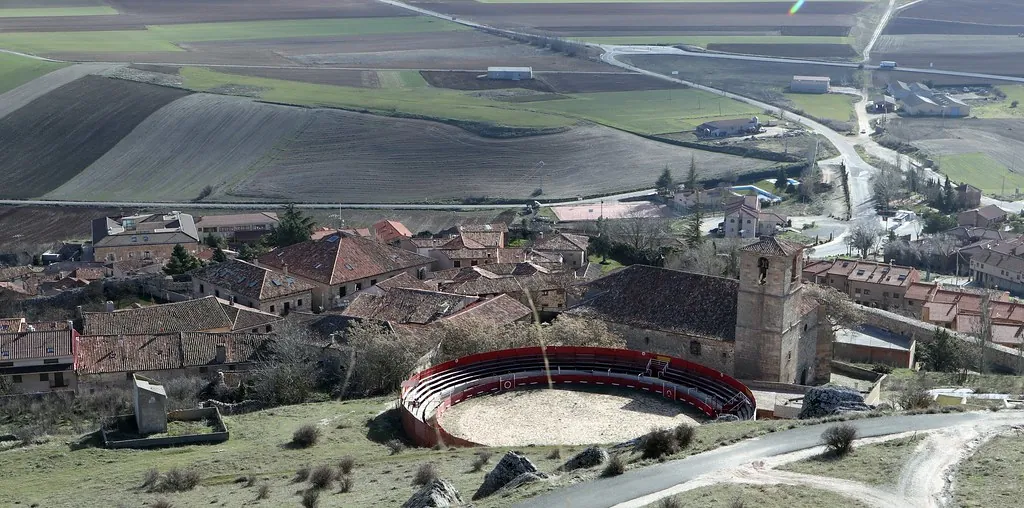
Anguita’s layout is straightforward. Short streets run between houses built with stone taken from the surrounding land. There are no large monumental complexes, yet many small details point to its agricultural and livestock past. Wide gateways allowed animals to pass through, pens were attached to homes, and thick masonry walls were designed to keep out the cold.
At the centre stands the parish church of San Juan Bautista. The present building dates from the 16th century, although later alterations changed part of its appearance. Its architecture is restrained, as is common in many villages of the former Señorío de Molina. Inside, a modest Baroque altarpiece survives, the result of extensions and additions carried out at different times.
In the area around the village there are also references to remains linked to old medieval defences. These are not always easy to identify as clear structures, yet they serve as a reminder that this was frontier land for centuries, shaped by its position between historic kingdoms.
The Upper Tajuña and the Open Parameras
If one feature defines Anguita, it is the landscape that surrounds it. Here the river Tajuña has carved a narrow valley whose rock walls contrast sharply with the flat expanse of the paramera above. In some stretches, gorges and sheer rock faces appear. Birds of prey nest in these cliffs, something relatively common in this part of the province.
Agricultural tracks leave the village and descend towards the valley or follow the nearby hills. These are simple routes, used for decades to connect orchards, pasture and neighbouring settlements. They are not always signposted, so it is wise to rely on a map or ask locally before setting out.
Autumn can bring mushrooms to the woods when the year has been wet, as in many areas of the Sierra Norte and the Señorío de Molina. Mushroom gathering has long been part of life in the comarca, though today it is regulated across much of the territory.
The altitude and limited artificial light make for particularly dark skies. On clear nights, it takes only a short walk beyond the built-up area to see the band of the Milky Way stretching clearly overhead.
Seasons of Return and Quiet Months
As in many small villages in this part of Spain, the calendar comes alive mainly in summer. That is when former residents return from elsewhere and patron saint festivities are concentrated. Religious events share space with music and communal meals held in squares or common areas of the village.
Winter tells a different story. Daily life becomes quieter, shaped traditionally by domestic tasks. It was also the season of the matanza del cerdo, the pig slaughter that formed part of the household economy and local culinary tradition. In some homes this practice continues, maintaining both a practical and cultural link with the past.
The contrast between these seasons is marked. Summer brings noise and reunion, while the colder months reinforce the sense of a small, close-knit community living at a slower pace, in tune with altitude and weather.
Reaching Anguita and Practical Notes
Anguita lies close to the N‑211 road, which crosses this part of Guadalajara towards the Señorío de Molina. From the provincial capital, the journey takes a little over an hour by car, depending on the route chosen.
The village itself can be explored on foot in a short time. What draws most attention, however, is not confined to its streets but extends into the surrounding terrain. The valley of the Tajuña, the traditional paths and the high parameras define the experience more than any single building.
Warm clothing is advisable outside the summer months. Even in spring, the wind can lower the perceived temperature considerably. Conditions are shaped by elevation and exposure, and the climate is part of what gives Anguita its particular character.
In the end, Anguita is understood through its geography. A small settlement above a narrow river corridor, set between rock and plateau, shaped by centuries as a frontier zone. Its church, stone houses and faint traces of defences speak quietly of the past. The wind across the paramera and the dark night sky complete the picture.