Full Article
about Arbancón
Gateway to the Black Architecture; known for its straw-stuffed carnival figures and age-old customs.
Ocultar artículo Leer artículo completo
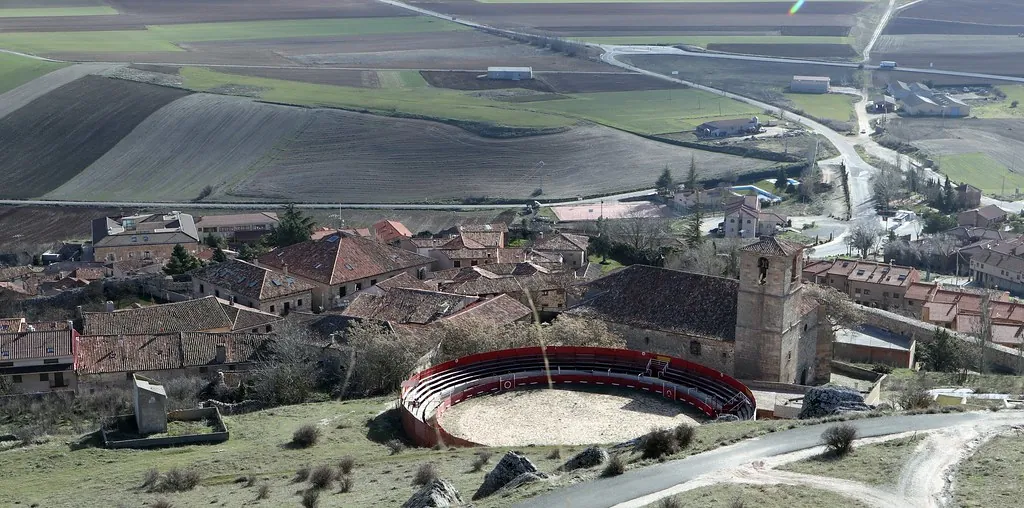
The church bell strikes noon, yet nobody appears. Not a single shop door opens, no lunch-hour chatter drifts from stone houses. At 900 m above sea-level, Arbancón keeps its own timetable—one dictated by daylight, livestock and the slow turn of seasons rather than the clock. For visitors schooled in Costa del Sol speed, the village's refusal to hurry can feel almost radical.
Granite, Adobe and the Art of Doing Nothing
Arbancón's population hovers around 140, a figure that doubles during August fiestas when grandchildren return from Madrid or Zaragoza. The rest of the year, silence pools in the narrow lanes like cool water. Houses are built from whatever the ground provided: honey-coloured limestone at the lower end of the village, mud-brick further up where the slope made hauling stone impractical. Walls are a metre thick; windows are small. These are buildings designed for temperature, not views, and they work—indoor temperatures stay within ten degrees of comfort year-round, reducing the need for air-conditioning or heating.
There is no formal tourist office. Instead, the parish church of San Pedro keeps its doors unlocked and a laminated map pinned beside the font. The building itself is 16th-century, remodelled after lightning struck the tower in 1782. Look for the wooden balcony wedged into the tower—an afterthought that allowed the priest to ring the bell without climbing the full height. Inside, the paintwork is recent but the colours (ox-blood red, lapis blue) follow patterns uncovered during a 1993 restoration. Entry is free; silence is expected.
A five-minute walk north brings you to the village's highest point, a rocky outcrop locals call El Castillo even though no castle ever stood here. The views justify the climb: across the Sierra Norte de Guadalajara, a rumpled blanket of holm-oak and cereal fields that turns from emerald in April to parchment by July. On clear winter days you can pick out the snow-dusted summits of the Sierra de Pela, 40 km to the north-east.
Walking Tracks that Begin at the Doorstep
You do not need a car once you are in Arbancón; the countryside starts where the tarmac ends. Three way-marked footpaths depart from the upper fountain, each designed for half-day rambles rather than serious expeditions. The yellow route descends through almond terraces to the abandoned hamlet of Las Huertas, a collection of roofless stone cottages taken over by storks and swallowtail butterflies. Allow two hours there and back; carry water because the return climb is steady.
Spring and autumn deliver the best walking weather—mild mornings, crisp evenings, wildflowers or fungi depending on the month. Summer hiking is possible if you start early; by 11 a.m. the thermometer can touch 34 °C and shade is scarce. Winter brings occasional snow, rarely more than 10 cm but enough to make driving from the main road (the CM-101) adventurous. Chains are advisable from December to February; the final 6 km climb gains 400 m and includes two hairpins that refuse to thaw until midday.
Shepherd tracks link Arbancón to the neighbouring villages of Valdepeñas de la Sierra and El Cardoso de la Sierra, allowing circular walks of 15–18 km. These paths are not way-marked; a downloaded GPX file and a fully-charged phone are sensible companions. Expect to meet merino sheep accompanied by mastiffs that bark first and sniff later. Stand still, speak calmly, and the dog will usually lose interest.
What Passes for Nightlife
Evenings centre on the single bar, Terraza El Refugio del Abuelo, open Thursday to Sunday year-round and nightly during fiestas. Coffee costs €1.20, a caña of beer €1.50, and the tapas menu rarely exceeds five items—manchego cheese, morcilla (blood sausage), perhaps a plate of setas (wild mushrooms) when the owner has been foraging. Locals play cards at the corner table; visitors are welcomed but conversations in English are limited to the basics. Ordering in Spanish is appreciated, though gestures and goodwill suffice.
There is no supermarket. Fresh bread arrives in a white van at 11 a.m.; meat must be ordered a day ahead from the butcher in Valdepeñas, 12 km away. Self-caterers should stock up in Guadalajara (45 min drive) before ascending. The village fountain dispenses potable water—bring a bottle and refill freely.
Accommodation is handled by four small casas rurales, none larger than six bedrooms. Casa Rural Las Albertas occupies a 19th-century schoolhouse and keeps the original slate blackboards as wall decoration. Expect nightly rates of €70–90 for a two-bedroom apartment, cheaper mid-week. Heating is by pellet stove; instructions are provided but British guests should note the system switches off automatically after three hours, so set an alarm if you want continuous warmth. All properties include Wi-Fi, though speeds top out at 10 Mbps on a good day. Streaming is optimistic; downloads are realistic.
Festivals Without the Foam Party
Festivities remain resolutely local. The August programme revolves around the feast of San Pedro: a Saturday evening mass followed by a communal paella (tickets €7, sold from the bar). Fireworks are modest—more sparklers than rockets—and finish by 11 p.m. out of respect for neighbouring livestock. The following morning, bulls (actually docile yearlings) run through a fenced lane while teenagers attempt to look brave. Spectating is free; participating requires a signed disclaimer and robust health insurance.
January brings San Antón, when pets and farm animals receive a sprinkling of holy water outside the church. Expect dogs, donkeys and the occasional sheep dressed in ribbon. The ritual lasts twenty minutes; afterwards everyone retreats indoors for migas—fried breadcrumbs studded with chorizo and grapes. If you are offered a plate, accept. Refusing migas is the rural equivalent of turning down a cup of tea.
Getting There, Getting Away
The simplest route from the UK is to fly into Madrid, collect a hire car and head north on the A-2 for 80 minutes. Turn off at Guadalajara for the CM-101, a well-surfaced mountain road that narrows after Valdepeñas. Public transport exists but demands patience: two trains daily from Madrid Chamartín to Guadalajara (35 min), then bus line 171 to Valdepeñas with a scheduled 90-minute wait for the connecting taxi up to Arbancón. Miss the connection and you are stranded until the following day.
Petrol stations are scarce beyond Guadalajara—fill the tank. Mobile coverage is patchy; download offline maps. The village has no cash machine and the bar is cash-only. Nearest pharmacy is in El Cardoso, 14 km away; bring basic medication with you.
The Honest Verdict
Arbancón will not suit travellers seeking boutique shopping or cocktail bars. Rainy days offer little beyond your own thoughts and whatever book you packed. Yet for those happy to trade stimulation for space, the village delivers a rare commodity: genuine quiet. No traffic hum, no neon, just wind in the oaks and the occasional clank of a goat bell. Come with provisions, realistic Wi-Fi expectations and a willingness to speak basic Spanish, and Arbancón repays the effort with a clarity of silence that city-centre Britain lost decades ago.